— SELESAI —
Terakhir diperbarui · May 30, 2026 · riset independen, tanpa sponsor.
We use minimal analytics + ads (no personal tracking). See our privacy policy.
Visiting temples and pagodas in Vietnam without knowing the basics is a fast way to cause offence. Here is what actually matters, from dress to incense to camera use.

Terakhir diperbarui · May 30, 2026 · riset independen, tanpa sponsor.
Artikel lain tentang kota ini.

Locals live on Zalo, tourists default to WhatsApp — here's why that gap matters and how to bridge it before your trip.

…
Hotels, homestays, hostels — strongest inventory in Vietnam.
Winter in the north is damp, grey, and surprisingly chilly. Forget the tropical gear and pack for layering to survive the humidity.
Thousands of foreigners teach English or freelance in Vietnam on tourist visas. Here is what Vietnamese law actually says, when it gets enforced, and how to do it properly.
Artikel lain di wilayah ini.
The Wise debit card works well in Vietnam if you set it up right. Here's how to avoid fees, use the VND balance, and when it beats alternatives.
The Wise debit card works well in Vietnam if you know the fee structure. Here's how to use it at ATMs and merchants without losing money on bad rates.
Vietnam runs on dong, but there are real situations where USD cash matters. Here is where you can actually pull USD from an ATM or bank counter.
More articles from the same category.
Forget the heavy gear. Packing for the Mekong Delta is about managing humidity, protecting your skin, and staying mobile on the water.

Wise works for sending VND to Vietnamese banks, but the process has quirks. Here's what fees to expect, which banks receive fastest, and why transfers get rejected.
Fees, speeds, and bank coverage compared for the three most-used international transfer services into Vietnam — so you pick the right one before you send.
Forget the resort-brochure packing lists. Here is the gear you actually need for Vietnam's coast, from the sands of Da Nang to the islands of Phu Quoc.
Mastering basic time and day markers in Vietnamese will save you from missed buses and confused taxi drivers. Here is the essential cheat sheet for your trip.

Most travel insurance policies have gaps that matter specifically in Vietnam — motorbike coverage, medical evacuation, and hospital payment methods. Here is what to check before you buy.
Vietnam (베트남 / 越南 / ベトナム)'s pagodas and temples are active religious spaces, not open-air museums. Monks pray there. Families bring offerings. Elderly women chant at 5 a.m. Turning up in shorts and sandals, waving a phone at the altar — it happens every day, and it is genuinely disrespectful. The rules are not complicated once you know them.
This is the one that catches the most visitors off guard. Both shoulders and both knees must be covered before you enter a pagoda, temple, or shrine — and this applies regardless of gender. A sleeveless shirt is not acceptable. Short shorts are not acceptable.
The easy fix: carry a light cotton scarf or a spare pair of linen trousers in your bag. In Hanoi, outside places like Tran Quoc Pagoda and the One Pillar Pagoda, vendors sell cheap sarongs for around 50,000–80,000 VND if you arrive underdressed. Some pagodas keep loaner wraps near the entrance gate, but do not count on it.
Footwear is a separate matter. Many temple halls require you to remove shoes before stepping onto the main platform or entering the inner sanctuary. Look for a shoe rack near the entrance, or watch what locals do. At larger complexes like Bai Dinh, you keep shoes on while walking the grounds but remove them at individual shrine halls. When in doubt, remove them.
Enter calmly and quietly. Avoid walking in front of people who are actively praying — pass behind them instead. When you reach the main altar, stand or kneel slightly to one side rather than planting yourself directly centre-front while someone else is mid-prayer.
Bowing is not mandatory for visitors, but it is a natural gesture of respect if you are standing at an altar. A single slow bow from the standing position — hands pressed together in front of the chest — is appropriate and will be understood. You do not need to replicate the full prostrations that devoted practitioners perform. The gesture is about intention, not performance.
Avoid pointing at statues or altars with a single finger. If you need to gesture toward something, use an open hand.

Photo by Valeria Drozdova on Pexels
"Huong" (incense) is central to Vietnamese Buddhist and folk religious practice. At most pagodas you will find sticks available at the main gate, either free or for a voluntary contribution of around 10,000–20,000 VND. Some larger sites sell bundles of three or five sticks.
If you want to participate: light the sticks until they catch, then fan or wave out the flame — do not blow on incense with your mouth, which is considered disrespectful. Hold the bundle at chest height with both hands and bow once before placing the sticks into the sand-filled urn in front of the altar. Larger pagodas have multiple altars dedicated to different deities or bodhisattvas; you can offer incense at each.
Do not step over the raised threshold at the entrance to a main hall — step over it one foot at a time from the side of the doorframe, or simply step carefully. Thresholds in Vietnamese religious architecture are considered sacred boundaries.
Leave any offerings — fruit, flowers, small amounts of cash — on the designated trays in front of the altar. Do not place food directly on the altar surface itself.
The working rule: photograph the architecture freely, but ask before you photograph people, and do not photograph monks or nuns without permission.
Monks are not a travel photograph subject by default. A monk sitting in meditation, chanting, or simply walking between halls is engaged in religious practice, not posing for tourists. Walking up close with a camera or phone is intrusive. If you genuinely want a photograph and the monk is relaxed and approachable — at a public festival, say, or at a site like Hue's Thien Mu Pagoda where monks sometimes interact with visitors — ask first with a gesture and accept a refusal graciously.
For altar statues and interior shrine rooms, the situation varies by pagoda. At heritage sites with significant tourism infrastructure, interior photography is usually tolerated. At smaller neighbourhood pagodas where active worship is happening, put the camera away. A quick glance around will tell you: if there are worshippers praying in front of the altar, this is not the moment.
Flash photography near altars is always inappropriate. The combination of bright flash and sacred statuary is considered jarring at best, disrespectful at worst.
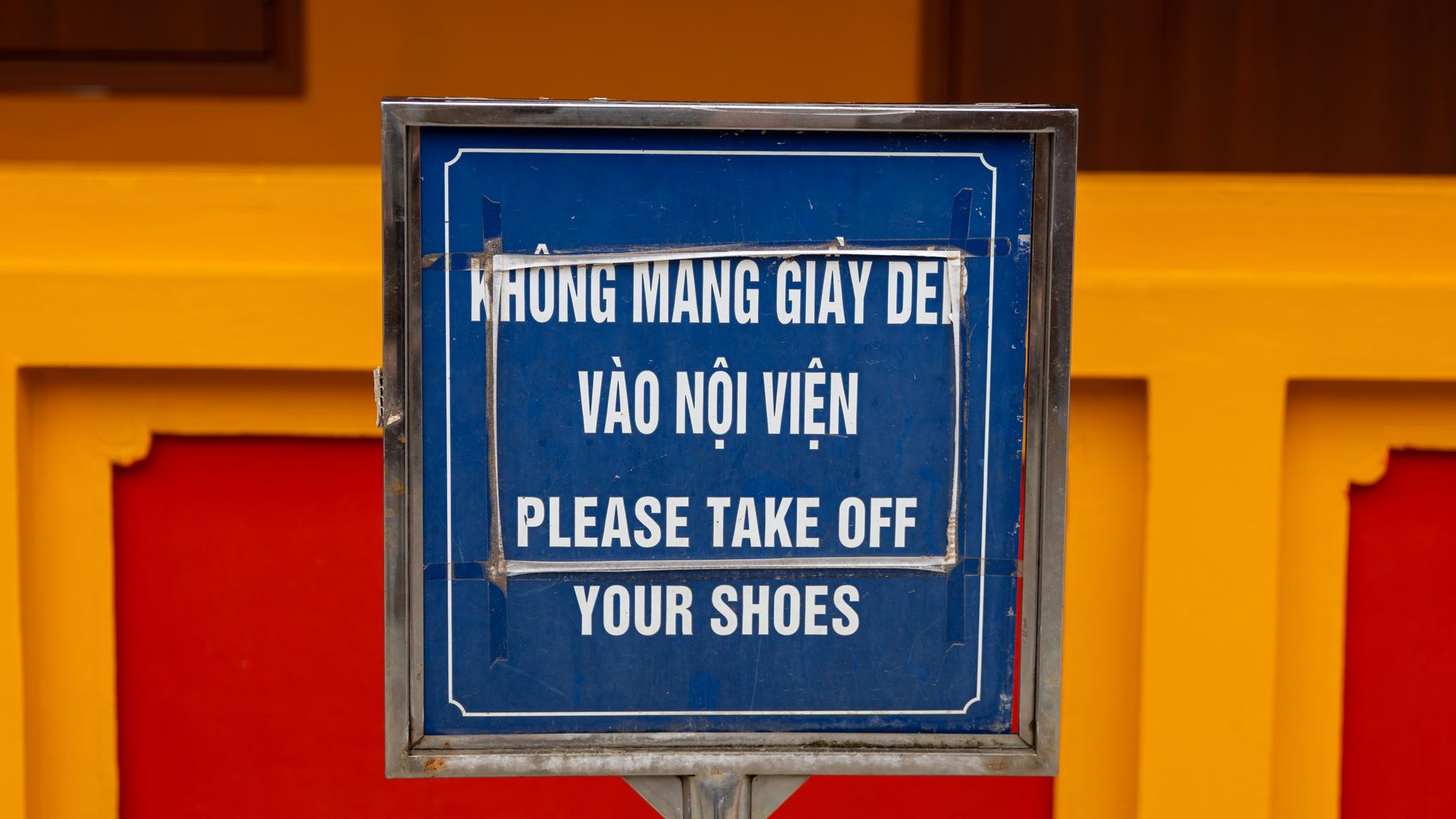
Photo by Hồng Quang Official on Pexels
Talking loudly inside the main hall — including phone calls. Keep voices low.
Sitting with feet pointed toward the altar or statues. Feet pointing toward sacred objects is considered disrespectful across most Southeast Asian Buddhist contexts. Sit cross-legged or kneel.
Wearing hats inside the main hall. Remove headwear before entering.
Arriving during morning chanting (usually around 5–6 a.m. and again at 5–6 p.m.) and treating it as a performance. If you arrive during prayer hours, observe from a respectful distance or return later.
Touching statues, prayer beads, or ritual objects on the altar. Even if nothing is posted saying you cannot, the answer is: you cannot.
Most Vietnamese religious communities are genuinely welcoming of respectful visitors — the temples exist, in part, as spaces of community and cultural transmission, not exclusively as monastic retreats. Cover up, move quietly, follow the local lead, and keep the camera pointed at the architecture rather than the people praying. That is essentially the whole of it.