One Pillar Pagoda: Hanoi's Iconic Lotus Temple
One Pillar Pagoda, known locally as "Chua Mot Cot," sits in the Ba Dinh district of Hanoi, near the Thang Long Citadel. It is formally part of a larger complex called Dien Huu tu, or "pagoda of extended blessings." The temple's most distinctive feature is the Lien Hoa Dai — the "lotus pedestal" — a wooden structure built atop a single stone pillar (1.25 meters in diameter, 4 meters high) that rises from what was once a pond. The design deliberately evokes a lotus blossom, a symbol of purity in Buddhism.
The original pagoda was constructed in 1049 and refined in 1105. It stands today as one of Vietnam (베트남 / 越南 / ベトナム)'s most recognizable temples, worth a detour if you're exploring Hanoi's religious landmarks. The site is compact — you can walk the grounds in fifteen minutes — but what it lacks in size it makes up for in density of history. Few structures in Southeast Asia pack a thousand years of legend, war damage, and reconstruction into such a small footprint.
The Legend Behind the Pagoda
The pagoda's origins rest on a story involving Emperor Ly Thai Tong, who ruled from 1028 to 1054. Court records say the emperor had no son — a grave concern for a dynasty. He dreamed of the Bodhisattva Avalokitesvara seated on a lotus, handing him a male child. After waking, Ly Thai Tong married a peasant woman he had encountered, and they bore a son.
In gratitude, and on the advice of a Buddhist monk named Thien Tue, the emperor commissioned the pagoda in 1049. The monk suggested a pillar rising from a lotus pond — a physical echo of the emperor's dream. The temple was built in the Tay Cam Garden in what is now central Hanoi.
The dream narrative is more than a fairy tale. It tied the Ly dynasty's legitimacy to Buddhist cosmology at a time when the court was actively promoting Buddhism as a state-supported faith. The pagoda wasn't just a prayer hall — it was a political statement rendered in wood and stone. You'll still see incense offerings from visitors who come specifically to pray for children, continuing a tradition that traces directly back to Ly Thai Tong's story.

Image by Thomas Schoch via Wikimedia Commons (CC BY-SA)
Royal Ceremonies and the Lost Bell
During the Ly dynasty, the pagoda became the site of an annual royal ceremony on Vesak (Buddha's birthday). The king would lead a ritual bathing of the Buddha statue, attended by monks and commoners alike. A symbolic release of a bird by the monarch — echoed by the assembled crowd — was part of the celebration.
In 1105, Emperor Ly Nhan Tong undertook major renovations. Four years later, a massive bronze bell was cast — so large and heavy that it could never be hoisted into the temple complex. Instead, it was moved to farmland near the pagoda and named the "Bell of the Turtles' Field" after the creatures that inhabited the area. The bell itself was melted down during the early 15th century occupation, its copper recast into military weapons.
The lost bell is one of those details that sticks with you. Imagine commissioning the finest bronze bell in the kingdom, only to discover it's too heavy to hang. The story says something about imperial ambition outpacing practical engineering — a theme you'll encounter often when visiting Hanoi's historical sites, including the Imperial Citadel just a short walk away.
Destruction and Restoration
After the Ly dynasty fell, the pagoda was restored several times, notably during the Nguyen period (1840-1850 and again in 1922). In 1954, the pagoda was dynamited — an act carried out by a Vietnamese officer in the French Army. He was severely punished for the destruction.
The Democratic Republic of Vietnam's Ministry of Culture undertook a full restoration in 1955, rebuilding the temple and the Lotus Station (the surrounding grounds) based on the Nguyen-era architectural style.
This means the structure you see today is not the 11th-century original — it's a mid-20th-century reconstruction following Nguyen-dynasty blueprints. Some visitors feel disappointed when they learn this. But consider: the site has been rebuilt multiple times over nearly a millennium. Each restoration is itself part of the pagoda's story. The commitment to rebuilding on the same spot, in a form faithful to the original vision, says as much about Vietnamese cultural memory as the original construction does.

Image by Beej Nodora via Wikimedia Commons (CC BY-SA)
Architecture and Symbolism
The pagoda's original design, as recorded in historical texts like the "Dai Viet su ky toan thu," included a surrounding lake (Linh Chieu lake, also called the Lotus Station's lake), exterior corridors, and bridges spanning an outer lake (Bich Tri Lake). A stupa stood in front of the temple yard.
Modern architectural research suggests the original Ly-era structure may have been hexagonal, not circular, to better mirror lotus petals. In 2020, researchers from SEN Heritage presented 3D models and virtual reality reconstructions proposing what the original Dien Huu complex may have looked like — a geometric configuration of Buddhist symbols arranged as a Mandala.
Today's pagoda, standing after its 1955 reconstruction, is modest in scale: a wooden shelter on its stone pillar, painted wood and tile. A replica was also built in the late 1950s in what was then suburban Saigon (now part of Ho Chi Minh City).
Look closely at the current structure and you'll notice the pillar isn't truly "one" — concrete supports were added around the base during the 1955 rebuild for structural stability. The single-pillar illusion works best when photographed from the front, where the support braces are hidden. Walk around the back and the engineering reality becomes more apparent. This is not a flaw; it's an honest compromise between symbolism and physics.
How to Visit: Practical Details
One Pillar Pagoda is inside the Ho Chi Minh (호치민 / 胡志明 / ホーチミン) Mausoleum complex on Chua Mot Cot Street, Ba Dinh district. The grounds are open daily, typically from 7:00 to 18:00 (last entry around 17:30). Admission to the pagoda itself is free. The mausoleum complex has its own schedule and rules, but you don't need a mausoleum ticket to visit the pagoda.
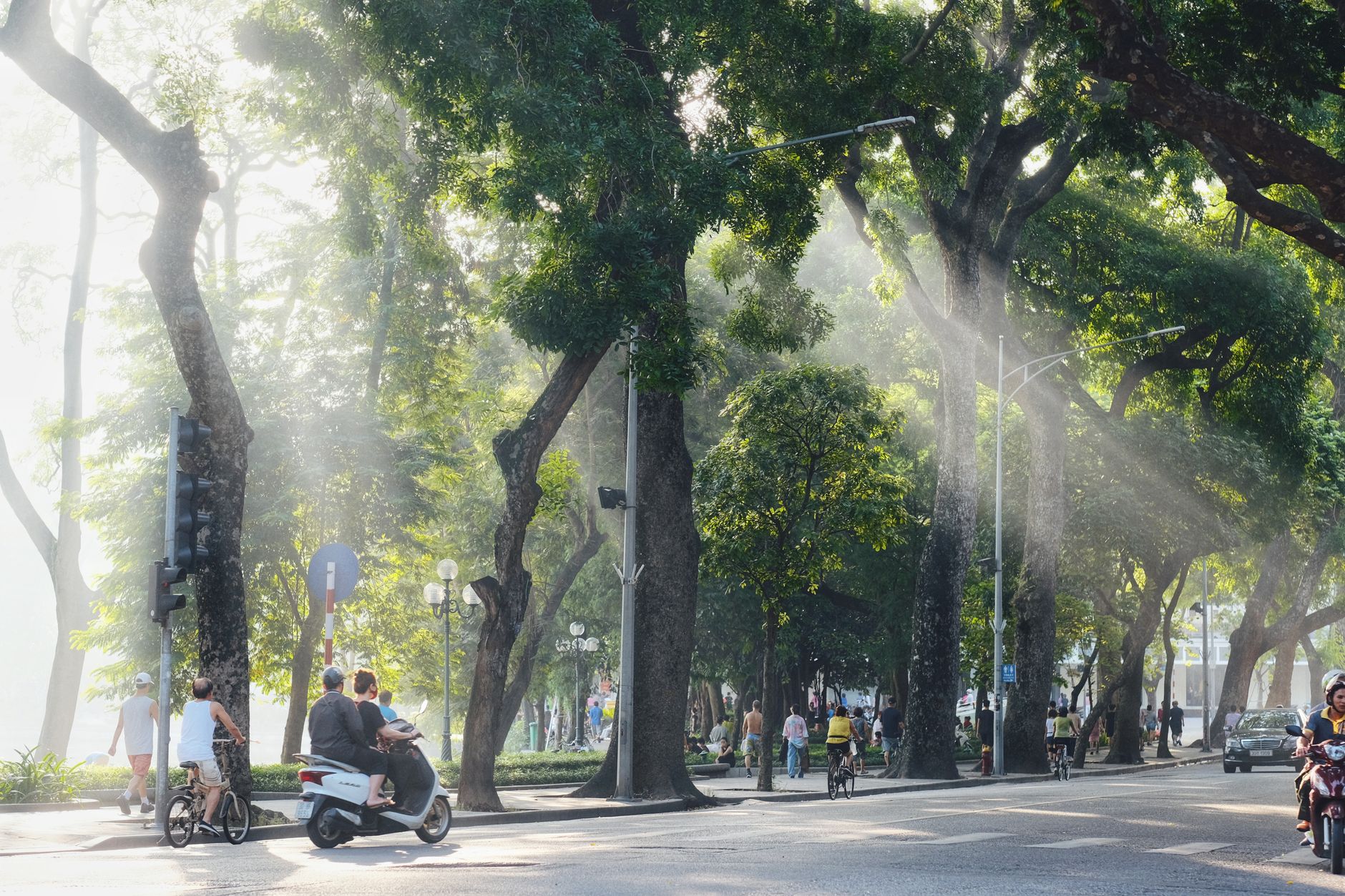
From Hoan Kiem Lake (the Old Quarter), the pagoda is about 3.5 km west — a 10-minute taxi or Grab ride (expect roughly 30,000-50,000 VND by motorbike, 50,000-80,000 VND by car). You can also walk it in about 40 minutes through pleasant tree-lined streets, passing the Temple of Literature on the way if you take Nguyen Thai Hoc Street.
Budget 15-20 minutes for the pagoda grounds. Most visitors combine it with the Ho Chi Minh Mausoleum (closed Mondays and Fridays, and during October-November for maintenance), the Presidential Palace gardens, and the Ho Chi Minh Museum — all within the same complex. If you add the Imperial Citadel of Thang Long, which is about 800 meters northeast, you have a solid half-day of historical sightseeing in Ba Dinh.
Dress modestly — knees and shoulders covered. This is an active Buddhist site, and while enforcement is relaxed, it's respectful. Remove hats before entering the prayer area at the top of the steps.
What to Eat Nearby
Ba Dinh is not Hanoi's densest street food district, but you won't go hungry. Within a 10-minute walk of the pagoda:
- "Pho" on Nguyen Tri Phuong Street: Several no-frills "pho" shops serve the classic Hanoi-style pho — clear broth, fewer herbs than southern versions, thin rice noodles. A bowl runs 40,000-60,000 VND.
- "Bun cha" near Doi Can Street: Bun cha — grilled pork patties with rice vermicelli and dipping broth — is Hanoi's quintessential lunch. Stalls around Doi Can and Nguyen Hong streets serve portions for 40,000-55,000 VND.
- "Ca phe" stops: After the pagoda, cool down with a Vietnamese iced coffee ("ca phe sua da") at any of the small cafes along Ong Ich Khiem Street. Prices range from 20,000-35,000 VND depending on whether you sit streetside or in an air-conditioned room.
If you're heading onward to the Old Quarter, save your appetite for the denser street food scene around Hang Buom or Ly Quoc Su streets, where you'll find everything from banh mi to bun rieu to egg coffee.
Common Mistakes and What Surprises Foreigners
- Expecting a large temple. The pagoda is small — genuinely small. The entire structure is roughly the size of a garden shed. First-time visitors sometimes walk past it looking for something grander. Adjust your expectations: the value here is historical and symbolic, not architectural scale.
- Visiting during midday heat. The pagoda grounds offer limited shade. In summer (May through September), temperatures regularly hit 35-38 degrees Celsius with heavy humidity. Morning visits (before 9:00) or late afternoon (after 16:00) are far more comfortable.
- Confusing it with the mausoleum schedule. The pagoda is open even when the mausoleum is closed. Don't skip the pagoda just because you see "mausoleum closed" online — the two operate on different schedules.
- Rushing through. Many tour groups allocate five minutes, snap a photo, and leave. Take a moment to walk around the Dien Huu complex grounds. The small courtyard garden behind the pagoda, with its bodhi tree and secondary shrine, is usually empty and peaceful.
- Not looking at the pillar from multiple angles. The classic photo is from the front, across the small lotus pond. But walk to the side and rear to see how the support structure works and to appreciate the construction up close.
Quick Reference
- Full name: Dien Huu tu (pagoda complex); Chua Mot Cot (One Pillar Pagoda)
- Location: Chua Mot Cot Street, Ba Dinh district, Hanoi
- Nearest landmark: Ho Chi Minh Mausoleum (adjacent)
- Built: 1049 (original); current structure dates to 1955 reconstruction
- Admission: Free
- Hours: Approximately 7:00-18:00 daily
- Time needed: 15-20 minutes (pagoda only); 2-3 hours (full mausoleum complex area)
- Pillar dimensions: 1.25 m diameter, 4 m height
- Dress code: Modest (cover knees and shoulders)
- Best combined with: Ho Chi Minh Mausoleum, Imperial Citadel of Thang Long, Temple of Literature (2 km south)
- Getting there from Old Quarter: ~3.5 km west; 10 min by Grab, 40 min on foot
Visiting
The pagoda remains one of Hanoi's most photographed temples, valued equally for its compact, unusual silhouette and its role as a living witness to nearly a thousand years of Vietnamese Buddhist practice and imperial legend. It pairs well with nearby visits to the Thang Long Citadel and the Ho Chi Minh Mausoleum complex.
A logical day route through Ba Dinh: start at the mausoleum complex early (it opens at 7:30 on operating days), visit One Pillar Pagoda and the surrounding gardens, walk northeast to the Imperial Citadel, then head south to the Temple of Literature for a late-morning visit. Grab lunch — a bowl of pho or a plate of bun cha — before the afternoon heat sets in.
Bottom Line
One Pillar Pagoda is not a place you visit for grandeur. It's a place you visit to stand in front of a thousand-year-old idea — a lotus rising from water on a single stem — and understand why that image has mattered to Hanoi through dynasties, wars, and rebuilding. Give it twenty unhurried minutes, pay attention to the details, and it will reward you more than sites ten times its size.
Last updated · May 29, 2026 · independently researched, never sponsored.