What makes Quy Nhon's "bun rieu cua" different
Quy Nhon sits on the central coast, and it shows in the bowl. "Bun rieu cua" — crab and shrimp broth over rice vermicelli — here is denser, more aggressive with seafood than the northern versions you'll find in Hanoi or Haiphong. The broth is built from crab roe, live shrimp, and tomato paste simmered for hours; locals insist the secret is using female crabs during spawning season (roughly March to May), when the roe is fullest. The result is a broth that coats your mouth and lingers.
You'll also notice more "cha cua" (crab paste) stirred directly into the bowl here—a paste made from fresh crab meat and spices—rather than served as a side. It dissolves into the broth, thickening it further. Vegetables are lighter than in the north: mint, dill, and lime replace the more abundant fresh herbs of Hanoi pho culture.
Where locals eat it
Bun Rieu Cua Ba Hoai (Ba Hoai's Crab & Shrimp Broth)
On Hung Vuong Street, a few blocks from the beach, Ba Hoai has been making the same recipe for 20 years. The stall opens at 6 AM and sells out by 9:30 AM most mornings—a sign that locals know something. The broth is noticeably clean and sweet, with crab fat floating visibly on the surface. A large bowl costs 45,000 VND; add grilled crab paste ("cha cua nuong") for 15,000 VND extra. The woman running it will ask how spicy you want the shrimp paste ("mam tom") on the side; say "vua" (medium) unless you're heat-trained.
Bun Rieu Cua Phuong (Phuong's Place, Tran Hung Dao)
This one is tucked in a narrow alley off Tran Hung Dao Street, near the old market. Phuong sources crabs directly from fishermen at nearby Thang Huong Port; the advantage is fresher stock and more control over crab size. Bowls are smaller and more expensive than Ba Hoai—55,000 VND for a standard serving—but the broth is notably richer and the crab meat chunks are larger. Go before 10 AM. Tables are plastic stools; expect to share with others. No frills, no English menu. Point and nod.
Bun Rieu Cua Nhan (Nhan's Afternoon Spot)
Most "bun rieu (분지에우 / 蟹肉米粉汤 / ブンリュウ) cua" stalls close by mid-morning, but Nhan opens a cart on Ly Tu Trong Street around 2 PM and stays until 7 PM—useful if you're arriving late or want lunch instead of breakfast. The broth is lighter and slightly sweeter than the morning versions, closer to a mid-day style. 40,000 VND per bowl. Less crowded, which means faster service, though locals debate whether afternoon crab broth is ever as good as the morning batch. Fair point.
Bun Rieu Cua at the Quy Nhon Central Market
Inside the main market (Ben Thanh-style layout, though smaller), there are 2–3 "bun rieu cua" stalls on the north side, near the fish section. Quality varies by day depending on crab availability. Prices range from 35,000 to 50,000 VND. The advantage is you can see the crabs alive in the tank before ordering, and ask the cook to use specific ones. Go early (6:30–8 AM). The noise and smell of the market are part of the experience; if you find it off-putting, skip it.
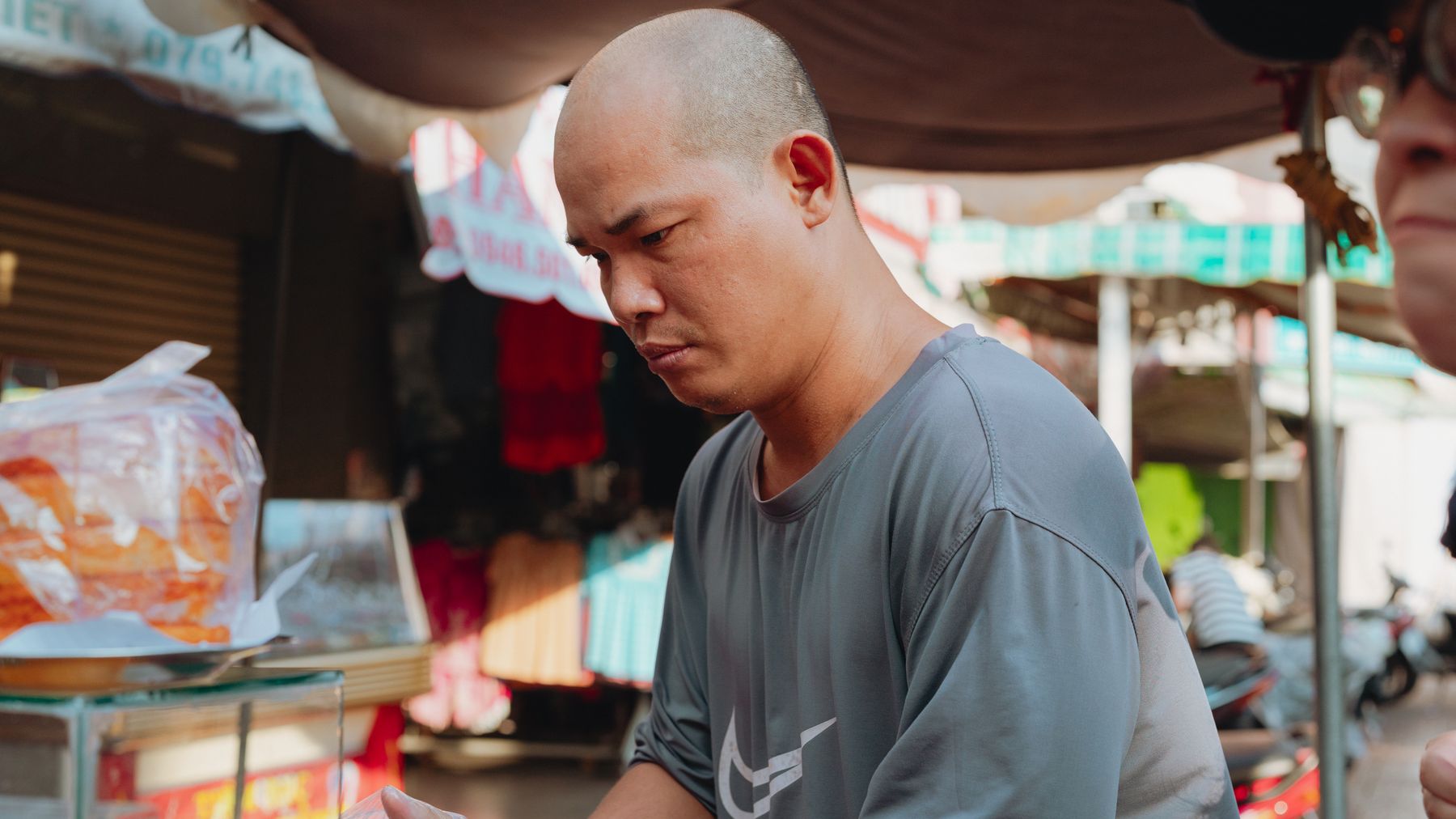
Photo by Theodore Nguyen on Pexels
How to order and what to expect
Point to the bowl size or hold up fingers for "1" or "2." If the stall has a menu board, it will show: "Bun Rieu Cua" (small), "Bun Rieu Cua Lon" (large). Large is usually 50,000–60,000 VND; small is 35,000–45,000 VND.
On the side, you'll get a small plate with fresh herbs (mint, dill, sawtooth coriander), lime wedges, and sliced chili. There will also be a jar of shrimp paste ("mam tom"), which smells funky and is completely optional—try a small dab mixed into the broth if you want umami depth. A bottle of chili sauce ("tuong ot") is usually on the table.
Add the herbs and lime to the bowl yourself. Stir everything together before eating. Slurp the noodles; it's the polite way to eat vermicelli in Vietnam.
Best time to go
Morning (6 AM–9 AM) is prime time. The broth is freshest, the crab was bought at 4 AM from the port, and you'll see the longest lines. If you're not an early person, go around 7:30 AM instead of 6—the stall will still have plenty, and the crowd is manageable.
Lunch (11 AM–2 PM) is a second option, though broth quality can dip as supplies deplete. Many stalls close by 10 AM anyway.
Dinner is rare. Only Nhan's afternoon cart stays open into evening, and by then the broth is a diluted or reheated version of the morning's. Skip it unless you have no other choice.

Photo by FOX ^.ᆽ.^= ∫ on Pexels
Cost and seasons
Expect to pay 40,000–55,000 VND (USD 1.60–2.20) for a bowl, plus 10,000–15,000 VND if you add crab paste. Prices stay consistent year-round, though the quality and richness of the broth spike during crab-spawning season (March–May), when roe is abundant. If you're in Quy Nhon during those months, eating it is non-negotiable.
Practical notes
Bring cash; most stalls don't take cards. Arrive early, eat fast, and move on—"bun rieu cua" is a breakfast dish, and most locals are in and out within 10 minutes. If a stall looks packed with locals at 6:45 AM, that's the place to eat.
Last updated · May 26, 2026 · independently researched, never sponsored.