What it is
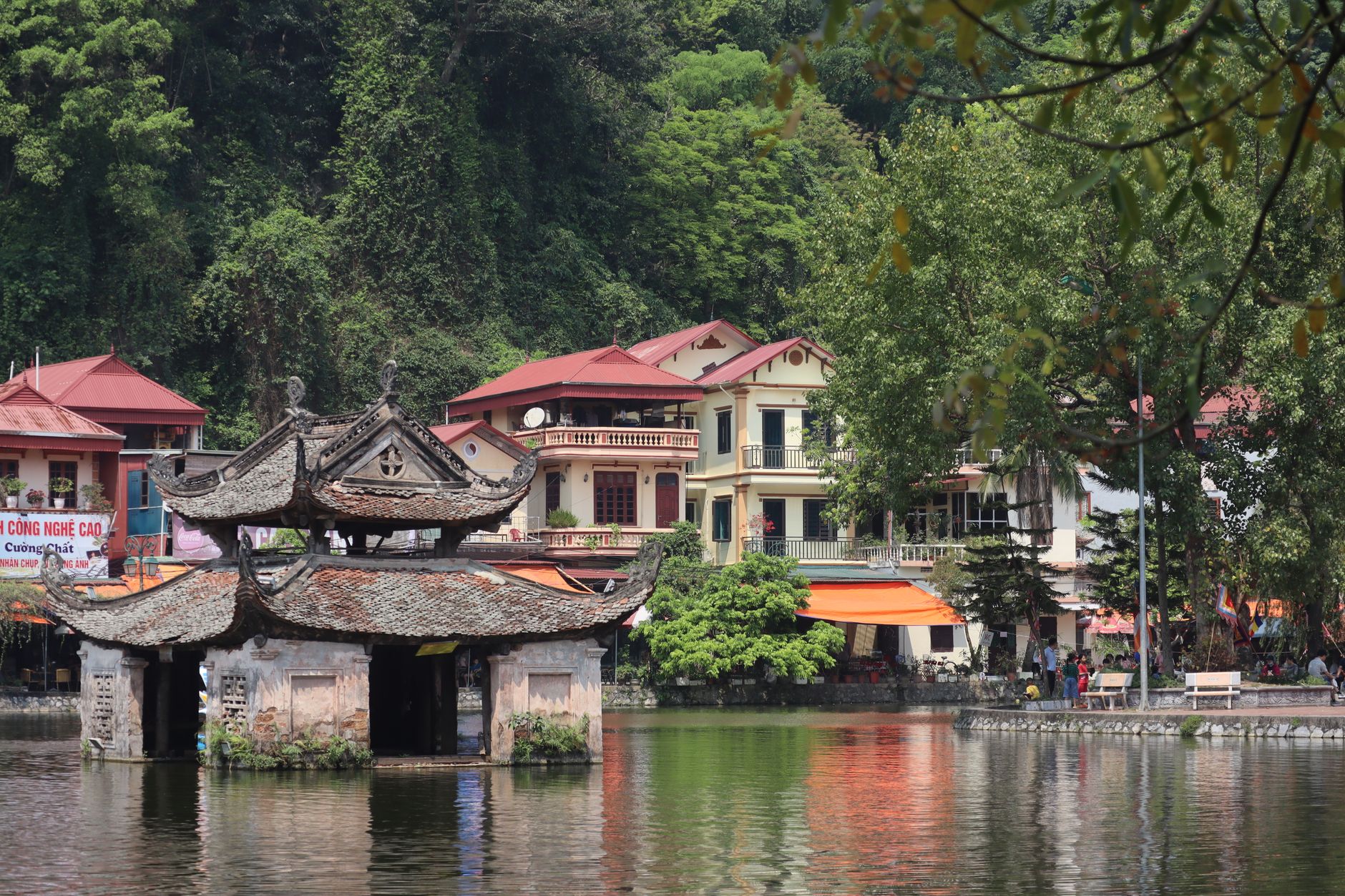
Den Truc - Ngu Dong Son is a two-part site about 15 km southwest of Ninh Binh (닌빈 / 宁平 / ニンビン) city center, sitting at the base of a limestone karst hill along the Day River. "Den Truc" (Bamboo Temple) is a small riverside pagoda complex surrounded by — predictably — bamboo groves. Behind and above it, Ngu Dong Son (Five-Cave Mountain) is a series of five interconnected limestone caves that climb through the karst, each chamber with its own altar and formations. The site has roots going back to the Ly Dynasty (11th century), when it functioned as a place of Buddhist worship tied to the local fishing communities along the Day River.
Unlike the tourist-heavy circuits at Tam Coc or Trang An, this place gets mostly domestic visitors, particularly during the spring festival season. You won't find English signage or ticket hawkers. That's part of the appeal.
Why travelers go
People come here for the combination: a quiet temple ground at water level, then a moderate climb through cave chambers with stalactites, Buddhist statues, and views over the rice paddies below. It's a half-day trip that works well paired with other Ninh Binh sites. The caves themselves are genuinely interesting — each of the five chambers has a different character, from tight squeezes to open cathedral-like spaces with natural light filtering through cracks in the rock.
If you've already done Tam Coc and Trang An and want something without the boat queues and selfie sticks, this delivers a quieter version of the same landscape.
Best time to visit
February to April is peak season — the spring festival (usually around the 3rd lunar month) brings incense smoke, chanting, and a lively atmosphere at the temple. Rice paddies are bright green, temperatures hover around 20-25°C, and the caves stay cool inside.
September to November is the other good window: fewer visitors, drier weather than summer, and golden rice fields in the surrounding valleys.
Avoid June-August if you can. The humidity makes the cave steps slippery, and afternoon downpours are near-daily. The site stays open year-round, but a rainy day here means wet stone stairs inside dark caves — not ideal.
How to get there
From Ninh Binh city center, the site is roughly 15 km to the southwest, in what was formerly Ha Nam province's territory (the administrative area was merged into Ninh Binh). Getting there:
- Motorbike: 25-30 minutes via QL1A south then cutting west. Rent a semi-automatic in town for 120,000-150,000 VND/day. This is the most flexible option.
- Grab/taxi: Around 150,000-200,000 VND one way. Ask the driver to wait (agree on a price beforehand — maybe 400,000 VND round trip with a 90-minute wait).
- Bicycle: Possible if you're staying nearby. Flat roads most of the way, about 45-50 minutes of cycling.
From Hanoi (roughly 90 km north), take a Ninh Binh-bound bus from Giap Bat station (70,000-100,000 VND, 2 hours), then arrange local transport from there.

Photo by Karolina on Pexels
What to do
Walk the temple grounds
Den Truc itself is compact — maybe 20 minutes to see properly. The main hall faces the Day River, flanked by bamboo and banyan trees. There's a courtyard with incense urns and a bell tower. On festival days, local women in "ao dai" make offerings at the altars. On regular days, you might have the place to yourself.
Climb through the five caves
The main event. A stone staircase (around 200 steps total, broken into sections) leads up and through five separate cave chambers. Each one is named: the first is the widest, with a large Buddha statue; the higher ones get progressively narrower. The fifth cave opens to a natural balcony with views over the karst valley. Budget 60-90 minutes for the full circuit, depending on your pace and how long you linger.
Take the river path
A walking trail runs along the Day River bank near the temple entrance. It's maybe 1 km, flat, shaded by bamboo. Good for cooling down after the cave climb. You'll pass small fishing platforms and a few local houses.
Visit during a festival
If your timing lines up with the spring festival (check lunar calendar — usually March or early April), the site transforms: processions, traditional music, incense everywhere, vendors selling "banh chung" and sticky rice. It's a window into rural northern Vietnamese religious life that you won't get at the big-ticket tourist sites.
Combine with Hoa Lu
The ancient capital at Hoa Lu is only about 8 km away. Pair the two for a full morning — Den Truc first (fewer people early), then Hoa Lu by mid-morning.
Where to eat nearby
The immediate area has a few family-run "com binh dan" spots (rice and sides, 35,000-50,000 VND per plate). Look for places with locals sitting outside.
Two things worth seeking:
- "Com chay" (burned rice): A Ninh Binh specialty — crispy rice crackers topped with stir-fried meat or goat. Several restaurants along the road back toward Ninh Binh city serve it. Expect 80,000-120,000 VND per portion.
- Goat meat: The province is known for it. "De tai chanh" (goat with lime) or grilled goat on a hot plate. Most goat restaurants cluster closer to Ninh Binh city center — try the stretch along Tran Hung Dao street.
Where to stay
Most travelers base in Ninh Binh city or Tam Coc village and day-trip to Den Truc.
- Budget: Hostels and guesthouses in Tam Coc area, 150,000-300,000 VND/night. Basic but clean, often with bicycle rental included.
- Mid-range: Hotels in Ninh Binh city center, 400,000-800,000 VND/night. Air-con, hot water, decent breakfast.
- Upper: A few boutique homestays in the Tam Coc rice paddies charge 1,000,000-1,500,000 VND/night with pool and views.

Photo by Ákos Helgert on Pexels
Practical tips locals would tell you
- Bring a small flashlight or use your phone light. The caves have some electric lighting but it's dim in sections, especially chambers 3 and 4.
- Wear shoes with grip. Flip-flops on wet cave stairs are asking for trouble.
- The entry fee is minimal — around 20,000-30,000 VND — but bring small bills. There's no ATM at the site.
- Incense and offering items are sold at the temple gate for 10,000-20,000 VND if you want to participate.
- Early morning (before 9 AM) means cooler temperatures and emptier caves. By midday on weekends, domestic tour groups arrive.
Common mistakes to avoid
- Skipping the upper caves: Some visitors do caves 1-2 and turn back. The best formations and the viewpoint are in caves 4 and 5. Commit to the full climb.
- No water: There's limited shade on the staircase sections between caves. Bring at least 500ml.
- Trying to visit on a motorbike without directions: Google Maps is hit-or-miss on the final 2 km of access road. Download offline maps or ask at your hotel for the exact turnoff.
- Expecting English signage: There is none. The site caters to Vietnamese visitors. A few words of Vietnamese ("xin chao", "cam on") go further here than at touristy Tam Coc.
Practical notes
Den Truc - Ngu Dong Son works best as a half-day addition to a broader Ninh Binh itinerary rather than a standalone destination. Pair it with Hoa Lu or Bai Dinh for a full day. If you're spending 2-3 days in the province — which the area deserves — this gives you a break from boat rides and something more physical to do.
Last updated · May 26, 2026 · independently researched, never sponsored.