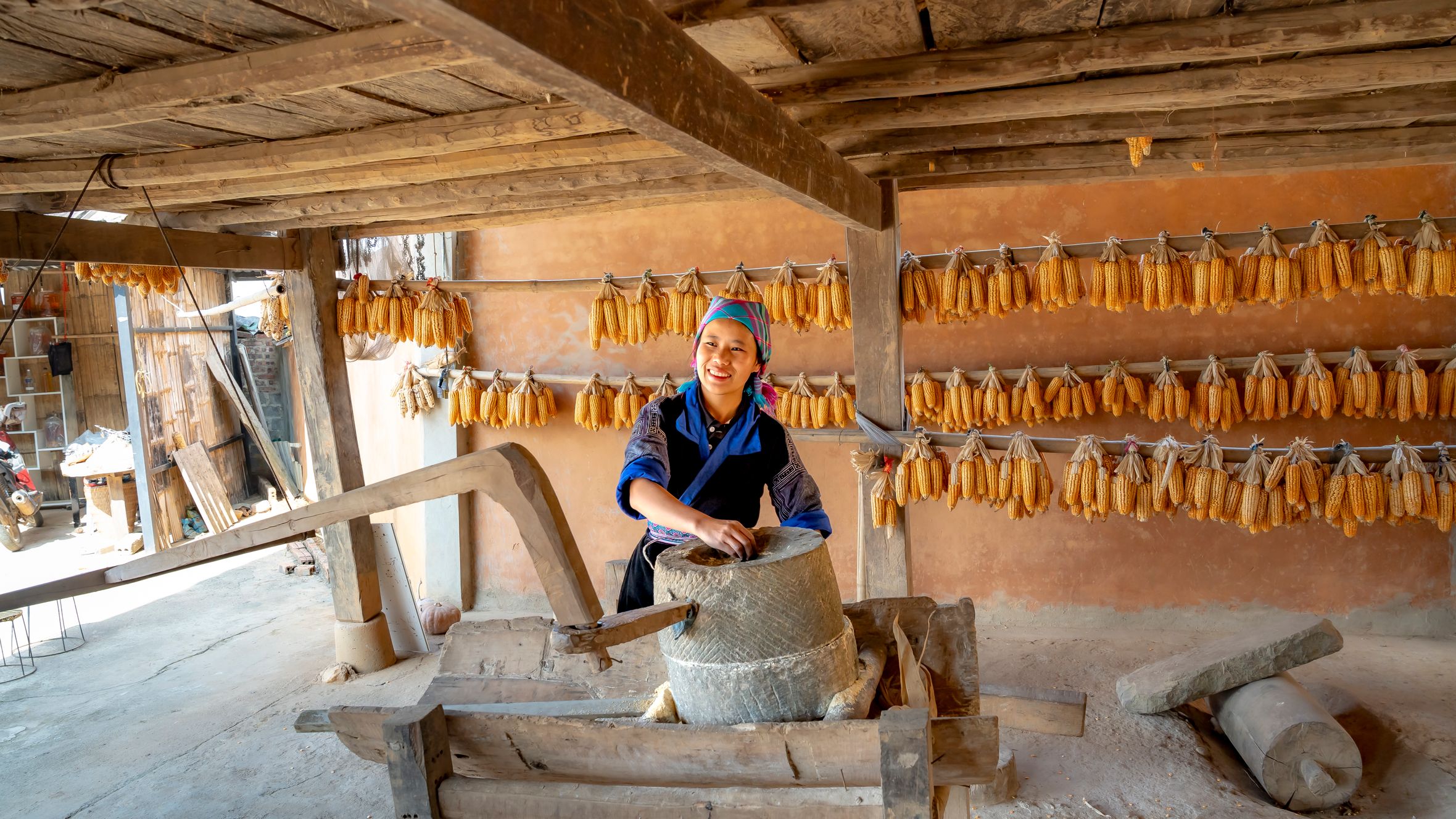
"Men men" — steamed corn flour, sometimes mixed with cassava, eaten with a ladle of broth or slow-cooked stew — is the daily staple of Hmong communities across the northern highlands. In Sapa, you can eat it, but you have to know where to look. The tourist strip will not help you.
What Men Men Actually Is
The dish is simple to describe and hard to fake well. Coarse corn flour is steamed in layers until it develops a slightly grainy, dense texture — closer to coarse polenta than anything fluffy. It absorbs liquid the way good bread does. Eaten plain it tastes of dried corn and woodsmoke. Eaten with a bowl of pork bone broth or a stew of wild greens and pork fat, it becomes something filling and genuinely warming at 1,500 metres in January.
Locals eat it for breakfast and lunch. The corn is typically grown on hillside plots above Sa Pa (사파 / 沙坝 / サパ) town — varieties that are starchier and less sweet than lowland corn. The colour ranges from pale yellow to almost grey depending on the harvest and the grind. Don't expect consistency between vendors.
Where to Find It
Cho Sapa Morning Market — Inside Section
Sapa's central market (Cho Sapa, off Fansipan Road, roughly 500 metres from the main square) opens around 05:30 and the men men stalls are set up by 06:00. Go to the covered interior section — not the outer ring selling scarves — and look for the women with large aluminum steamer pots. Two or three vendors work this area on rotation depending on the day.
A standard bowl with broth runs 15,000–20,000 VND. You sit on a plastic stool and eat fast because they're feeding market workers, not tourists. No English spoken, point at what you want. Best days: Tuesday and Saturday when the market is largest.
Chi Hmong Kitchen — Muong Hoa Valley Road
This is the most consistently open dedicated spot for men men, located about 3 km from town on the road toward Muong Hoa Valley (look for a hand-painted sign in red, approximately 300 metres past the Cat Cat Village turnoff). It's run by a woman named Chi whose family grows their own corn on the slope behind the building.
Her version uses a slightly coarser grind than the market vendors and she serves it with a pork and chili stew that has enough fat to coat the bowl. 25,000–30,000 VND for a full portion. Open roughly 07:00–13:00 daily, closed irregularly — if the fire isn't going when you arrive, she's done for the day. Cash only.
Ta Phin Village — Communal Cooking Area
If you're walking or motorbike-ing to Ta Phin (about 12 km from Sapa town), the village has an informal eating area near the weaving cooperative where older women cook men men for themselves and will sell portions to visitors who ask politely. No signage, no fixed hours — it depends on who is cooking that morning.
This is the most authentic context you'll find for the dish. The stew here often includes "rau cai" (local mustard greens) and dried pork. Price is whatever they tell you, usually 10,000–15,000 VND, and they appreciate the business. Don't barge in with a camera before you've paid for food.
Hmong Home Stay Table — Lao Chai
Several Lao Chai homestays (15 km from Sapa, accessible via the Muong Hoa Valley trekking trail) include men men as part of their evening meal if you request it a few hours ahead. Not every homestay does this — ask specifically when you book. The preparation here is more considered than market versions because the host has time. Some serve it alongside grilled pork and pickled vegetables.
Meal rates vary, typically 80,000–120,000 VND for a full dinner that includes men men, meat, and vegetables. Worth it for the setting alone — eating by a fire in a longhouse while it rains outside is a different experience from any restaurant.
Bac Ha Market Day (Day Trip Option)
If your trip overlaps with Bac Ha's Sunday market (about 80 km from Sapa by road — a long but doable day trip), the food section near the livestock pens has the highest concentration of men men vendors you'll find anywhere in the region. Multiple Hmong and Flower Hmong women cook and sell simultaneously, which means you can compare textures and stews side by side. 10,000–20,000 VND per portion. The market runs roughly 06:00–12:00 before it collapses quickly.

Photo by HONG SON on Pexels
Skip This Place
There is a restaurant on Cau May Street in central Sapa — it has "Traditional Hmong Food" in the signage — that lists men men on an English-language menu for 95,000 VND. What arrives is instant corn porridge, smooth-textured and slightly sweet, garnished with a decorative chili. It has nothing to do with the dish. The price is nearly five times what you'd pay at the market. Skip it entirely. If a restaurant has laminated menus and a QR code, it is not the place to eat men men.

Photo by Quang Nguyen Vinh on Pexels
Practical Notes
Men men is a breakfast and lunch food — don't plan to find it for dinner outside of homestay arrangements. The dish is filling enough that one bowl plus broth is a full meal; most portions are sized for physical workers, not light eaters. Bring cash in small denominations; no stall or market vendor takes cards.
Last updated · Aug 5, 2026 · independently researched, never sponsored.



