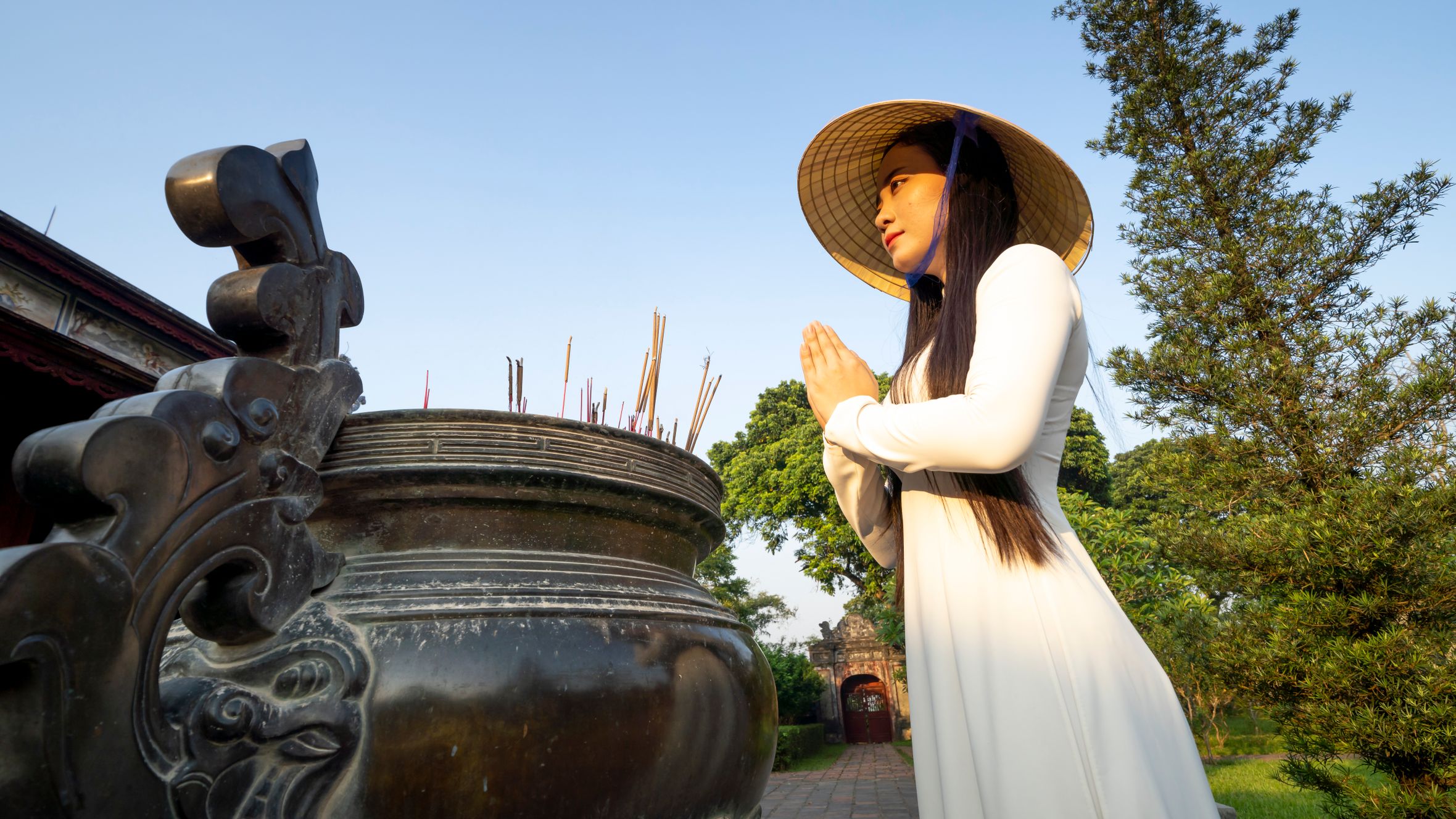
Den Kiep Bac sits at the foot of Nham Bien mountain in what was formerly Hai Duong province — now part of the expanded Hai Phong after Vietnam (베트남 / 越南 / ベトナム)'s 2025 provincial merger. It's one of the most important spiritual sites in northern Vietnam, and unless you're visiting during a festival, you'll likely have the complex mostly to yourself on a weekday morning.
What it is and why it matters
Den Kiep Bac is a temple complex dedicated to Tran Hung Dao, the 13th-century military commander who repelled three Mongol invasions. The site sits on the grounds where he once stationed his troops along the Luc Dau Giang river system — a strategic corridor that controlled access to the Red River Delta.
The temple has been rebuilt and expanded many times over seven centuries. What you see today is a mix of Nguyen-dynasty architecture and modern restoration work, spread across several worship halls, courtyards, and a hillside path. Tran Hung Dao isn't just a historical figure here — he's venerated as a saint. Vietnamese families come to pray for protection, success in business, and good health. The atmosphere is less tourist attraction, more living religious site.
Why travelers go
Most foreign visitors end up here for one of three reasons: they're interested in Vietnamese history, they want to see a major pilgrimage site without tourist infrastructure crowding it out, or they're combining it with nearby Con Son temple as a day trip from Hanoi or Hai Phong.
The complex rewards slow exploration. The main hall has intricate wood carvings and a large bronze statue of Tran Hung Dao. The surrounding grounds include smaller shrines to his family members and generals. And the walk up Nham Bien mountain behind the temple — maybe 20 minutes at a comfortable pace — gives you a view over the river plain that makes the site's military history click into place.
Best time to visit
The big event is the Tran Temple Festival, which runs from the 15th to the 20th of the eighth lunar month (usually September or early October). This is when hundreds of thousands of pilgrims converge on the site for ceremonies, incense offerings, and traditional performances. It's impressive but genuinely crowded — think shoulder-to-shoulder on the main paths.
If you want the experience without the crush, go between October and March. The weather is cooler and drier, mornings can be misty, and the temple grounds feel contemplative rather than chaotic. Avoid major Vietnamese holidays like Tet unless you specifically want to see the site during peak spiritual activity.
How to get there
From Hanoi (하노이 / 河内 / ハノイ) (about 80 km): The most practical option is to hire a private car or take a Grab to the temple. Expect around 90 minutes each way and roughly 800,000–1,000,000 VND for a round trip with waiting time. There are also buses from My Dinh or Gia Lam station heading toward Chi Linh — the ride costs around 80,000–100,000 VND, but you'll need a xe om (motorbike taxi) for the last few kilometers from the main road to the temple entrance, about 30,000 VND.
From Hai Phong city center (about 70 km): Similar logistics. A Grab car runs around 700,000–900,000 VND round trip. Local buses exist but connections are indirect and time-consuming — a private vehicle saves real frustration here.
Pairing Den Kiep Bac with Con Son Pagoda makes sense since they're only about 5 km apart. Most visitors do both in a single half-day.

Photo by Kirandeep Singh Walia on Pexels
What to do
Walk the main temple complex
The central hall houses the primary altar to Tran Hung Dao. Take your time with the woodwork — the dragon and phoenix carvings on the main beams are some of the finest examples of traditional Vietnamese temple art in the north. Side halls honor his wife, Quoc Mau Thien Thanh, and his key generals.
Hike up Nham Bien mountain
A stone path leads from behind the temple up to a smaller shrine at the hilltop. It's not strenuous — maybe 150 meters of elevation — but the view over the river valleys below is the kind of thing that makes you understand why someone chose this exact spot to build a military headquarters 700 years ago.
Visit the Tran Hung Dao museum
A small exhibition hall near the entrance displays replicas of weapons, maps of the Mongol invasion campaigns, and historical context panels. It's modest but useful if you want background before exploring the temple itself.
Watch the rituals
Even outside festival season, you'll often see families arriving with elaborate offerings — fruit towers, paper votives, incense bundles. If you're respectful and keep your camera discreet, observing the rituals is one of the most genuine cultural experiences in northern Vietnam.
Combine with Con Son Pagoda
Con Son is associated with Nguyen Trai, a 15th-century scholar and strategist. The pagoda sits in a pine forest and has a very different feel — quieter, more literary. Together the two sites give you a layered picture of Vietnamese spiritual and intellectual traditions.
Where to eat nearby
The area around Den Kiep Bac isn't a food destination, but there are local restaurants along the road between the temple and Chi Linh town center. Look for "banh cuon" — the steamed rice rolls here are made fresh and served with a dipping sauce that leans heavier on fish sauce than the Hanoi version. "Pho" shops are everywhere, solid and cheap at 35,000–45,000 VND a bowl. If you're heading back toward Hanoi, the stretch through Hai Duong city has decent "bun cha" spots worth a stop.
Where to stay
Most travelers visit Den Kiep Bac as a day trip from Hanoi or Hai Phong. If you want to stay overnight — useful during festival season — Chi Linh has a handful of guesthouses in the 250,000–400,000 VND range. The Vinpearl resort complex in Chi Linh is the upscale option at roughly 1,500,000–2,500,000 VND per night. Neither category is remarkable; they're functional bases.

Photo by Valeria Drozdova on Pexels
Practical tips locals would tell you
- Dress modestly. This is an active worship site. Cover your shoulders and knees. You'll see Vietnamese visitors in long sleeves regardless of the heat.
- Bring incense if you want to participate. Vendors at the entrance sell bundles for 10,000–20,000 VND. Lighting incense and placing it at the main altar is welcome — just follow what others are doing.
- Go early. The temple opens around 7:00 AM. Morning light on the courtyards is best, and you'll beat any tour groups that arrive after 10:00.
- Shoes off inside the halls. There are racks at each entrance.
- Carry cash. There are no ATMs at the temple complex itself. Donation boxes are present at most altars, and small bills (10,000–50,000 VND) are appropriate.
Common mistakes to avoid
Don't schedule just 30 minutes. The complex is bigger than it looks, and rushing through a worship site feels wrong and looks worse. Budget at least 90 minutes for the temple plus the hillside walk.
Don't visit only during the festival expecting a peaceful experience. The Tran Temple Festival is powerful but overwhelming — if contemplation is what you're after, come on a regular weekday.
Don't rely on English signage. There's very little. Download a translation app or read up beforehand so the historical context isn't lost on you.
Practical notes
Entrance is free, though there's a small parking fee of 10,000–20,000 VND for motorbikes and cars. The site pairs naturally with Con Son Pagoda and can be folded into a broader northern Vietnam loop that includes Ninh Binh or Ha Long Bay. If you're based in Hanoi, it's one of the most worthwhile day trips that almost no foreign tourists take.
Last updated · May 29, 2026 · independently researched, never sponsored.






