What it is
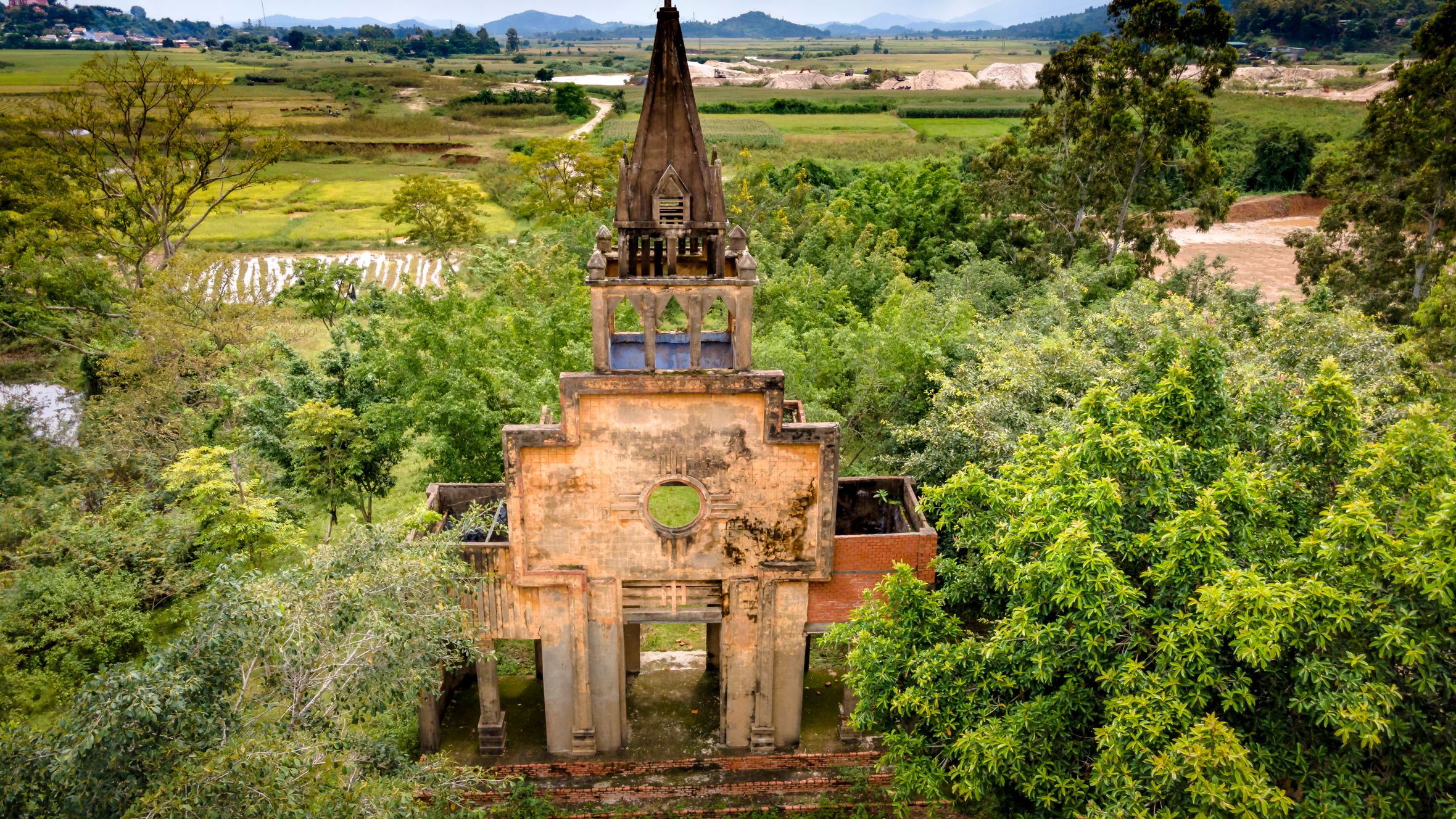
Nha Tho Do Hai Ly is a ruined Catholic church standing in the tidal flats where the Red River Delta meets the sea. Built by French missionaries in the early 20th century, it served the fishing community of Hai Ly commune until rising seas and coastal erosion forced villagers to relocate inland in the 1990s. The congregation moved. The church stayed. Now it sits alone on a wide expanse of sand and mud, its Gothic arches open to the sky, walls stained black by decades of salt air and tidal flooding.
The site sits in the coastal stretch of what was formerly Nam Dinh province, now part of the expanded Ninh Binh (닌빈 / 宁平 / ニンビン) administrative area. Don't confuse it with Ninh Binh's famous limestone karst scenery — this is flat delta coastline, completely different terrain.
Why travelers go
It's one of the more genuinely strange landscapes in northern Vietnam (베트남 / 越南 / ベトナム). The church looks transplanted from a post-apocalyptic film set — a European Gothic skeleton surrounded by nothing but wet sand, mangroves, and sky. At low tide, you can walk hundreds of meters out to it. At high tide, waves lap against its foundations.
Photographers come for the surreal compositions. The light at sunrise and sunset here is something else — the flat horizon means unobstructed golden hour that lasts. But even without a camera, there's a meditative quality to the place. It's quiet. Few domestic tourists make the trip outside weekends and holidays, and international visitors are rare.
Best time to visit
The sweet spot is October through March — dry season, cooler temperatures, and the clearest skies. December and January can be cold and grey, but the moody fog adds atmosphere if you're into that.
Avoid June through August if possible. It's hot, humid, and the monsoon rains make the coastal flats muddy and harder to navigate. The church doesn't disappear in rainy season, but the experience is less pleasant.
Regardless of month, check tidal charts before going. You want low tide to walk out to the structure comfortably. High tide means you're watching from the shore or wading through knee-deep water.
How to get there
From Ninh Binh city, the drive is roughly 60-70 km east toward the coast, about 1.5 hours by motorbike or car depending on traffic through the delta villages.
By motorbike: The most flexible option. Rental in Ninh Binh runs 120,000-150,000 VND/day for a semi-auto. Roads are flat delta highways and village lanes — easy riding, no mountain passes. Plug "Nha Tho Do Hai Ly" into Google Maps; the pin is accurate.
By car/taxi: A private car from Ninh Binh costs around 600,000-800,000 VND round trip with waiting time. Grab cars are available but drivers may be reluctant for the return trip since it's a remote area.
From Hanoi: It's about 150 km, roughly 2.5-3 hours by car via the Cau Gie - Ninh Binh expressway, then east on provincial roads. Some travelers combine it with a trip to Ninh Binh's karst areas — visit Tam Coc or Trang An in the morning, then drive east to the coast for sunset.

Photo by Hồng Quang Official on Pexels
What to do
Walk out to the church at low tide
The main event. The tidal flat extends far out, and the walk itself is part of the experience — squelching through wet sand with the ruin growing larger ahead of you. Wear shoes you don't mind getting muddy. Flip-flops work but you'll lose them in the suction.
Catch sunrise or sunset
Sunrise is better if you want solitude. The flat eastern horizon means the sun comes up right behind the church — silhouette shots basically compose themselves. Sunset works too, painting the ruins orange from behind you.
Explore the surrounding mangrove flats
The coastline here has been replanted with mangroves as part of erosion control. Walking the raised paths through the young mangrove forest is pleasant, and you'll see locals harvesting clams and oysters in the mud.
Visit the newer church inland
The replacement church — where the congregation actually moved — is about 2 km inland. It's a functioning parish with a modest but well-kept building. Worth a quick look for context on how the community adapted.
Watch the fishing boats come in
The nearby coast has small-scale fishing operations. Early morning, boats return with the night's catch. It's not a tourist show — just daily life in a delta fishing commune.
Where to eat nearby
This is deep delta countryside. Don't expect restaurant rows. Your best bet:
Seafood at the coast: Small family-run places near the fishing hamlets serve whatever came in that morning — steamed clams, grilled fish, stir-fried "oc" (snails) with lemongrass. Expect 80,000-150,000 VND per person for a full spread. Look for places with plastic tables and locals eating — the usual Vietnam rule applies.
"Bun rieu" and "com binh dan": On the road back toward Ninh Binh, roadside spots serve solid bun rieu (crab noodle soup) and rice-and-dish lunch sets for 35,000-50,000 VND. Nothing fancy, reliably good.
If you want a proper meal, save your appetite for Ninh Binh city where options are broader — goat meat ("de tai chanh") is the local specialty there.
Where to stay
There's no accommodation at the church site itself. Your options:
Ninh Binh city: Budget guesthouses from 200,000 VND/night, mid-range hotels 400,000-800,000 VND, a few boutique places near Tam Coc up to 1,500,000 VND. This is the practical base for most travelers.
Homestays near the coast: A handful of family homestays exist in the surrounding communes, 150,000-300,000 VND/night. Basic rooms, friendly hosts, zero English. Useful if you want sunrise at the church without the early drive.

Photo by Quang Nguyen Vinh on Pexels
Practical tips locals would tell you
- Check the tide. Seriously. This is the single most important planning detail. Use a tidal chart app or ask your hotel to check. Low tide windows vary by 30-60 minutes daily.
- Bring water and sun protection. There is zero shade on the tidal flats. In summer, the reflected heat off wet sand is brutal.
- The mud is real. After rain or at mid-tide, sections of the flat are genuinely sticky. Sandals with straps beat flip-flops. Water shoes are ideal.
- Go on a weekday. Weekend crowds (mostly domestic photography groups) can number in the dozens, which kills the atmosphere for a place that thrives on emptiness.
- Bring cash. No ATMs nearby. The closest are in town centers 15-20 km away.
Common mistakes to avoid
Arriving at high tide and being disappointed. The church is still visible, but you can't reach it and it loses the dramatic isolation effect. Plan around the water.
Assuming it's close to Ninh Binh's main sights. Tam Coc, Trang An, and Bai Dinh are in the western limestone area. Hai Ly is on the eastern coast. Budget 1.5 hours each way — it's a half-day commitment minimum.
Not bringing a charged phone/GPS. The last few kilometers involve unmarked village lanes. Without navigation, you'll end up asking directions at every junction (which works, but slowly).
Leaving too late for sunset. The drive back through unlit village roads after dark is doable but not fun, especially on a motorbike. Give yourself buffer time.
Practical notes
Nha Tho Do Hai Ly is free to visit — no ticket, no gate, no opening hours. It's an unmanaged ruin on public tidal land. Combine it with a broader Ninh Binh itinerary if you have 3+ days in the area, or treat it as a detour on the Hanoi-to-coast route. It rewards travelers who plan around the tides and show up at the right hour.
Last updated · May 29, 2026 · independently researched, never sponsored.