What Tam Chuc Is — and Why It's Worth the Trip
Tam Chuc (full name: Chua Tam Chuc) is a Buddhist pagoda complex built into limestone karsts on the shore of Luc Nham Lake, about 70 km south of Hanoi. It sits in what was formerly Ha Nam province — now folded into the expanded Ninh Binh (닌빈 / 宁平 / ニンビン) province after Vietnam's 2025 administrative merger. The complex covers roughly 5,000 hectares, making it the largest pagoda site in Vietnam by area, and it hosted the UN Vesak celebration in 2019.
But here's the thing people get wrong: Tam Chuc isn't an ancient temple. Construction began in 2014 and much of what you see is modern, built with serious money and engineered to impress at scale. The main pagoda halls sit partway up Thac Boi mountain, reachable by a long stone staircase. Below, the lake stretches between karst formations that look like they wandered over from Ninh Binh's Trang An.
Travelers come here for the landscape as much as the architecture. The combination of water, rock, and open sky is unlike most pagoda visits in Vietnam (베트남 / 越南 / ベトナム), where you're usually in a city or on a single hilltop. Tam Chuc feels expansive — almost empty on weekdays, which is part of its appeal.
Best Time to Visit
The sweet spot is October through April, when the weather is cooler and drier. Mornings in November and December often bring low mist across the lake, which makes the boat ride genuinely atmospheric.
Avoid the weeks around Tet and the Vesak festival (usually in May). During Tet especially, Tam Chuc draws enormous crowds — we're talking tens of thousands of domestic visitors in a single day. The electric carts and boats back up, wait times stretch past an hour, and the peaceful-lake experience disappears entirely. If you must go during a holiday, arrive before 7:00 AM.
Summer months (June–August) are hot and humid. You'll be climbing several hundred stone steps to reach the upper pagodas, and doing that at 37°C with 90% humidity is genuinely unpleasant.
How to Get There from Hanoi
Tam Chuc is about 70 km from central Hanoi, due south along the QL1A or via the Cau Gie – Ninh Binh expressway.
By car or motorbike: Take the Cau Gie – Ninh Binh expressway and exit at the Phu Ly interchange. From there it's about 12 km on local roads to the complex entrance. Total drive time is around 1.5 hours from Hanoi's city center. Expressway tolls run about 45,000 VND each way for a car.
By bus: Catch a bus from Giap Bat station to Phu Ly (about 40,000–60,000 VND, roughly 1.5 hours). From Phu Ly bus station, grab a taxi or Grab to Tam Chuc — around 80,000–100,000 VND for the 12 km ride.
By organized tour: Several Hanoi tour operators bundle Tam Chuc with Ninh Binh stops like Trang An or Bai Dinh. Day trips typically run 600,000–900,000 VND per person. Convenient, but you'll have limited time at each site.

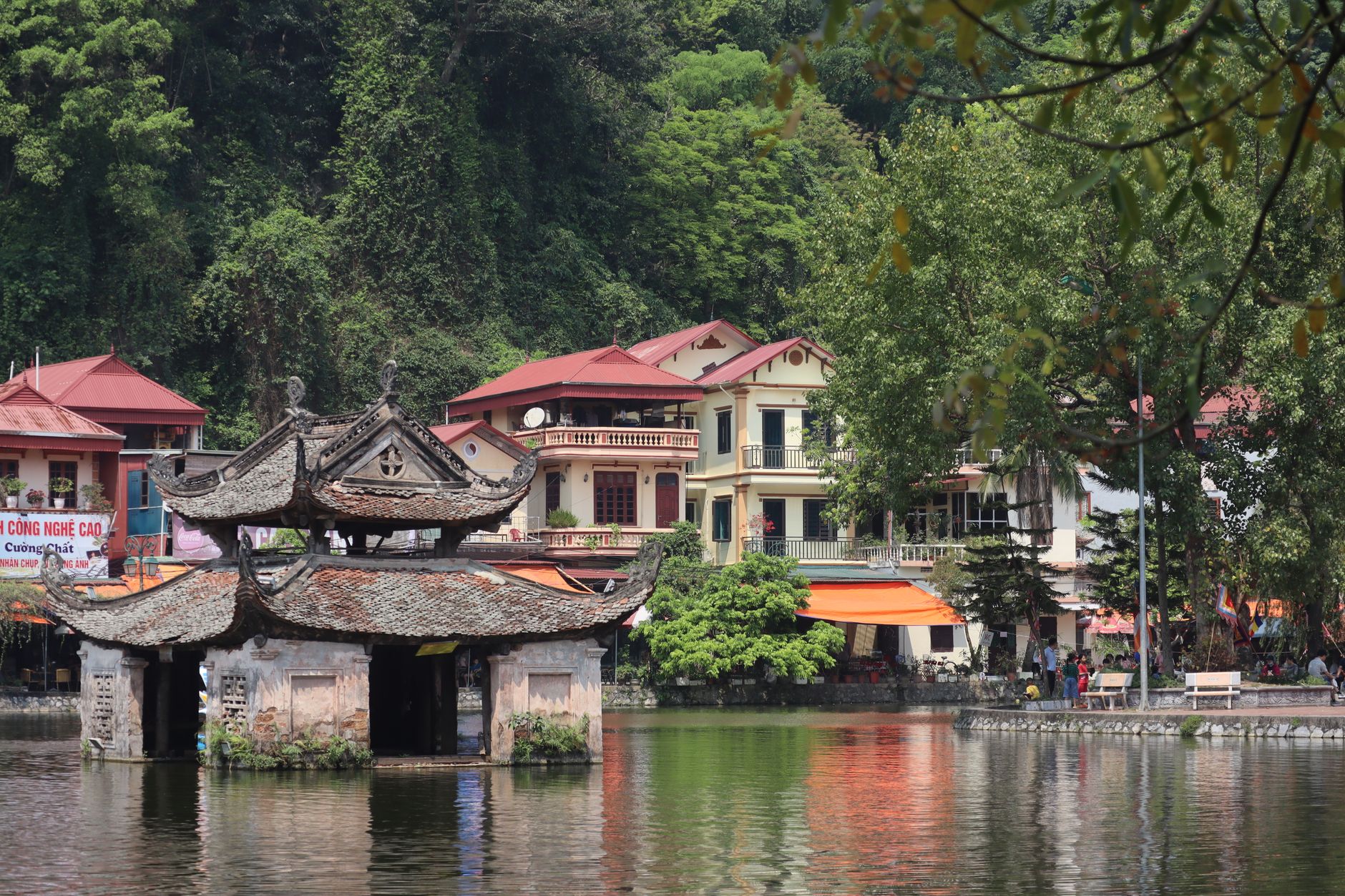
Photo by Karolina on Pexels
What to Do at Tam Chuc
Take the Boat Across Luc Nham Lake
This is the centerpiece experience. Electric boats ferry visitors from the main dock across the lake to the pagoda base, weaving between karst islands. The ride takes about 15 minutes each way. Boat tickets cost 200,000 VND per person (round trip, included in most entrance packages). On a quiet weekday morning with mist on the water, it's the best part of the visit.
Climb to Ngoc Pagoda on Thac Boi Mountain
From the boat landing, a stone staircase of roughly 400 steps leads up to Ngoc Pagoda, the highest point in the complex. The climb takes 20–30 minutes at a steady pace. Inside, the halls feature large stone murals depicting Buddhist stories — carved from single pieces of stone, impressive in craftsmanship regardless of the modern construction date. The view from the top over the lake and surrounding karsts is the real reward.
Walk Through the Three Lower Pagodas
At the base of the mountain, three large pagoda halls sit in a line: Tam The, Phap Chu, and Quan Am. Each one is built with dark stone and houses oversized Buddha statues. The Tam The hall contains three bronze Buddhas that weigh several tons each. Even if temple fatigue sets in (it's a lot of pagoda in one visit), the interior stonework is worth a slow look.
Explore the Karst Islands by Boat
Some boat routes loop around the smaller karst islands rather than heading straight to the pagoda dock. Ask at the ticket counter about the extended route. The islands are covered in dense green vegetation and the water is surprisingly clean. It's a quieter alternative to Ha Long Bay's boat tours, on a much smaller scale.
Ride the Electric Cart Through the Grounds
The complex is enormous. Walking from the main gate to the boat dock takes 20+ minutes on paved paths. Electric carts run the route for 30,000 VND per person. Not essential, but useful if you're short on time or visiting with older relatives.
Where to Eat Nearby
Tam Chuc itself has a food court near the main gate with standard Vietnamese fare — rice plates, "pho", and snacks — at tourist-inflated prices (60,000–100,000 VND per dish). It's fine but forgettable.
Better option: drive 12 km into Phu Ly town. Look for local "bun cha" joints along the main road — Ha Nam province was historically known for its version, slightly sweeter than Hanoi's. "Com tam" rice plates are easy to find for 35,000–50,000 VND. There's also a cluster of restaurants along the road to Tam Chuc serving goat meat ("de tai chanh" — goat with lime), which is a regional specialty worth trying if you eat meat.
Where to Stay
Most travelers visit Tam Chuc as a day trip from Hanoi or combine it with a night in Ninh Binh town (about 30 km south). In Ninh Binh, budget guesthouses start around 250,000 VND/night, mid-range hotels run 500,000–900,000 VND, and a few boutique spots near Tam Coc push 1,500,000 VND and up.
In Phu Ly, a handful of local hotels charge 300,000–500,000 VND/night. They're basic but functional — useful if you want an early start at Tam Chuc before the crowds arrive.

Photo by Karolina on Pexels
Practical Tips
- Dress code matters. Tam Chuc is an active religious site. Cover your shoulders and knees. Staff at the gate will turn people away in shorts or sleeveless tops, or offer rental cover-ups for a fee.
- Bring water and sun protection. The staircase climb is exposed, and there's limited shade on the boat. A hat and a water bottle save you from overpriced drinks at the summit.
- Budget 3–4 hours minimum. Between the cart ride, boat crossing, staircase climb, and three pagoda halls, rushing through in under two hours means missing the point. The scale is the experience.
- Cash is useful. Card payments work at the main ticket office, but the food court, cart drivers, and small vendors are cash-only.
Common Mistakes
- Going on a weekend or holiday without a plan. Weekend crowds are significant. If you can only visit on Saturday or Sunday, arrive by 7:30 AM.
- Wearing the wrong shoes. The stone steps get slippery when wet. Sandals are a bad call — bring proper walking shoes.
- Skipping the boat ride. Some visitors try to walk around the lake to save the 200,000 VND. The paths aren't designed for it, and the boat is genuinely the best part.
- Expecting an ancient site. If you come looking for centuries-old patina and spiritual quietude, you'll be disappointed. Tam Chuc is modern, monumental, and unapologetically large-scale. Enjoy it for what it is.
Practical Notes
Tam Chuc pairs naturally with a Ninh Binh itinerary — hit Trang An or Bai Dinh on one day, Tam Chuc the next morning, and you've covered two of northern Vietnam's biggest Buddhist-landscape sites without backtracking. From Hanoi, it's an easy overnight trip that most visitors find more rewarding than a single rushed day.
Last updated · May 29, 2026 · independently researched, never sponsored.