What it is
Don Cao sits on a limestone knoll about 50 meters above Dong Van town center, in the far north of Ha Giang province. It's a small French-colonial military outpost built in the early 1890s — thick stone walls, watchtowers at the corners, a courtyard you can walk in under a minute. The French garrisoned troops here to control the road into China. Later it served as a base during various 20th-century conflicts in the borderlands.
The structure isn't large or lavishly restored. What makes it worth the climb is the view: Dong Van's cluster of grey rooftops wedged into a valley, ringed by karst peaks that go blue-grey in the afternoon haze. On a clear morning you can trace the road switchbacks heading toward Lung Cu.
Why travelers go
Most people passing through Dong Van are riding the Ha Giang loop — the 3-to-5-day motorbike circuit that's become one of northern Vietnam (베트남 / 越南 / ベトナム)'s defining road trips. Don Cao is one of the few stops in Dong Van town itself that justifies getting off the bike for 30-45 minutes.
Reasons to visit:
- The fort offers the best elevated viewpoint in town without a hike.
- It's genuinely atmospheric — crumbling stonework, moss on the walls, quiet except for wind.
- The old quarter below (Dong Van's "pho co") connects directly, so you can pair both in one walk.
- Photography is excellent at sunrise or late afternoon when light rakes across the karst.
Don Cao won't consume half your day. It's a short, rewarding detour — not a destination you'd plan a trip around, but one that rewards the 15-minute climb.
Best time to visit
Dong Van sits at around 1,000 meters elevation. Weather follows Ha Giang (하장 / 河江 / ハーザン)'s pattern:
- September to November — clear skies, comfortable temperatures (15-22°C), rice terraces golden in nearby valleys. Best months overall.
- March to May — buckwheat and peach blossom season. Mornings can be foggy, which either ruins or improves your photos depending on taste.
- December to February — cold, sometimes near freezing at night. Fog can smother the view for days. But fewer tourists.
- June to August — rain. Roads get slippery, landslides possible on the loop. The fort itself is fine but the plateau views suffer.
For Don Cao specifically, go early morning (before 8 AM) or late afternoon (after 4 PM). Midday light flattens the karst and the courtyard has no shade.
How to get there
Dong Van town is roughly 150 km north of Ha Giang city, which is itself about 300 km from Hanoi.
Hanoi to Ha Giang city
Overnight sleeper buses run from My Dinh bus station (around 250,000-350,000 VND, 6-7 hours). Several companies depart between 8 PM and 10 PM. You can also take a daytime bus or hire a private car (roughly 3,500,000 VND one way).
Ha Giang city to Dong Van
Local buses leave Ha Giang bus station in the morning (around 6:30 AM, 120,000 VND, 4-5 hours on winding roads). Most travelers rent a motorbike or hire an "easy rider" guide in Ha Giang city — the loop road is the whole point.
Dong Van town to Don Cao
From the town market, walk uphill on the stone-paved lane heading north. Signs point to "Don Cao." It's about 600 meters and maybe 15 minutes of climbing on steps cut into rock. No vehicle access to the top.
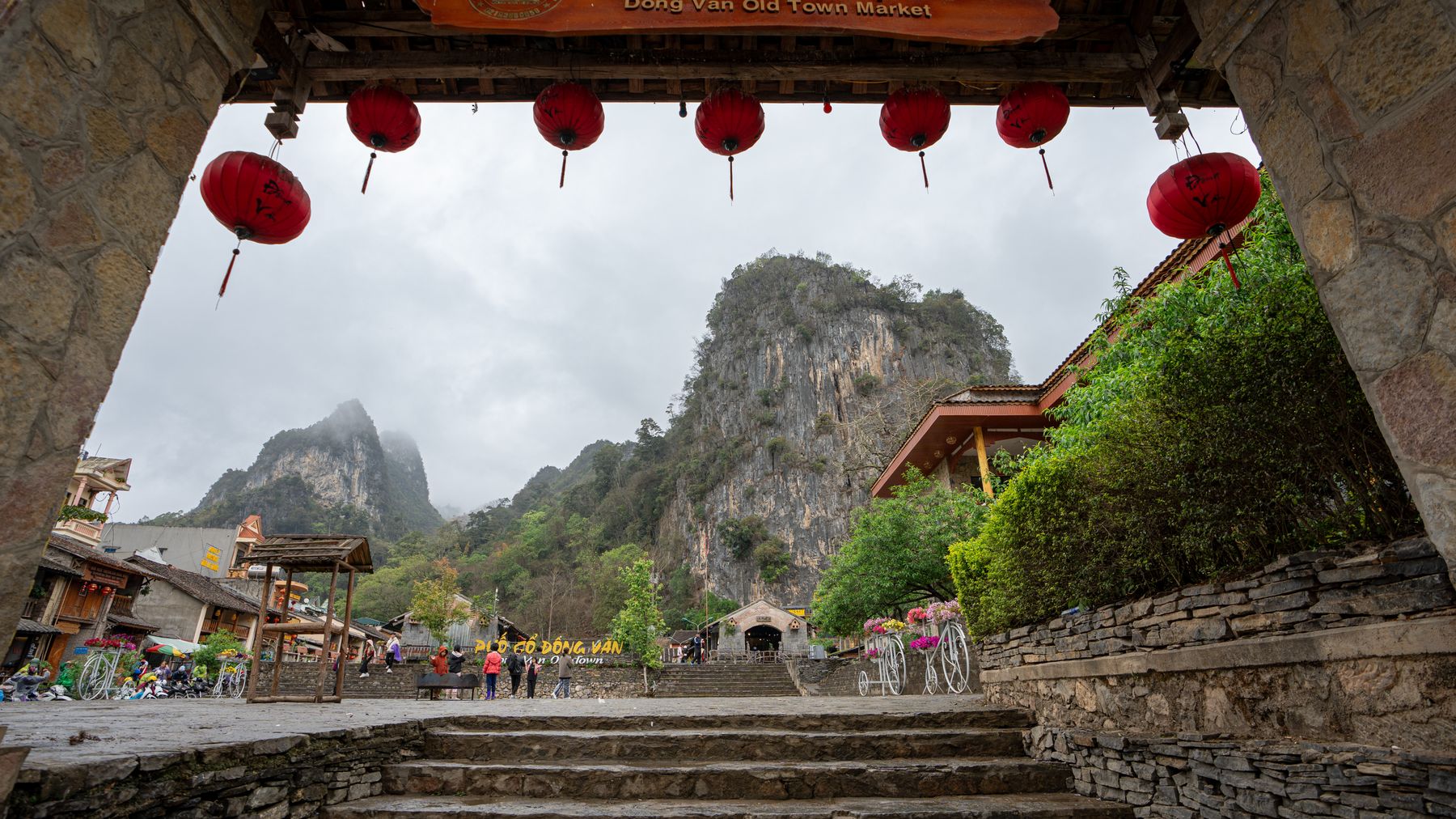
Photo by Nguyen Khuong on Pexels
What to do
- Walk the walls. The perimeter takes five minutes. Each corner watchtower frames a different angle of the valley.
- Explore the courtyard. A few information boards (Vietnamese and basic English) explain the fort's history. The main building has been partly restored.
- Photograph the roofline. Dong Van's old quarter has distinctive Hmong-style grey stone houses with clay-tile roofs visible from above.
- Pair with the old quarter. Descend via the same path, turn left, and you're in "pho co Dong Van" — a short street of restored stone houses, some now cafes or small museums. Budget 30-45 minutes for both.
- Sunrise visit. If you're staying overnight in Dong Van, the pre-dawn climb is worth it. You'll likely have the fort to yourself.
Where to eat
Dong Van town has a strip of local restaurants along the main road near the market. Options:
- "Pho" and "bun" stalls at the morning market — open from around 6 AM. A bowl runs 30,000-40,000 VND.
- Lung Cu Restaurant (on the main road) — serves local Hmong-style dishes: "thang co" (horse-meat stew), grilled pork, stir-fried vegetables. Mains 60,000-100,000 VND.
- Coffee in the old quarter — a couple of small cafes in restored stone houses serve Vietnamese coffee. Expect 25,000-35,000 VND for a "ca phe sua da."
- Dong Van night market (weekends, Saturday evening) — skewers, corn wine, steamed corn, local snacks.
Don't expect refined dining. This is mountain-town food — hearty, simple, inexpensive.
Where to stay
Dong Van has a range of guesthouses and a few hostels. Nothing luxury.
- Budget (200,000-400,000 VND/night): Local nha nghi near the market. Basic but clean enough. Hot water usually available.
- Mid-range (500,000-900,000 VND/night): Places like Dong Van House or similar homestay-style spots with valley views, breakfast included.
- Hostel dorms (150,000-250,000 VND/bed): A couple of backpacker-oriented places have opened in recent years.
Book ahead on weekends from September to November — the loop gets busy.

Photo by Vietnam Hidden Light on Pexels
Practical tips
- Entry fee: Around 20,000 VND (as of recent visits). Sometimes no one is collecting.
- Footwear: The path is stone steps, occasionally slippery after rain. Trainers are fine; flip-flops are not.
- Water: Bring your own. Nothing sold at the top.
- Time needed: 30-45 minutes total, including the climb.
- Connectivity: 4G signal is decent in Dong Van town and at the fort.
Common mistakes
- Skipping it because it looks small on the map. The view alone justifies the stop.
- Going midday in summer. No shade, harsh light, and you'll sweat through the climb.
- Confusing Don Cao with the Vuong family mansion. The mansion ("dinh ho Vuong") is a different site, about 15 km away in Sa Phin. Both are worth visiting but they're not the same place.
- Not allowing time for the old quarter below. If you only do the fort and leave, you miss the best part of Dong Van town.
Practical notes
Don Cao works best as a morning stop on Day 2 or 3 of the Ha Giang loop — climb up before breakfast, descend into the old quarter for coffee, then ride on toward Lung Cu or Ma Pi Leng pass. It's a short visit but one of the few places on the loop where you get altitude perspective without a grueling hike.
Last updated · May 29, 2026 · independently researched, never sponsored.