Thick, chewy, almost translucent — "banh canh" noodles are not trying to be anything subtle. Add crab meat, a split claw, slippery quail eggs, and a broth that coats the back of a spoon, and you have one of southern Vietnam's most satisfying bowls, one that somehow remains under the radar compared to its more famous cousins pho and bun bo hue.
What Banh Canh Actually Is
"Banh canh (반깐 / 粗米粉汤 / バインカイン)" refers to the noodle itself before it refers to any particular soup. The noodle is made from tapioca starch, rice flour, or a blend of both, then extruded or hand-cut into thick, round cylinders — somewhere between udon and a wide rice noodle in texture. The tapioca version has a slightly gelatinous quality that divides people neatly: you either love the chew or you don't. Most people who grew up eating it love it.
The noodle shows up across the country in different forms. In Hue, you get "banh canh gio heo", a lighter pork-knuckle broth with a clear, clean finish. In Trang Bang (Tay Ninh province), banh canh is eaten dry, wrapped in rice paper with herbs. But the version most visitors encounter — and the one worth going out of your way for — is banh canh cua, built around crab and concentrated almost entirely in the south.
The Anatomy of a Proper Bowl
A canonical Saigon bowl of banh canh cua is assembled in layers, and each component earns its place.
The Broth
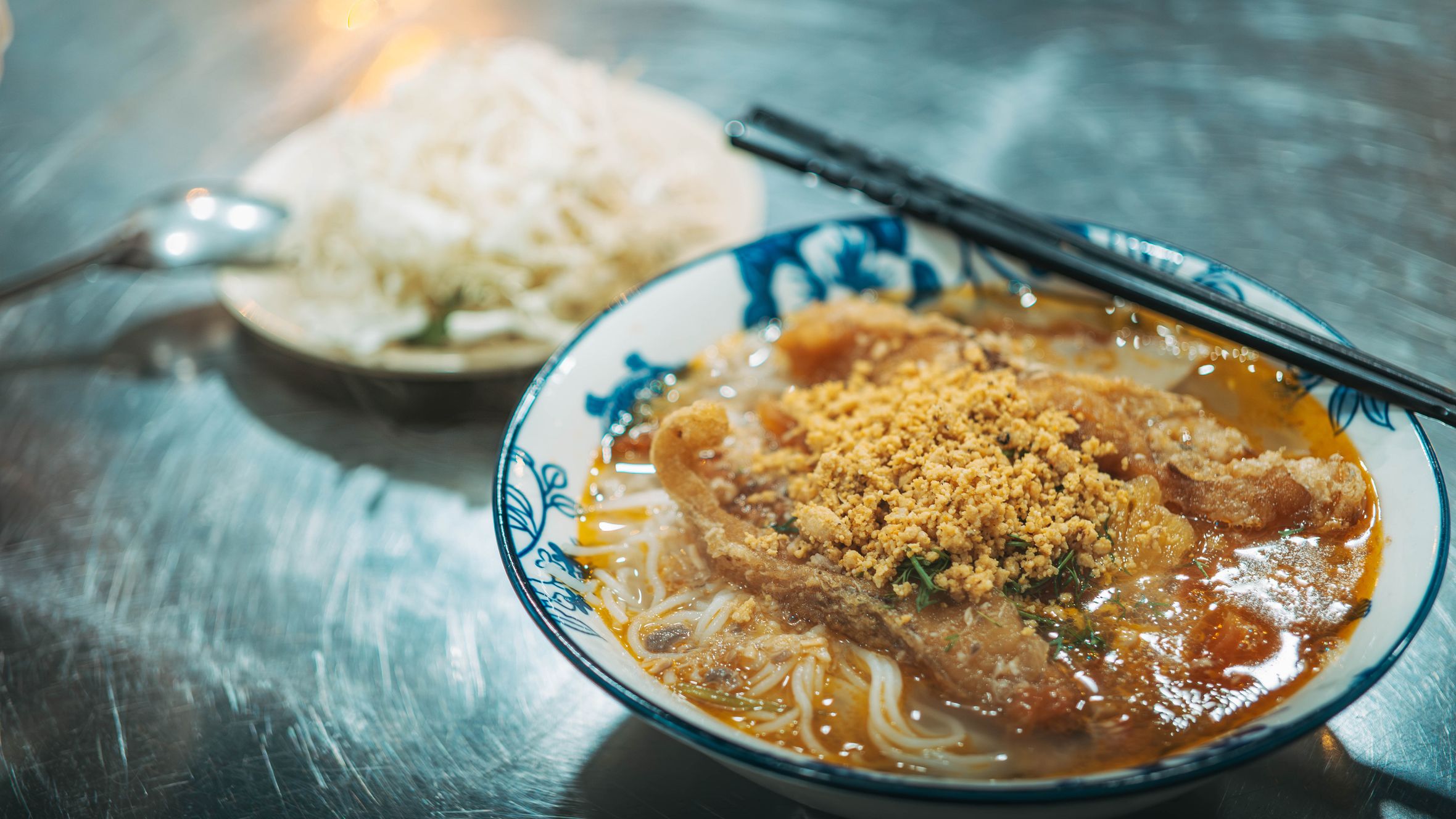
The base starts with pork bones simmered for several hours, then crab — usually swimming crab (cua bien) or mud crab (cua dong) — is added and cooked down until the shells release everything they have. Some cooks add annatto oil for color, which gives the broth its characteristic deep orange-red hue (후에 / 顺化 / フエ). The result is thick, almost bisque-adjacent, with a salinity that hits you immediately and a sweetness from the crab that lingers.
This is not a delicate broth. It is meant to be rich. If a bowl arrives looking watery and pale, something has gone wrong.
The Noodles
In Saigon, the tapioca-heavy blend is standard. The noodles are soft but with resistance — they should not dissolve under the spoon. A portion runs about 200–250g per bowl, which is genuinely filling even before you account for the toppings.
The Toppings
This is where banh canh cua earns its southern-comfort reputation:
- Cua (crab): Either a whole crab claw or a heap of picked crab meat stirred through the broth. The claw presentation is theatrical and practical — you crack it at the table.
- Cha lua or cha chien: Vietnamese pork sausage, either the steamed silky "cha lua" version or pan-fried fish cake patties. Both are common; many shops use a combination.
- Trung cut: Boiled quail eggs, halved or whole, usually four to six per bowl. They absorb the broth and add a richness that pushes an already heavy bowl further.
- Hanh phi: Crispy fried shallots scattered on top just before serving. Non-negotiable.
- Rau song: A plate of fresh herbs — usually Vietnamese coriander (rau ram) and bean sprouts — served on the side.
A full bowl in Saigon costs between 50,000 and 90,000 VND depending on the crab portion size. Some shops offer an "extra claw" upgrade for another 20,000–30,000 VND, which is almost always worth it.

Photo by Gu Ko on Pexels
Regional Variants Worth Knowing
Saigon (standard): The version described above. Thick broth, tapioca noodles, crab claw, quail eggs, cha lua. Found at dedicated banh canh cua shops, typically open morning through early afternoon only — the broth runs out.
Mekong Delta style (Can Tho, Soc Trang): The broth is sometimes thinner and more fragrant with lemongrass. Freshwater crab is more common here given proximity to rivers. You may also find coconut milk added in small quantities in some Soc Trang variations, a trace of Khmer culinary influence in the region.
Hue-adjacent versions: Different animal entirely — lighter broth, no crab, pork knuckle dominant. Worth knowing so you don't confuse the two when traveling through central Vietnam.
How to Order
Most banh canh cua shops run a simple menu. You choose your size (nho/small or lon/large) and sometimes your protein emphasis. If you want extra crab meat rather than a claw, say "them cua" (thêm cua). If you want it less rich, "nhat nuoc" signals you'd like the broth ladled on lighter — though many cooks will find this request quietly baffling.
Eat it fast. The tapioca noodles absorb broth aggressively and the texture changes within ten minutes. Squeeze the lime in immediately, add a few drops of chili sauce if the shop provides it, and eat before the noodles go soft.

Photo by Trần Phan Phạm Lê on Pexels
Where to Try It
Banh Canh Cua Co Lieu — Saigon (District 4) A long-running shop on Xom Chieu Street that opens at 6:30 a.m. and frequently sells out by 10. The broth here is deeply reduced and almost sticky on the spoon. Expect 65,000–75,000 VND per bowl. Arrive early or you're eating somewhere else.
Banh Canh Cua Ba Giang — Saigon (Binh Thanh) A neighborhood institution with generous crab claw portions. Less intense broth than Co Lieu, but the cha chien here is exceptional — thick, bouncy, properly seared. Around 60,000–80,000 VND.
Quan Banh Canh Cua Thanh Xuan — Can Tho For the Mekong Delta variant, this small shophouse near Ninh Kieu wharf does a lemongrass-forward version with freshwater crab. The bowl is lighter than Saigon's but the crab flavor is cleaner. About 45,000–55,000 VND. Worth stopping for if you're passing through Can Tho.
Practical Notes
Banh canh cua is a morning and late-morning dish — most dedicated shops close by noon or shortly after. If you're hunting a specific spot, go before 9 a.m. to guarantee availability. The dish reheats poorly, so takeaway is not really an option worth pursuing.
Last updated · May 29, 2026 · independently researched, never sponsored.