Hanoi has no shortage of things wrapped in banana leaf, but "banh gio" earns its own category. A smooth, slightly translucent pyramid of rice flour dough, steamed over a pork-and-wood-ear-mushroom filling, it lands somewhere between a dumpling and a savory cake. You can eat it standing up at a cart on your way to work, or you can sit down at a proper shop and get it dressed up with extras. Both are legitimate. They are not the same experience.
The Street Cart Version
The mobile cart is the original delivery system for banh gio. Vendors typically work early — from around 6 a.m. to 9 or 9:30 a.m. — and then again late at night, sometimes from 9 p.m. until past midnight. The two windows rarely overlap; it's the same dish serving two completely different moods.
On the breakfast circuit, carts cluster near school gates, market entrances, and bus stops. Around Cho Hom on Pho Hue street, and along the lanes feeding into Dong Xuan Market in the Old Quarter, you'll spot vendors with a covered basket steamer strapped to the back of a bicycle or parked on a low plastic stool setup. The banh gio here cost between 10,000 and 15,000 VND per piece. You unwrap the banana leaf yourself, pull the pyramid apart with a wooden skewer or a small plastic fork, and eat it standing or crouching on a stool the size of a hardback book.
The dough on a good cart version is silky and firm without being gummy. The filling is modest — a spoonful of seasoned ground pork, a few strips of "moc nhi" (wood-ear mushroom), sometimes a sliver of Vietnamese pork sausage called "cha". The banana leaf imparts a faint grassy scent that plastic wrap absolutely cannot replicate. This matters.
At night, the same format reappears but the customer base shifts. These are the after-drinking crowd, students finishing a study session, people coming off a late shift. The late carts near the intersections around Hoan Kiem Lake — particularly along Dinh Tien Hoang and the small streets behind St. Joseph's Cathedral — are easy to find after 9:30 p.m. just by following other people.
The Sit-Down Version
A handful of dedicated banh gio shops in Hanoi (하노이 / 河内 / ハノイ) treat the dumpling as the centerpiece of a proper small meal rather than a grab-and-go snack. The most discussed among locals is Banh Gio Co Lan on Duong Thanh Street in the Old Quarter, open roughly 6 a.m. to 10 a.m. and again from around 6 p.m. to 9 p.m. Prices run 20,000 to 25,000 VND per piece.
At a sit-down place, the banh gio arrives already unwrapped on a plate, often sliced open to show the filling. What changes the experience is what comes alongside: "nuoc cham" (the standard dipping sauce of fish sauce, lime, chili, and sugar), a side of "cha que" (cinnamon pork roll), pickled shallots, and sometimes a small bowl of broth to sip. You're building flavors rather than just eating the thing straight.
The dough texture at dedicated shops tends to be more refined — smoother, more even — because they're steaming in controlled batches rather than keeping a basket warm for hours on a cart. Whether that's worth the slightly higher price and the need to actually sit down is a personal call.

Photo by Nguyễn Hưng on Pexels
What to Actually Order
If you're eating in the morning before 9 a.m. and you just need something warm and filling, a street cart is the right move. Two pieces and you're set for 25,000 to 30,000 VND total. Eat them fast while they're hot; banh gio turns dense and heavy as it cools.
If you want to understand the dish properly — the interplay between the dough, the filling, the dipping sauce, and the accompaniments — sit down at least once. Order two pieces, ask for cha que on the side, and don't rush it.
One thing both versions share: banh gio does not travel well. It's not takeaway food. The banana leaf wrapper keeps it warm for maybe twenty minutes, and after that the texture deteriorates noticeably. Eat it where you buy it.
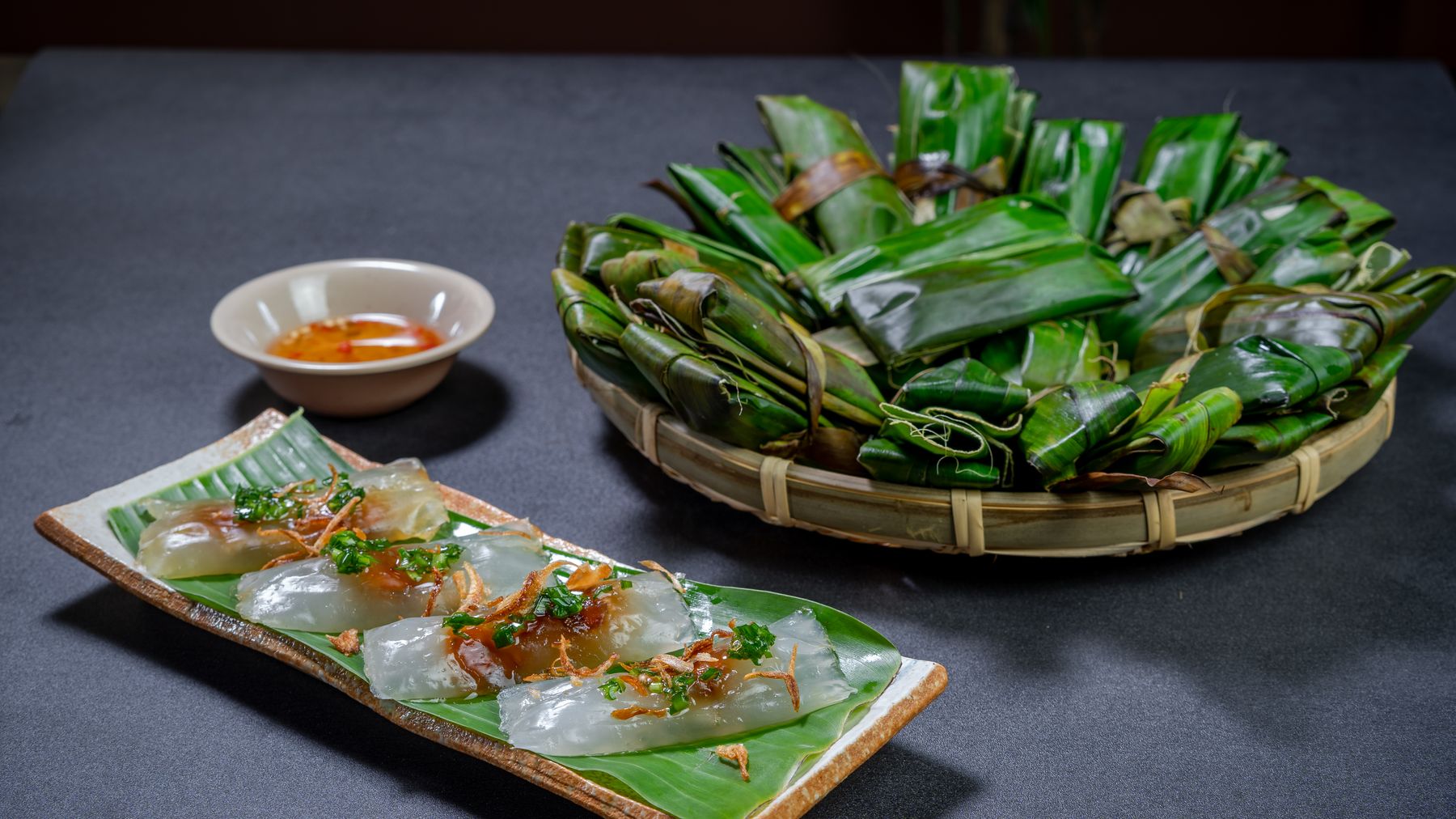
Photo by Hải Nguyễn on Pexels
Practical Notes
Street carts are cash only, small bills preferred — have 20,000 VND notes ready. Sit-down shops are also cash only in most cases. If a cart has a line, join it; turnover is fast and a queue usually means the dough is fresh off the steamer, not sitting.
Last updated · May 26, 2026 · independently researched, never sponsored.