Twelve thousand dong used to buy you a full plate. It still won't cost you much more than 25,000–35,000 VND today, and "bot chien" — pan-fried rice-flour cubes tossed with egg, spring onion, and a glossy puddle of soy and chili sauce — remains one of the most satisfying things you can eat off a plastic stool in Saigon at 10 p.m.
What Bot Chien Actually Is
At its simplest, bot chien is a block of steamed rice-flour cake (the same base dough used in "banh cuon") that has been cut into rough cubes, fried hard on a flat iron pan with lard or oil until the exterior crisps and browns, then cracked with one or two eggs and tossed until the egg sets in torn, lacey sheets around the cubes. Green onion goes in last. The whole thing lands on a plate with a small dish of soy sauce sharpened with fresh chili and sometimes a splash of vinegar.
That's the canonical version. There is not much to it, which is precisely why execution matters — pan temperature, the ratio of crust to soft interior, how much egg, how dark the soy.
Where It Comes From
Bot chien traces its lineage directly to the Chinese-Vietnamese Teochew community that settled Cholon — Saigon (사이공 / 西贡 / サイゴン)'s historic Chinatown district — in the 18th and 19th centuries. The dish is a close cousin of the Teochew and Hokkien preparation known in Mandarin as cai tou kueh (chai tow kway in Singapore and Malaysia, or "carrot cake" in Southeast Asian hawker shorthand, though no carrot is involved).
The Teochew version traditionally uses white radish mixed into the flour base. The Saigon adaptation stripped out the radish, made the cake denser and chewier, and leaned harder into the caramelisation on the pan. Over generations it moved out of Cholon's shophouse kitchens and onto pushcarts, eventually becoming the default cheap snack of Saigon's student population — the kind of thing you eat after a late class or before a long night of "bia hoi".
It never really spread north in any serious way. You'll find scattered versions in Da Nang and Hanoi, but they're outliers. Bot chien is functionally a southern dish, and most specifically a Saigon dish.
The Dough: What Makes or Breaks It
The cake block is made from a blend of rice flour and tapioca starch — the tapioca is what gives it that characteristic chew inside even after the outside has crisped. The mixture is steamed in trays, cooled, then cut. Good vendors make their own blocks fresh every day. Inferior versions use pre-made blocks that have sat too long and turn gummy when fried rather than developing a crust.
You can spot a conscientious vendor by the pan: it should be screaming hot, ideally a well-seasoned cast-iron or carbon-steel flat griddle, and the cubes should sizzle loudly and immediately when they hit the surface. If the pan is tepid and the cubes sit there steaming rather than frying, the result will be soft and oily throughout — edible but not the dish at its best.

Photo by Kim Villanueva on Pexels
Variants Worth Knowing
Bot Chien Do (Red Bot Chien)
The most common variation you'll see on Saigon menus. Soy-based sauce is added directly into the pan while the egg is still setting, giving the finished plate a reddish-brown colour and a slightly sweeter, stickier glaze. It's more forgiving for vendors because the sauce masks uneven browning, but a well-executed version has a deeply savoury crust that straight bot chien can't match.
Bot Chien Trung Vit Lon
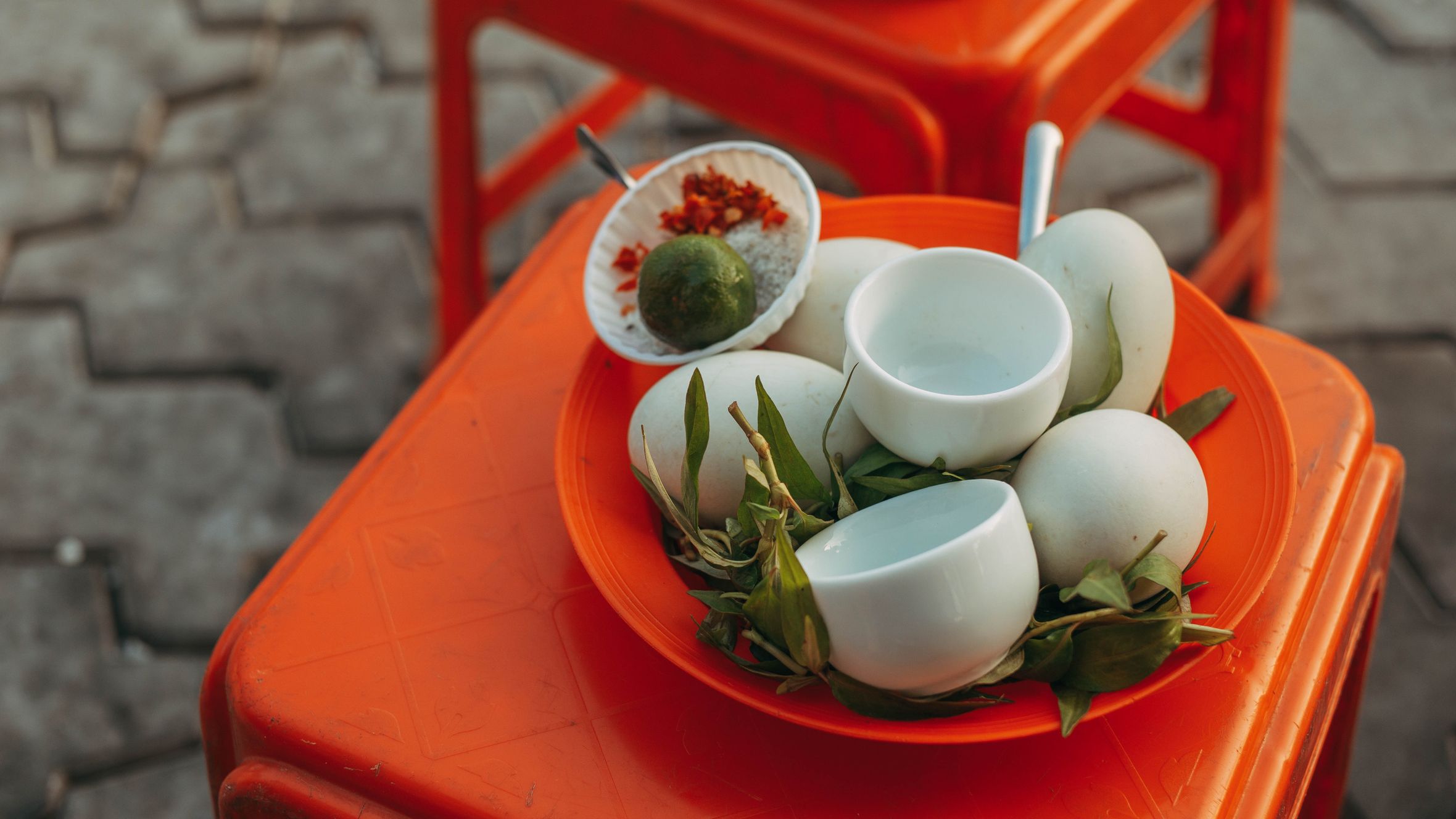
Some stalls, particularly in Districts 4 and 8, will offer the option of topping the plate with a "trung vit lon" — a fertilised duck egg — cracked and fried alongside the rice cubes. The yolk and partial albumen add richness that makes the dish substantially more filling. Not for everyone, but a genuinely good combination if you're already comfortable with the ingredient.
Bot Chien Chay
Vegetarian-friendly by default — the basic dough contains no meat — though you should confirm the cooking fat isn't lard. Many Saigon stalls near pagodas or in District 3 offer explicit chay (vegetarian) preparation, using vegetable oil and a lighter soy.
How to Order
Bot chien vendors typically operate in the evening, from around 4 p.m. into the early morning hours. Walk up, find a stool, and the process is almost always the same:
- State how many eggs you want ("mot trung" = one egg, "hai trung" = two). Two is standard for a full portion.
- Specify do or regular if the stall offers both.
- The sauce dish comes automatically. If you want more chili, ask: "them ot".
- A single portion runs 25,000–35,000 VND in Saigon. Anything above 40,000 VND is tourist-adjacent pricing.
Eat it immediately. Bot chien does not survive sitting — the crust softens within minutes.

Photo by Sokat Rachman on Pexels
Where to Try the Canonical Version
Bot Chien Co Lan — District 5, Saigon. The stall most cited by locals as the reference point. Located near the Nguyen Trai and Tran Hung Dao intersection in Cholon, which is appropriate given the dish's roots in the neighbourhood. Been operating for decades. The cubes are made in-house and the crust-to-soft ratio is nearly perfect.
Bot Chien Thien Huong — Ba Thang Hai Street, District 10, Saigon. A more accessible location if you're not heading to Cholon. Slightly larger portions, the bot chien do here is particularly good — the glaze has depth without being cloying.
Quan Bot Chien 63 — Da Nang (다낭 / 岘港 / ダナン). If you're passing through Da Nang rather than Saigon, this small shop on Le Duan Street is the most consistently recommended spot in the city. The preparation is a shade closer to the Saigon style than most central-region attempts, and it's open until midnight most nights.
Practical Notes
Bot chien is almost exclusively a street or open-air shophouse food — you won't find it in hotel restaurants or sit-down Vietnamese dining rooms. Night markets and student-dense neighbourhoods (District 3, 5, 10 in Saigon) are your best hunting grounds. If you're building a Saigon food night around it, a plate of bot chien pairs well before or after a bowl of "hu tieu" from a nearby cart — both are cheap, filling, and very much of the city.
Last updated · May 26, 2026 · independently researched, never sponsored.