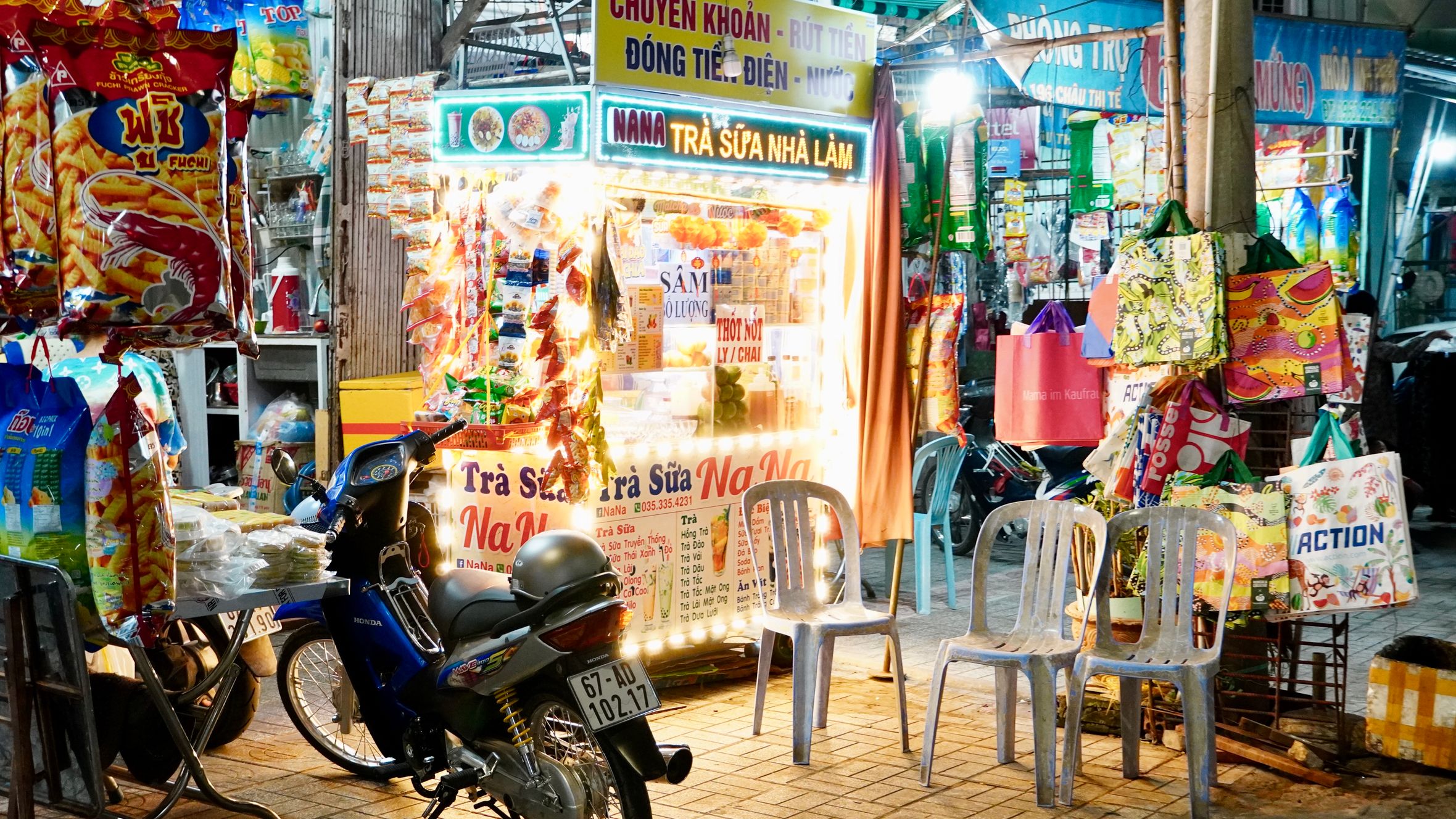
Can Tho's floating markets get the photos, but the food that locals actually eat happens in places that don't have a sign, let alone a Google listing. If you're willing to point, smile, and sit on a plastic stool at 7am, you'll eat better than anyone with a reservation.
Why the Best Stalls Have No Reviews
Most of Can Tho (껀터 / 芹苴 / カントー)'s street food economy runs on neighborhood loyalty. A woman who sets up her cart at the corner of Hai Ba Trung and Nguyen Trai every morning doesn't need TripAdvisor — her regulars have been coming for fifteen years. These cooks aren't hiding; they're just not performing for cameras. The absence of an online presence is usually a signal that the food is priced and seasoned for the people who live there, not tourists passing through.
Expect to pay 20,000–40,000 VND for most bowls. Cash only, always.
Where to Look
The Alleys Off Ninh Kieu Riverside
The waterfront promenade around Ninh Kieu Wharf is tourist-facing. Walk one block inland and the density of no-name cooks increases immediately. The alleys threading west off Hai Ba Trung between roughly the 200 and 400 blocks are worth a slow morning walk. Look for a pot, a folding table, and a handwritten menu taped to the wall — or no menu at all.
This is where you'll find "hu tieu" done the Southern way: clear pork broth, thin rice noodles, a few slices of pork and shrimp, a pile of raw bean sprouts and herbs on the side. It's lighter than the version you get in Saigon and closer to the Khmer-influenced style that's native to the Mekong Delta (메콩 델타 / 湄公河三角洲 / メコンデルタ). A bowl runs about 25,000 VND. Nobody will speak English and that's fine — point at what the person next to you is eating.
Xuan Khanh Market's Back Rows
Xuan Khanh Market (cho Xuan Khanh) sits about 3 km from the city center along 3 Thang 2 Street. The front stalls sell produce and dry goods. The back rows — past the butcher section — are where a handful of women cook to order from around 5:30am until they sell out, usually by 9am.
The thing to find here is "banh canh", the thick, slightly chewy noodle soup that doesn't get nearly enough attention. In Can Tho the broth is often made from pork trotters and crab, and it's richer and more unctuous than what you find further north. Point at the pot of thick noodles and hold up fingers for the number of bowls. Accompaniments — fresh chilies, a wedge of lime, Vietnamese basil — arrive automatically.
Also watch for "bun rieu" at the market edges: a tomato-and-crab-paste broth with thin rice vermicelli that's deeply savory in a way that's hard to explain until you've had a bowl. 30,000 VND is a fair price; if they quote you more, they know you're a visitor.
The Early-Morning Cart Circuit on Co Bac Street
Co Bac Street near the intersection with Ly Tu Trong hosts a loose rotation of push-cart vendors from about 6am. The offerings shift by day and by season, but you can reliably find "banh mi" here — not the tourist-banh-mi of Hoi An, but the Delta version: a smaller, crispier baguette with pate, cold cuts, pickled daikon, and a hit of Maggi sauce. 15,000–20,000 VND.
Earlier in the morning (before 7am), look for a vendor selling "banh cuon" — steamed rice rolls filled with minced pork and wood-ear mushroom, served with a dish of nuoc cham and fried shallots scattered on top. This is breakfast food in the true sense: delicate, light, gone by 8am.

Photo by Tuan Vy on Pexels
How to Navigate When There's No Menu
A few practical habits that make ordering easier in these spots:
Watch before you sit. Spend thirty seconds observing what's being served. If everyone has the same bowl, that's the dish. Sit down and point at it.
Learn two phrases. "Cho toi mot to" (give me one bowl) and "Bao nhieu?" (how much?) will get you most of the way there. Numbers you'll hear: "hai muoi" (20,000), "ba muoi" (30,000), "bon muoi" (40,000).
Don't over-order on arrival. Some stalls run out of specific components — the crab paste, the pork trotters, the fried shallots — early. If something isn't available, the cook will tell you with a wave of the hand. Flexibility is part of the deal.
Arrive hungry and early. Almost every stall worth finding is sold out by 10am. 6:30–8am is the window. If you're staying near Ninh Kieu, you can walk to three or four spots in a single morning without planning anything.

Photo by Nguyen Huy on Pexels
What to Expect
Not every stall will be memorable. That's part of eating this way — you'll have two extraordinary bowls and one that's just fine. The point isn't a curated tasting experience; it's eating the way Can Tho actually eats. You're sharing a table with people on their way to work, paying local prices, and getting food that hasn't been adjusted for outside palates.
Can Tho is a livable, mid-sized city — not a backpacker hub — which means these corners stay intact longer than in cities with heavier tourist pressure. The cook who's been at that alley corner since 1998 probably isn't going anywhere soon.
Practical Notes
Bring small bills (5,000 and 10,000 VND notes alongside 20,000s) — exact change is appreciated. Most of these stalls operate entirely in cash. A motorbike taxi or xe om can shuttle you between market areas for 20,000–30,000 VND if the distances feel long in the heat.
Last updated · May 29, 2026 · independently researched, never sponsored.







