What it is
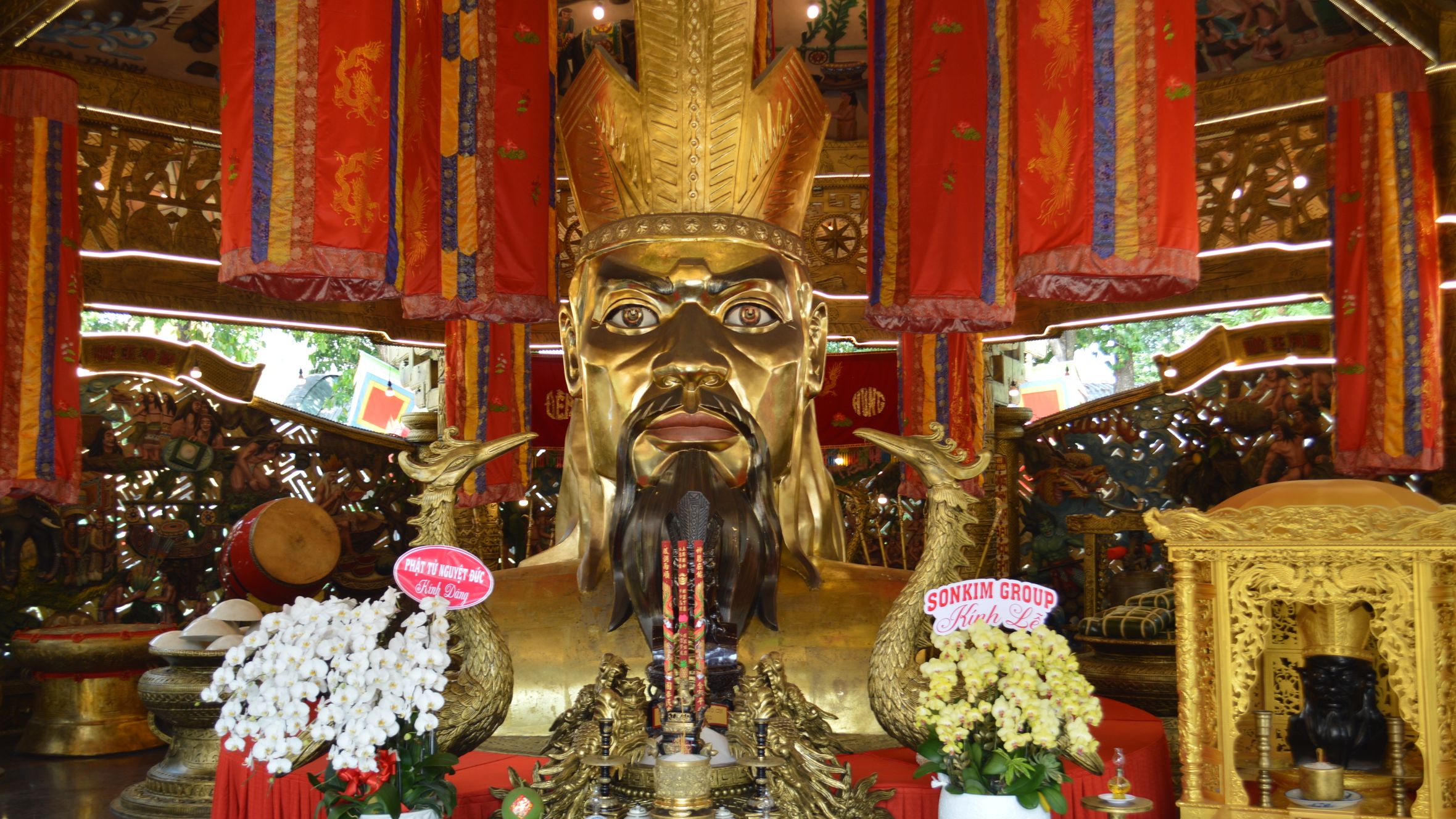
Chua Thien Vuong Co Sat — often called the Chinese Pagoda by English-speaking visitors — sits on a pine-covered hill about 5 km southeast of Da Lat's city center. Built in 1958 by the local Cantonese Buddhist congregation, it's one of a trio of Chinese-origin temples in the area (the others being Linh Son and Linh Phuoc). The name translates roughly to "Heavenly King Ancient Temple," and the complex blends Southern Chinese and Vietnamese Buddhist architecture in a way that feels distinctly different from most pagodas you'll visit elsewhere in the country.
The main draw is three sandalwood Buddha statues, each standing about 4 meters tall and weighing around 1,500 kg. They were shipped from Hong Kong in the early 1960s and remain among the largest single-wood Buddhist carvings in Vietnam (베트남 / 越南 / ベトナム). The temple grounds are compact — you can see everything in 45 minutes — but the hilltop setting among Da Lat's signature pine trees makes it worth more than a quick photo stop.
Why travelers go
Da Lat (달랏 / 大叻 / ダラット) has no shortage of pagodas, but Chua Thien Vuong Co Sat earns its visits for a few specific reasons. The sandalwood statues are genuinely impressive up close — the craftsmanship and scale are hard to appreciate from photos. The temple sits at roughly 1,500 meters elevation, surrounded by mature pine forest, so even on warm days the air is cool and the grounds are quiet outside of Tet and major holiday weekends.
It's also a functional temple, not a museum. Monks live on-site, incense burns daily, and you'll see local Vietnamese families making offerings on lunar calendar dates. If you've mostly visited the more tourist-oriented sites around Da Lat — the cable car, Crazy House, the flower gardens — this is a welcome change of pace.
Best time to visit
Da Lat's dry season runs roughly from December through March, and that's the most comfortable window. Mornings are cool (12-18°C), skies are usually clear, and the temple grounds stay dry underfoot. The 150-odd steps up to the main hall can get slippery during the rainy season (May through October), so if you're visiting in those months, go in the morning before afternoon downpours roll in.
Avoid the days immediately around Tet / 越南春节 / テト) and the 15th of the lunar month if you want a quieter experience — the temple gets genuinely crowded with worshippers. Weekday mornings year-round are reliably calm.
How to get there from Da Lat center
The temple is on Khe Sanh street (the road that runs south toward the Tuyen Lam Lake area), about 5 km from Da Lat Market.
- Motorbike or scooter: 15 minutes from the center. Rentals run 120,000-150,000 VND/day for a semi-auto. Parking at the base of the temple steps costs 5,000 VND.
- Grab/taxi: 40,000-60,000 VND one way. Ask the driver to wait or arrange a return — Grabs can be slow to arrive in this area.
- Organized tour: Most "Da Lat city tour" packages (300,000-400,000 VND/person) include this as a stop, but you'll get 20-30 minutes max. Not ideal if you want to actually sit and take in the place.
The road is paved and in good shape. No off-roading required.

Photo by Nghĩa Văn on Pexels
What to do
Walk the full staircase
The approach from the parking area leads up a long flight of stone steps flanked by pine trees and dragon-motif balustrades. Don't skip it by cutting around the side — the climb is part of the experience, and the gradual reveal of the temple complex above is well worth the five minutes of effort.
See the three sandalwood Buddhas
The main hall houses statues of Amitabha Buddha, Sakyamuni Buddha, and the Bodhisattva of Universal Virtue. Stand close enough to notice the grain of the sandalwood — each statue was carved from a single piece of wood. The hall is dim and incense-heavy, which adds to the atmosphere but makes photography tricky. Leave the flash off.
Explore the side halls and courtyard
The temple has secondary halls dedicated to Quan Am (Avalokiteshvara) and various guardian figures. The courtyard between buildings has well-maintained bonsai and a bell tower. The bell dates from the original 1958 construction.
Sit in the pine grove
Behind the main hall, benches sit under the pine canopy. This is one of the more peaceful spots in Da Lat, and a good place to just stop for 15 minutes if you've been doing the tourist-site circuit all morning.
Check the ceramic mural wall
On the lower terrace, there's a long mosaic-style wall depicting Buddhist scenes. It's easy to walk right past it on the way up the stairs — look to your left as you begin the ascent.
Where to eat nearby
The temple area itself has a few vendors selling corn on the cob, "banh trang nuong" (Da Lat-style grilled rice paper — basically a Vietnamese pizza), and hot soy milk. For a proper meal, head back toward the center.
- "Banh canh" with sweet potato noodles is a Da Lat specialty. Try the stalls along Nha Chung street, about 3 km back toward town. Bowls run 35,000-45,000 VND.
- Da Lat's version of "banh mi" — with local pate and pickled vegetables — is solid at the Banh Mi Phuong Trang cart near the market area.
Da Lat is also one of the best cities in Vietnam for vietnamese coffee, and the streets around the market have dozens of small cafes serving it with condensed milk or as a cold drip.
Where to stay
Most travelers base themselves in central Da Lat rather than near the temple. Options by budget:
- Budget (200,000-400,000 VND/night): Hostels and guesthouses around the market area. Dorm beds available for under 200,000 VND.
- Mid-range (600,000-1,200,000 VND/night): Mini-hotels on Phan Dinh Phung and Bui Thi Xuan streets. Clean rooms, hot water, usually includes breakfast.
- Upper (1,500,000+ VND/night): Boutique places around Tuyen Lam Lake or the hillside villas toward the southwest. Better views, quieter, but you'll need your own transport.

Photo by Huy Phan on Pexels
Practical tips locals would tell you
- Dress modestly. Shoulders and knees covered — this is an active place of worship. The monks won't turn you away in shorts, but you'll get looks.
- Bring small bills. The donation box at the main altar is where you contribute if you'd like to. There's no entrance fee, but leaving 20,000-50,000 VND is a respectful gesture.
- Combine it with nearby stops. The Elephant Waterfall (Thac Voi) and the Linh Phuoc Pagoda (the "bottle pagoda" in Trai Mat) are both on the southern side of Da Lat and can be hit in the same half-day.
- Go early. The grounds are most atmospheric before 9 AM, when the incense is freshly lit and tour buses haven't arrived yet.
Common mistakes to avoid
- Rushing through on a tour bus. Twenty minutes isn't enough. Budget at least 45 minutes to an hour.
- Skipping it because "it's just another pagoda." The Chinese-origin architecture and the sandalwood statues make this different from the typical Vietnamese Buddhist temple.
- Wearing shoes into the main hall. There's a shoe rack at the entrance — use it.
- Visiting only on weekends. Weekend crowds, especially during Vietnamese school holidays, fill the staircases and make the main hall feel cramped.
Practical notes
Chua Thien Vuong Co Sat is open daily, roughly 7 AM to 5 PM. No ticket required. The temple is easy to combine with a morning in southern Da Lat before heading back to town for lunch.
Last updated · May 29, 2026 · independently researched, never sponsored.








