
Sticky rice cooked inside freshly cut bamboo tubes, roasted over a wood fire until the outside chars and the inside smells faintly of smoke and green bamboo — "com lam" is one of those foods that sounds simple until you eat a bad version and realize how much can go wrong. In Sapa, where H'Mong and Tay vendors have been making it for generations, the good versions are genuinely excellent. Here's where to spend your money.
What Makes Sapa's Com Lam Different
The sticky rice used here is typically "gao nep nuong" — a short-grain glutinous variety grown in the terraced paddies below town, around Muong Hoa valley. It has more natural sweetness than lowland nep and holds its shape inside the bamboo without going gluey. Vendors soak the rice overnight, stuff it into young bamboo sections with a splash of coconut milk (some skip the coconut; traditionalists argue either way), then prop the tubes over charcoal or wood embers for 45 minutes to an hour. The bamboo chars but doesn't burn through. You split it open at the table and peel back the inner membrane — a thin, papery layer that comes away cleanly when done right. Eat it with "muoi vung" (sesame salt), "thit nuong" (grilled pork skewers), or a fried egg if you're at a full breakfast spot.
The Address Book
Ba Huong Com Lam — Cau May Street
This is the stall most locals point you toward first, and for good reason. Ba Huong has been set up on Cau May, near the bottom end closest to the market, for over a decade. She uses rice from her own family's plot in Lao Chai and wood fire exclusively — no charcoal shortcuts. One tube costs 15,000–18,000 VND. She's usually out by noon. Open roughly 6:30 am to 12:00 pm. Order two tubes minimum; one is never enough.
Cho Sapa (Sapa Market) — Ground Floor, North Corner
The covered market on Fansipan Road has three or four com lam vendors clustered in the northwest corner of the ground floor. The stall run by a Tay woman in a blue apron (no English signage — look for the bamboo tubes propped over a low brazier) consistently produces the smokiest version in town. She seasons her muoi vung more aggressively than most, with a higher ratio of salt to sesame. Price: 12,000–15,000 VND per tube. Open daily 7:00 am to 2:00 pm. Busiest, and freshest, before 10:00 am.
Quan Com Lam Xanh — Thach Son Street
A small sit-down spot rather than a pure street stall. Com Lam Xanh does a proper set meal: two tubes of com lam, two pork skewers, a bowl of "canh rau" (vegetable broth), and pickled vegetables for around 55,000–65,000 VND per person. The bamboo tubes here are slightly thinner than market-style, which means a shorter cook time and occasionally a less developed smoky flavor — but the pork is well-marinated and the whole package is good value. Open 10:00 am to 8:00 pm. Good option if you want to sit down after a morning trek.
H'Mong Village Stalls — Ta Van Road, Km 7–9
If you're walking or motorbike-riding down toward Ta Van village, you'll pass several H'Mong roadside setups selling com lam directly from the fire, often alongside grilled corn and sweet potato. These are the least polished operations — plastic stools, no menus, occasional language barrier — but the rice quality here is exceptional because you're closer to where it's actually grown. Prices drop to 10,000–12,000 VND per tube. No fixed hours; most active between 8:00 am and 1:00 pm on weekdays. Bring small bills.
Bep Sapa Restaurant — Ham Rong Street
Bep Sapa is a mid-range restaurant that does a respectable tourist-friendly version of com lam as part of a broader northern Vietnam (베트남 / 越南 / ベトナム) menu. The bamboo tubes are properly charred and the coconut milk is detectable. It's not the most authentic setup — you're eating in a warm room with a printed menu and an English-speaking server — but it's reliable, clean, and priced fairly at 20,000 VND per tube or 80,000–120,000 VND for a full set with grilled meats. Open 8:00 am to 9:00 pm daily. Good fallback in the rain.
Skip This Place: The Stalls on the Main Walking Street (Hoang Lien / Tourist Strip)
The stretch of bamboo-tube vendors set up along the tourist pedestrian strip near the main square deserves a direct warning. The rice is often pre-cooked and reheated inside the bamboo rather than cooked fresh over fire — you can tell because the bamboo exterior barely chars and the rice inside has a slightly dried-out texture. At 20,000–25,000 VND per tube, they're charging more than the market stalls for a noticeably worse product. The vendors here work high foot-traffic and know most buyers won't return. Walk five minutes downhill to Cau May or the market instead.

Photo by Chuot Anhls on Pexels
How to Eat It
Hold the tube upright, split the bamboo lengthwise with the knife provided (or ask the vendor to do it), and peel the membrane back from the top. The rice should come out as a compact cylinder — slightly sticky on the outside from the bamboo sugars, fluffy in the center. Dip into muoi vung, tear off a piece of grilled pork, eat with your hands. It's a breakfast food by tradition but nobody will look at you strangely for eating it at 3:00 pm after coming off a trail.
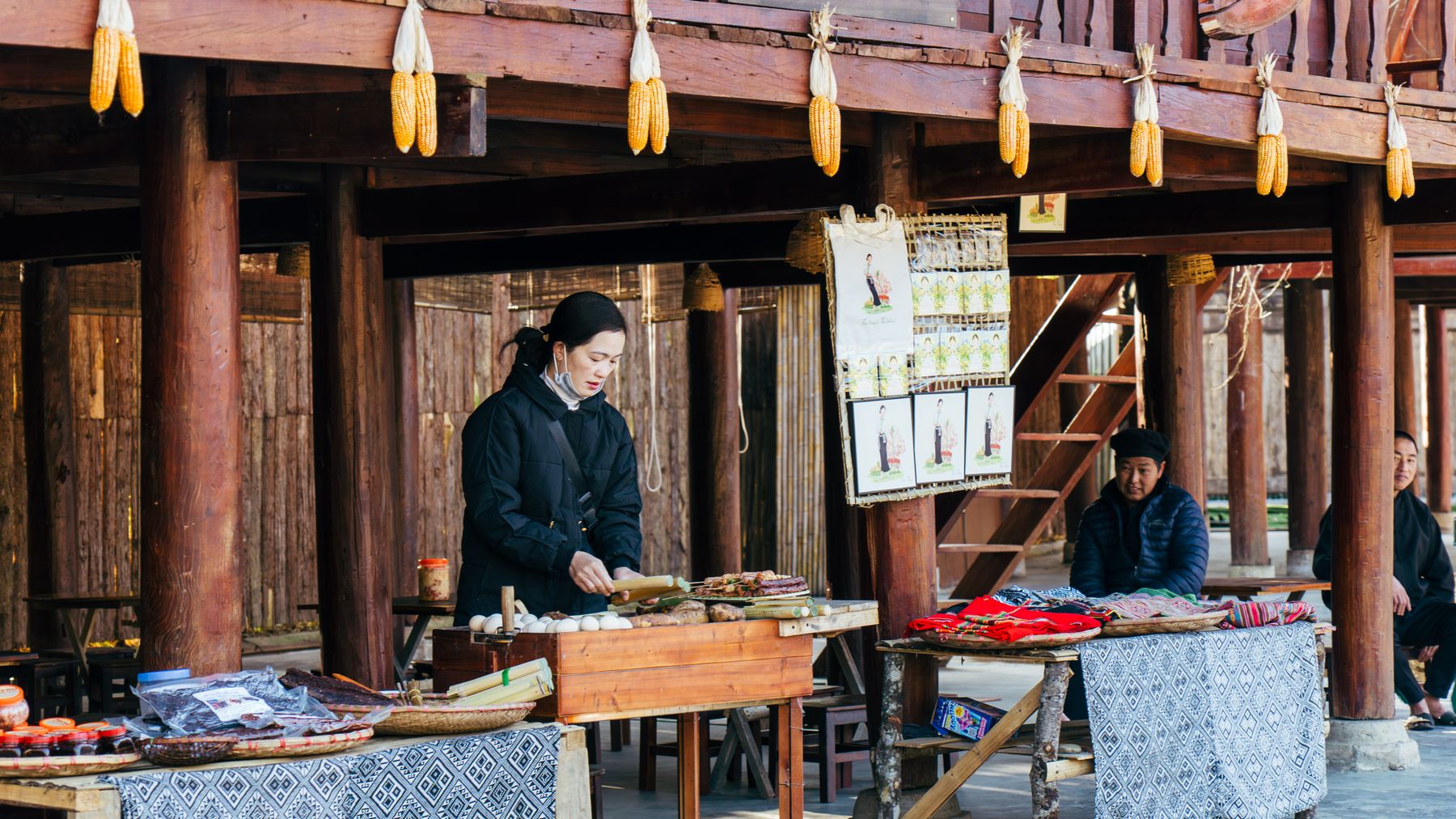
Photo by Gibson Chan on Pexels
Practical Notes
Com lam is a morning-to-early-afternoon food across the board — most vendors are sold out or winding down by 1:00 pm, and the market stalls close earlier than that. If Sapa is a stop on a longer northern loop through Ha Giang or Ninh Binh (닌빈 / 宁平 / ニンビン), budget a morning specifically for market eating rather than trying to squeeze it in around afternoon treks. Prices listed here reflect 2024 rates and may shift slightly by season or vendor.
Last updated · May 26, 2026 · independently researched, never sponsored.



