If you eat one thing in Saigon and you're not sure what to pick, order "com tam". It's cheap, filling, endlessly customizable, and eaten by everyone from construction workers to office managers — sometimes at the same plastic table on the same sidewalk.
What Broken Rice Actually Is
The name is literal. "Com" means rice; "tam" means broken, or fractured. Before industrial milling was precise, grains would crack during processing. Those fragments — shorter, slightly irregular — were separated from the whole grains and sold at a discount. Whole-grain rice went to wealthier households. Broken rice went to everyone else.
What nobody anticipated was that broken rice, when cooked, has a slightly different texture than whole-grain. It's softer, a bit stickier, and absorbs sauce differently. Once you've eaten com tam (껌땀 / 碎米饭 / コムタム) long enough, switching back to regular com trang for this kind of plate meal feels like a downgrade. The texture just works better with the fat from grilled pork and the salt-sweet punch of nuoc cham.
Where It Came From
Com tam is a Saigon (사이공 / 西贡 / サイゴン) dish. Its roots are working-class southern Vietnamese — specifically the laborers, rickshaw drivers, and market porters of Cho Lon and the old 3rd and 5th districts in the early 20th century. Street vendors would set up before dawn with charcoal grills and pots of fish sauce, catering to workers who needed a hot meal fast and couldn't afford much.
The dish spread outward from those neighborhoods through the mid-century, and by the 1970s and 1980s it was fully embedded in Saigon's food identity. Today you'll find com tam shops across Vietnam, including in Hanoi, but the version you get in the south — especially in Saigon — is different in character. Richer, heavier on the protein, more generous with the sauce.
The Canonical Trio: Suon, Bi, Cha
A full com tam plate is built around three core components, and understanding them makes ordering much easier.
"Suon nuong" is the grilled pork chop. This is the centerpiece. A good suon nuong is marinated in lemongrass, fish sauce, sugar, and garlic, then grilled over charcoal until the edges char slightly and the surface caramelizes. It should have a visible crust and still be juicy in the middle. Thin-cut chops are traditional — thick steakhouse-style cuts are a modern restaurant affectation. If the suon nuong is pale and steamed-looking, go elsewhere.
"Bi" is shredded pork skin mixed with finely ground roasted rice powder. The texture is unlike anything else in Vietnamese cooking — slightly chewy, dry at first, then rich once the dressing hits it. Bi is polarizing for first-timers but becomes addictive. It's typically piled in a small mound beside the suon.
"Cha" in this context refers to "cha trung", a steamed egg meatloaf made from ground pork and egg, set in a small ramekin and steamed until firm. It's mild, custardy in the center, and acts as a flavor counterpoint to the more aggressive suon and bi. Some shops call it "cha trung hap" to distinguish it from other cha varieties.
A standard plate — com tam suon bi cha — runs 35,000 to 55,000 VND at a street shop, around 70,000 to 90,000 VND at a sit-down restaurant.
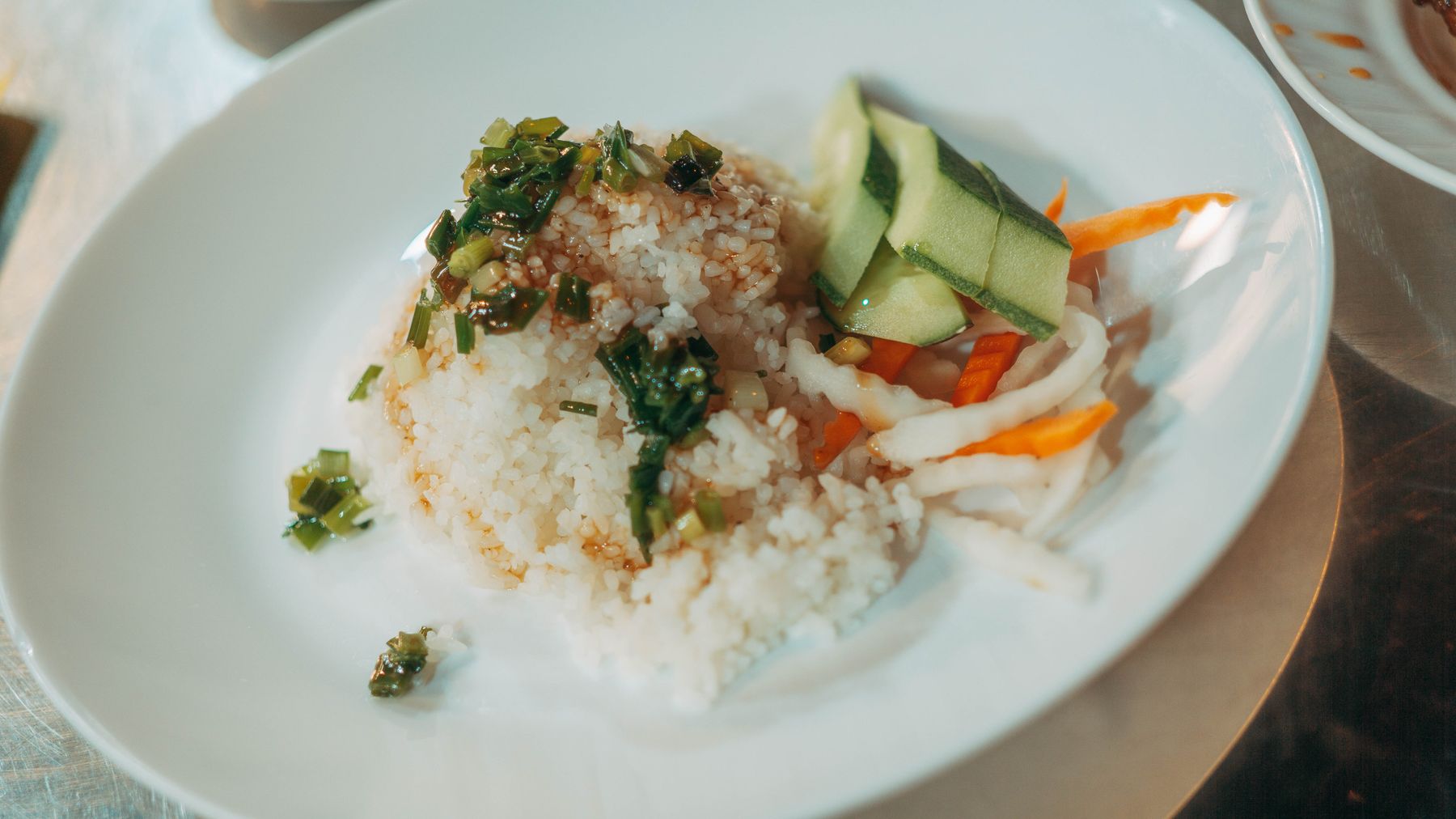
Photo by FOX ^.ᆽ.^= ∫ on Pexels
The Fish Sauce Drizzle
The nuoc cham that comes with com tam is not the same light dipping sauce you get with goi cuon or cha gio. It's darker, sweeter, and more concentrated — heavier on the fish sauce and sugar, often with a deeper caramel note. Some shops add a small amount of coconut water to the mix.
The technique matters. You pour a modest amount directly over the rice, not over the meat. The broken rice soaks it up fast. The goal is for every spoonful of rice to carry flavor without drowning the plate. Pour too much and it pools and goes cold and thin. Pour in stages as you eat.
The garnish plate — sliced cucumber, pickled daikon and carrot, a wedge of tomato — is there to cut through the richness. Don't ignore it.
How to Order
At a street com tam shop, you typically tell the vendor what you want on the plate. "Com tam suon bi cha" gets you the full trio. If you want to simplify: "com tam suon" (just the pork chop) or "com tam suon cha" (skip the bi). Most shops will ask if you want a fried egg added — "them trung op la" — which is worth saying yes to for an extra 5,000 to 8,000 VND.
You'll also see com tam with "ca kho to" (caramelized fish in clay pot) or "ga nuong" (grilled chicken) on some menus. These are legitimate variations, but if it's your first time, go with the pork chop trio.

Photo by Matheus Bertelli on Pexels
Where to Try It
Saigon — Com Tam Thuan Kieu (District 5)
This is the old-neighborhood version. District 5 is where com tam's working-class roots are most visible. Thuan Kieu and surrounding streets have shops that have been running the same setup for decades: charcoal grill, short plastic stools, no English menu. Get there before 8am or after 6pm for the best suon nuong.
Saigon — Com Tam Ba Ghien (Binh Thanh District)
Probably the most discussed com tam institution in the city. Three locations, perpetually busy, often cited as the benchmark for suon nuong quality. Expect to share a table. The bi here is particularly good.
Da Lat — Com Tam Phuong (Nguyen Cong Tru Street)
Com tam in the highlands feels slightly different — the cooler air, the heavier appetite. Phuong is a local institution on Nguyen Cong Tru, a short walk from the central market. The cha trung here is exceptional, and portions are larger than the Saigon equivalent.
Practical Notes
Com tam shops open early and often close by mid-afternoon — many run out of suon nuong by 10am on weekends. If you're eating at a street stall, the plastic bag of nuoc cham on the table is communal; use the spoon provided. Eat it hot: the dish deteriorates fast once the rice cools.
Last updated · May 29, 2026 · independently researched, never sponsored.