"Goi cuon" is Vietnam's most flexible dish. The basic idea — fresh ingredients wrapped in soft rice paper, dipped in sauce — stays constant from Hanoi to the Mekong Delta (메콩 델타 / 湄公河三角洲 / メコンデルタ). Everything else is negotiable.
In the south, where the dish originated, you'll find shrimp and pork belly with lettuce, basil, and perilla, wrapped in paper-thin "banh trang". The dipping sauce is usually "tuong" (fermented soybean paste) mixed with crushed roasted peanuts and fried shallots. Move north and the name changes to "nem cuon", the rice paper gets thicker, and the sauce might include a splash of "ruou nep cai" (glutinous rice wine).
There's no master recipe. Goi cuon (고이꾸온 / 越南春卷 / ゴイクオン) is a template, not a fixed dish.
What Goes Inside
The filling breaks down into five categories:
Protein: Boiled pork belly, shrimp (boiled or pan-fried), beef, duck, crab, "cha" (cured pork), "gio lua" (Vietnamese sausage), eggs. Some vendors use pig ear or fish.
Rice paper (banh trang): The thin, soft type that doesn't need soaking. Southern rolls use much thinner paper than central Vietnam versions. The harder, stiffer paper is for "nem ran" (fried spring rolls), not fresh rolls.
Herbs and greens: Lettuce (usually leaf lettuce, not iceberg), Vietnamese coriander ("rau ram"), Thai basil, perilla, dill. The herb mix varies by city.
Vegetables and fruit: Cucumber, green banana, sour star fruit, jicama, pineapple. These add crunch and acidity.
Noodles: Thin vermicelli ("bun") or vermicelli sheets ("bun la"). Some rolls skip noodles entirely.
The Sauce
Two main styles:
-
Tuong (fermented soybean paste): Thinned with water, mixed with crushed peanuts, fried shallots, sometimes a bit of hoisin. Common in the south.
-
"Nuoc cham" (fish sauce dip): Fish sauce, lime juice, sugar, garlic, chili. Some recipes add cornstarch or coconut milk for thickness. In Hanoi, vendors sometimes mix in ruou nep cai.
A third variation uses pickled vegetables — kohlrabi and carrot, salted and blanched, then mixed with garlic, chili, lime, and fish sauce.

Image by Cheong. Original uploader was Cheong Kok Chun at en.wikipedi via Wikimedia Commons (CC BY-SA)
How to Roll
At street stalls and homes, you assemble your own. Lay out the rice paper, add a lettuce leaf, then layer protein, noodles, herbs, and vegetables in the center. Roll it tight, folding in the sides as you go. Some cooks tie the roll with a blanched shallot strand or place a chive lengthwise for flavor and structure.
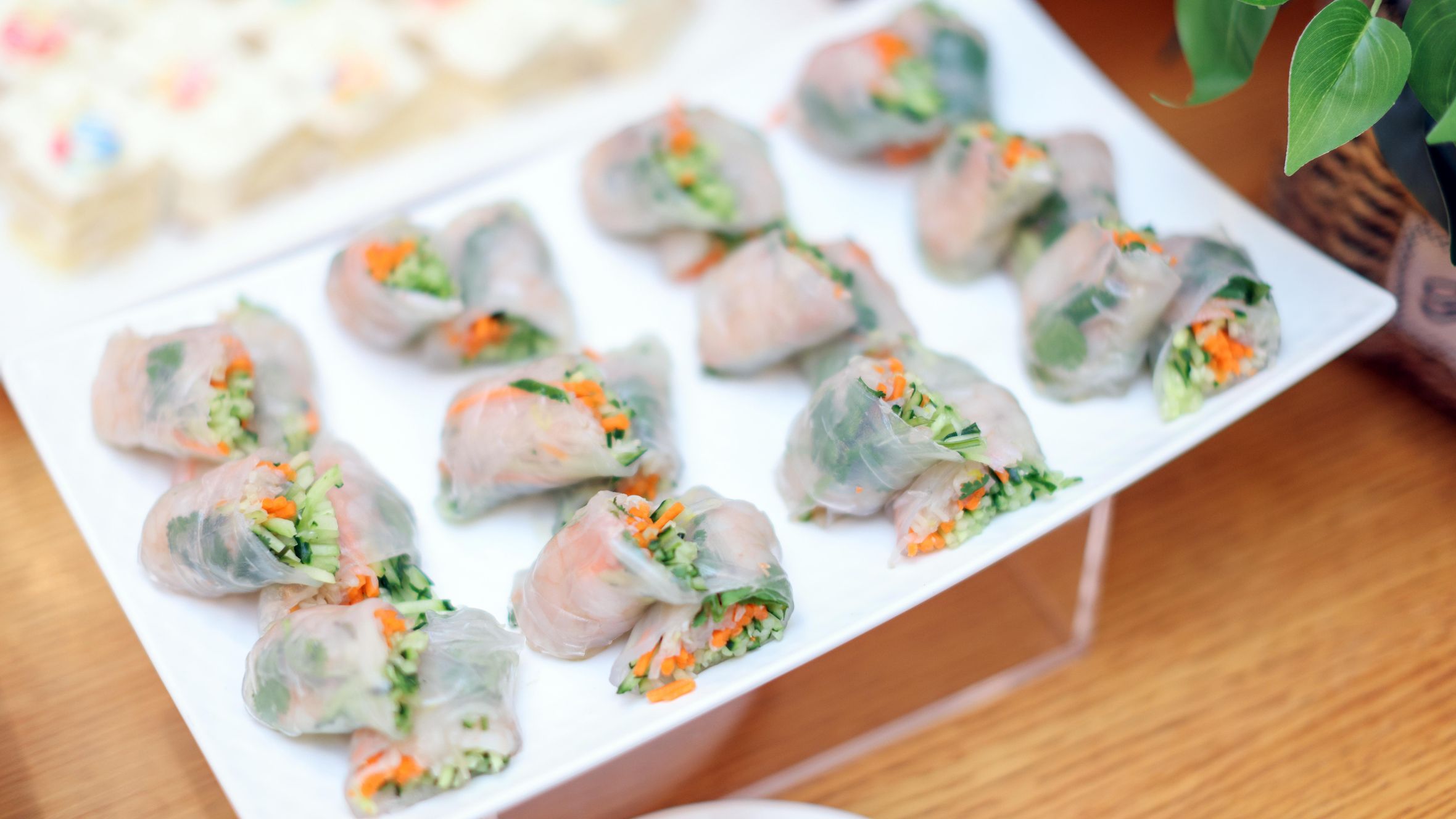
Restaurants and takeaway vendors pre-roll them, often cutting each roll into bite-sized pieces. Foam boxes with skewers let you eat without getting your hands messy.

Image by CEphoto, Uwe Aranas via Wikimedia Commons (CC BY-SA)
Regional Variations
"Thit luoc cuon" (boiled pork rolls): The simplest version. Boiled pork belly or hock, rice paper or fig leaves, dipped in "mam nem" (fermented anchovy sauce) or "mam tom chua" (sour shrimp paste).
"Nem cuon tom thit" (shrimp and pork rolls): The standard Saigon goi cuon. Boiled pork belly, pan-fried shrimp (sliced lengthwise), thin omelet strips, lettuce, vermicelli, herbs. Often includes green banana and sour star fruit. Dipped in tuong or nuoc cham.
"Pho cuon": A Hanoi specialty that first appeared at the corner of Ngu Xa and Nguyen Khac Hieu streets. Fresh pho noodle sheets replace rice paper. The filling is stir-fried beef with garlic and scallions. Dipped in nuoc cham, sometimes with a side of "quay" (fried dough).
"Nem tai" (pig ear rolls): Boiled pig ear, sliced thin, tossed with roasted rice powder, wrapped in rice paper with fig leaves, "la mo tam the" (tri-color piper leaves), "la dinh lang", and "kinh gioi" (Vietnamese balm). The herb mix is specific — this isn't a dish where you improvise.
"Nem chua cuon" (fermented pork rolls): Fried, grilled, or fresh "nem chua" (fermented pork), cut into pieces, wrapped with herbs, dipped in sweet-sour-spicy fish sauce. Several Hanoi shops specialize in this.
"Mon cuon Thuy Nguyen": A Hai Phong specialty. Uses short segments of vermicelli sheets. Blanched shallots soften and tie the roll. Thin omelet strips, crispy pan-fried river shrimp, boiled pork belly, fried tofu, all julienned. The lettuce leaf stays partially open to show the filling. The shallot strand wraps around the outside.
"Bo cuon la cai" (beef in mustard greens): Lightly cooked beef, mustard greens, unripe banana, green star fruit, served with black bean sauce and mustard.
"Ca cuon" (fish rolls): Hanoi's "nem ca" uses marinated, pan-fried fish fillets with mayonnaise, vermicelli, and dill. In the south, grilled snakehead fish ("ca loc nuong trui") wrapped with wild herbs is common. Steamed mackerel with boiled lean pork and fresh ginger is another variation.
"Thit chua cuon": A Thanh Son (Phu Tho) specialty. Sour fermented pork wrapped in rice paper with herbs similar to nem tai.
Where to Start
If you're new to goi cuon, order nem cuon tom thit at any southern street stall or northern banh trang tron shop. It's the baseline version — shrimp, pork, herbs, nuoc cham. Once you understand that template, the regional variations make sense.
The dish is everywhere: street corners, markets, sit-down restaurants, hotel breakfast buffets. Prices range from 5,000–15,000 VND per roll at street stalls, 30,000–60,000 VND for a plate of four at mid-range restaurants.
Goi cuon isn't exotic. It's daily food. That's why it works.
Last updated · May 29, 2026 · independently researched, never sponsored.