The Reunification Express doesn't just connect Hanoi and Saigon — it passes through five distinct culinary regions in roughly 33 hours. The SE3 is the fastest overnight service on this route, departing Hanoi at 19:30 and pulling into Saigon around 04:00 the following night. Book a four-berth soft sleeper (around 800,000–1,100,000 VND depending on season), bring cash in small bills, and treat every station stop as a scheduled meal.
Before You Board — Hanoi Station
Hang Bai and the streets around Ga Ha Noi are worth arriving early for. Grab "bun cha" from one of the lunch spots on Hang Manh before your evening departure — you won't find it south of the 17th parallel in anything close to the same form. The train's onboard dining car exists, but the food is expensive (50,000–80,000 VND for watery instant noodles) and skippable. Stock up at the station minimarkets on bánh mì, fruit, and bottled water instead.
Stop 1 — Vinh (Around 01:30)
Vinh station is a middle-of-the-night stop, roughly six hours south of Hanoi. The SE3 pauses here for about ten minutes. Platform vendors appear regardless of the hour — this is Vietnam (베트남 / 越南 / ベトナム) — and they're selling "cha" (a dense, pork-based sausage specific to Nghe An province) wrapped in banana leaf, grilled corn, and small parcels of sticky rice. Prices run 10,000–20,000 VND per item. Set an alarm. The cha from Vinh has a smokier, drier texture than what you get in Hanoi, and it travels well if you want to snack through the night.
Stop 2 — Hue (Around 07:00–08:00)
This is the most important food stop on the route. The SE3 sits at Hue station for around 20 minutes, which is just enough time to get off, buy something from the vendors crowding the platform, and reboard. Look for women carrying baskets of "banh loc" — small, translucent tapioca dumplings filled with shrimp and pork fat, served with a sweet fish sauce. They cost 5,000–10,000 VND each. You'll also find "bun bo Hue" in styrofoam cups if you want something warm and substantial — the broth here has a lemongrass-and-shrimp-paste depth that the Hanoi (하노이 / 河内 / ハノイ) versions never quite nail.
If your schedule allows a longer stop for two or three nights and rebook), the city rewards it. The food culture here is arguably the most complex in the country, shaped by centuries of imperial court cooking.
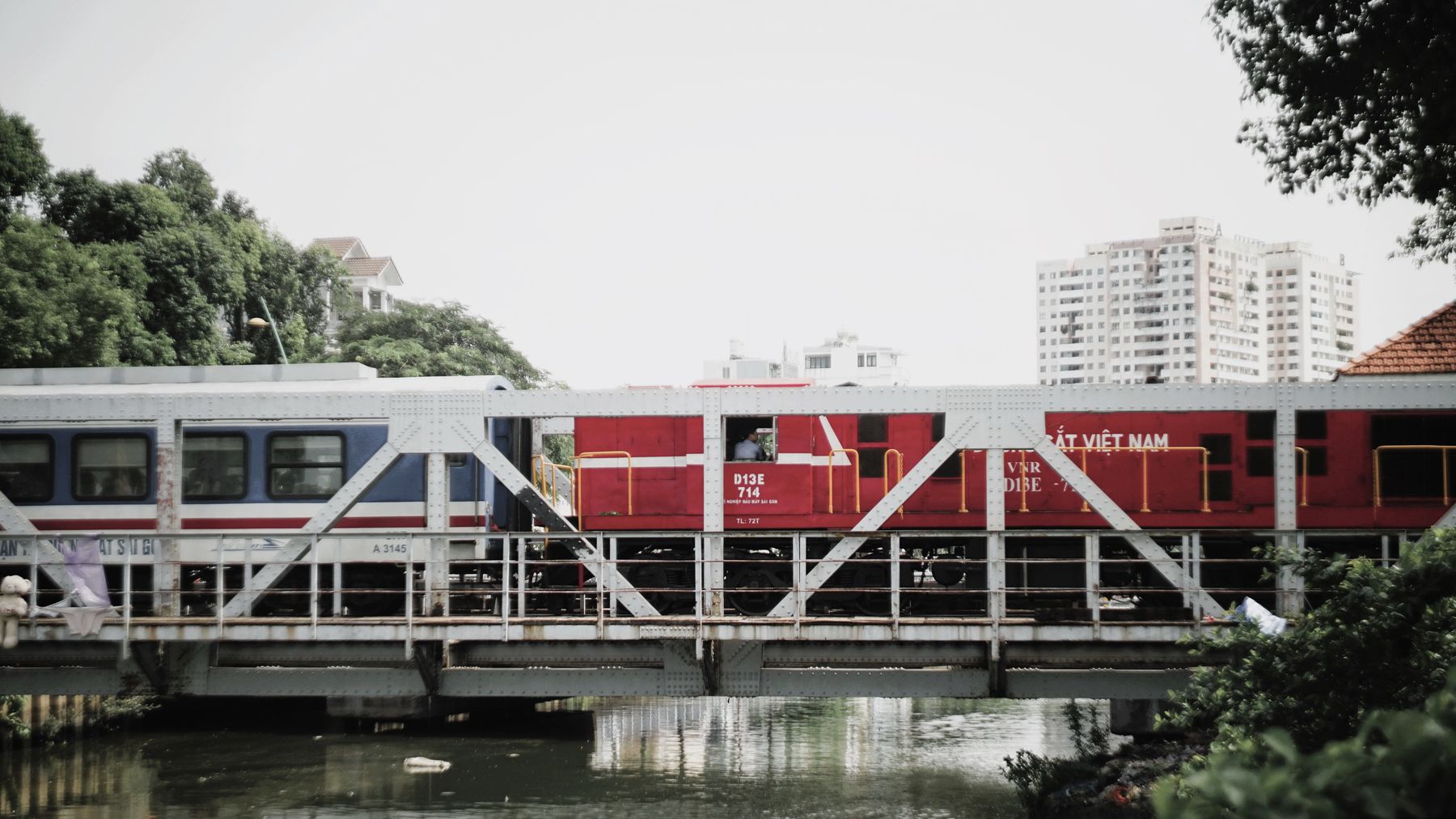
Photo by Edward Cao on Pexels
Stop 3 — Da Nang (Around 10:00–11:00)
Da Nang gets a longer stop, sometimes 15–25 minutes. The station isn't the most exciting food scene on the route, but vendors sell "mi quang" in to-go containers — the turmeric-yellow noodle dish native to Quang Nam province, dressed with pork, shrimp, peanuts, and a small amount of broth (it's almost a dry noodle dish by pho standards). A portion runs 30,000–40,000 VND. There are also cold drinks and fresh fruit if the central Vietnam heat is already getting to you.
Da Nang is worth noting as a jumping-off point for Hoi An, about 30 km south, if you're building a longer itinerary around this train journey.
The Afternoon Stretch — Ca Na and Thap Cham
The afternoon section of the journey — through Binh Thuan province — passes some of the most dramatic coastal scenery on the line. Smaller stations like Ca Na and Thap Cham have brief stops where vendors sell dried squid, cashews from Binh Phuoc, and dragon fruit grown locally. Dried squid (muc kho) is 20,000–40,000 VND a bag and pairs reasonably well with the bia hoi cans some passengers bring aboard. It's snack food, not a meal, but it fits the rhythm of the journey.

Photo by Pragyan Bezbaruah on Pexels
Stop 4 — Nha Trang (Around 14:30–15:30)
Nha Trang station is the last proper food stop before Saigon. The platform vendors here lean heavily on seafood — grilled fish skewers, fresh spring rolls stuffed with local herbs ("goi cuon"), and "banh canh cha ca", a thick noodle soup made with fish cake that's the city's signature bowl. Portions from station vendors run 40,000–60,000 VND. Buy two — the stretch from Nha Trang to Saigon takes another five to six hours and the dining car isn't going to improve.
Nha Trang's food scene extends well beyond the station if you're stopping here. The city's beachside seafood restaurants get tourist-priced quickly, but the backstreet "banh canh" stalls near Cho Dam market are the real version at a quarter of the cost.
Arriving in Saigon
The SE3 pulls into Ga Sai Gon (Saigon station, in the Tan Binh district) around 04:00. It's too early for most things, but not for "hu tieu" — the southern pork-and-rice-noodle soup that Saigon runs on, available from 24-hour carts within a few blocks of the station. A bowl at this hour, after 33 hours on a train, costs about 40,000 VND and tastes considerably better than it has any right to.
Practical Notes
Book SE3 tickets through the Vietnam Railways site (dsvn.vn) or at any major station — soft sleeper berths on the lower bunk go fast in peak season (July–August, Tet). Bring 500,000 VND in small bills specifically for platform vendors; they rarely have change for 200,000-VND notes. Station stop durations vary by a few minutes depending on freight traffic, so stay close to your carriage and watch for the conductor's signal.
Last updated · May 29, 2026 · independently researched, never sponsored.