Dat Mui sits at the very bottom of Vietnam, the point where the Mekong Delta (메콩 델타 / 湄公河三角洲 / メコンデルタ) finally runs out of land and gives way to open sea. It's not a beach resort or a party town — it's a mangrove cape, a national park, and a geographic marker that carries real weight for Vietnamese travelers. For foreigners, it's one of the more unusual day trips in the south, and getting there is half the experience.
What Dat Mui actually is
Dat Mui (literally "land's tip") is the southernmost point of mainland Vietnam (베트남 / 越南 / ベトナム), located in Ngoc Hien district, about 110 km south of Ca Mau city. The area is part of Mui Ca Mau National Park, a UNESCO-recognized biosphere reserve dominated by mangrove forests, tidal flats, and coastal wetlands. There's a concrete monument — the GPS Marker at Cape Ca Mau — that marks the coordinates, and a flagpole tower you can climb for a wide view of where river meets sea.
The cape has been expanding southward for decades due to sediment deposits from the Mekong system. The land literally grows here, roughly 80-100 meters per year in some spots. Vietnamese tourists come in large numbers, especially around Tet, to stand at the country's endpoint. It's symbolic in a way that's hard to overstate domestically.
Why travelers go
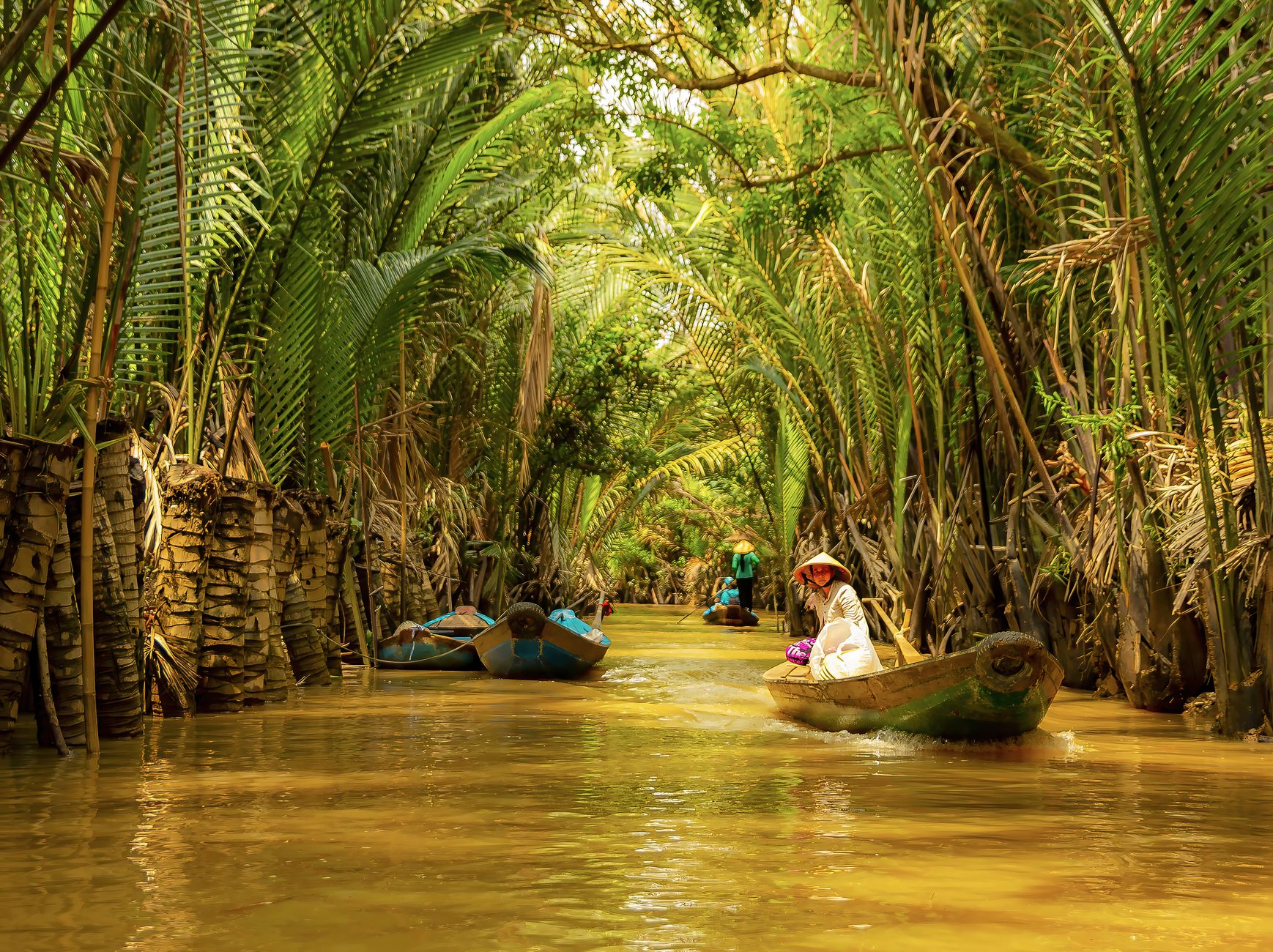
Most foreign visitors who make it to Dat Mui are either completionists — people ticking off Vietnam's geographic extremes — or travelers genuinely interested in mangrove ecosystems and Mekong Delta life beyond Can Tho. The boat ride through dense mangrove channels is the real draw. It's quiet, green, and feels removed from the rest of the delta in a way that the floating markets don't. If you've spent time in Saigon or the busier parts of the south and want to see what Vietnam looks like when you subtract the noise, this is it.
Best time to visit
The dry season, roughly December through April, is the most comfortable window. Skies are clearer, the waterways are calmer, and the trails through the national park aren't waterlogged. The wet season (May to November) brings heavy afternoon rains and can make the boat ride choppier, though the mangroves look their most lush. Avoid the days immediately around Tet / 越南春节 / テト) if you don't want crowds — Vietnamese domestic tourism spikes hard at the cape during the holiday.
Temperatures hover around 27-33°C year-round. Humidity is constant. Bring a hat and water regardless of the month.
How to get there
Dat Mui is not quick to reach. That's part of the deal.
From Ca Mau city, the standard route is a combination of road and boat. Take a car or motorbike south on Highway 1 toward Nam Can town (about 65 km, roughly 1.5 hours by car). From Nam Can, you catch a speedboat to Dat Mui — the ride takes around 30-40 minutes and costs approximately 100,000-150,000 VND per person one way on shared boats. Private boat charters run higher, around 1,500,000-2,500,000 VND for a round trip.
Alternatively, a direct boat from Ca Mau city's Phao Dai pier runs to Dat Mui. This takes about 2-2.5 hours and costs around 120,000 VND. Departures are limited — usually early morning — so check times the day before.
From Can Tho, you're looking at a 4-5 hour drive to Ca Mau city first (about 180 km), then continuing as above. Some tour operators in Can Tho bundle Dat Mui into two-day Ca Mau trips.
From Saigon, it's a full day of travel each way — roughly 350 km by road to Ca Mau. Most travelers fly to Ca Mau's airport (limited flights from Saigon, around 1 hour) and arrange transport from there.

Photo by AN Nhol on Pexels
What to do
Walk the boardwalk and climb the tower
The main site at Dat Mui has a raised concrete boardwalk through the mangroves leading to the GPS monument and a multi-story observation tower. The tower gives you a panoramic view of the cape — mudflats stretching out, mangrove canopy in every direction, and on clear days, open ocean. Entry to the national park area costs around 30,000 VND.
Boat through the mangrove channels
This is the highlight. Small wooden boats take you through narrow waterways lined with mangrove roots. The guides are local and usually only speak Vietnamese, but the experience doesn't need much narration. Watch for mudskippers, crabs, and wading birds. A mangrove boat tour runs about 200,000-350,000 VND per person depending on duration.
Visit the monkey bridge and fishing villages
Along the route to Dat Mui, you'll pass small villages where life runs on tidal rhythms. Some still use "cau khi" — monkey bridges — the narrow single-log crossings that are disappearing elsewhere in the delta. The fishing hamlets near Nam Can are worth a stop if you're driving.
Walk the mudflats at low tide
If the tide is out, you can walk onto the exposed mudflats near the cape. It's messy and you'll need shoes you don't care about, but it's a direct encounter with the sediment process that's building new land in real time.
Catch sunrise or sunset from the cape
If you overnight nearby, sunrise from the tower is worth the early alarm. The light over the flat delta horizon is genuinely good, and you'll likely have the place mostly to yourself before the day-trippers arrive.
Where to eat nearby
Ca Mau province is known for its seafood, and the closer you get to the coast, the fresher it gets. Two things to look for:
"Bun nuoc leo" — a Khmer-influenced noodle soup with fish-based broth, fermented fish paste, roasted pork, and fresh herbs. It's the signature bowl of the Ca Mau / Bac Lieu area. Expect to pay around 30,000-45,000 VND. You'll find it in Ca Mau city's markets more reliably than near Dat Mui itself.
Mud crab ("cua bien") — Ca Mau's most famous ingredient. The mangrove crabs here are large, meaty, and significantly cheaper than in Saigon. A kilo of live crab runs around 350,000-500,000 VND at local restaurants in Nam Can or Ca Mau city. Have them steamed with salt and lemon or stir-fried with tamarind.
Where to stay
Dat Mui itself has very limited accommodation — a few basic guesthouses near the cape charge around 200,000-400,000 VND per night. Don't expect air conditioning or hot water at the lower end.
Most travelers base in Ca Mau city, where options range from budget hotels (300,000-500,000 VND) to mid-range places like Muong Thanh or Luk Hotel (800,000-1,200,000 VND). There's nothing resembling a resort in the area.

Photo by Alberto Capparelli on Pexels
Practical tips locals would tell you
- Bring cash. There are no ATMs at Dat Mui and card payment doesn't exist out here.
- Mosquito repellent is not optional. The mangroves are their territory.
- Wear long sleeves on the boat — sun reflects hard off the water.
- If you're prone to motion sickness, take medication before the speedboat. The river mouth can get rough.
- Charge your phone fully before leaving Ca Mau city. Power outlets at the cape are unreliable.
Common mistakes to avoid
Trying to do it as a day trip from Can Tho. It's technically possible but miserable — you'll spend 10+ hours in transit for maybe 2 hours at the cape. Stay overnight in Ca Mau city instead.
Showing up without checking boat schedules. Boats from Ca Mau to Dat Mui don't run hourly. Miss the morning departure and you're stuck arranging private transport or waiting until the next day.
Expecting a beach. There's no sandy coastline here. It's mudflats and mangroves. Adjust expectations accordingly — the landscape is interesting, not photogenic in the Instagram sense.
Practical notes
Dat Mui works best as part of a broader Mekong Delta loop — combine it with a couple of days in Can Tho, then head south through Bac Lieu and Ca Mau before the cape. Budget two full days minimum for the Ca Mau portion. It's far from everything, which is exactly the point.
Last updated · May 29, 2026 · independently researched, never sponsored.