The Sunday market at Dong Van is not a tourist market. It is a weekly gathering for H'Mong, Dao, Tay, and Lo Lo communities from the surrounding karst plateau, and the food reflects that — rough, filling, built for people who walked two hours downhill to get there.
Getting to Dong Van
Dong Van is roughly 150 km from Ha Giang city, the last 50 km of which run along the Ma Pi Leng pass and the Nho Que River canyon. If you are riding a motorbike — and most people here are — budget four to five hours from Ha Giang city depending on stops and road condition. The market runs from early morning, with the biggest crowd between 7 a.m. and 11 a.m. If you want to eat rather than just browse, arrive before 9.
A handful of guesthouses sit within walking distance of the market square in Dong Van town. Staying Saturday night is the obvious move.
Thang Co — the dish the market is known for
"Thang co" is a slow-cooked horse meat and offal stew, ladled from a large communal pot that has been simmering since before dawn. The broth is dark, deeply spiced with "mac khen" (a local pepper), and poured over sliced meat and organs into a bowl you share at a low wooden table. The smell is strong and the texture is unlike anything you will find in Hanoi or Saigon. One bowl runs about 25,000–35,000 VND.
It is an acquired taste, and some people do not acquire it. If you are in that group, the market has options.
Men Men — corn everywhere
"Men men" is steamed corn flour, coarsely ground and pressed into a mound. It is the staple grain of the plateau — rice does not grow well at this altitude — and you will see it sold alongside dried corn kernels stacked in 50-kg sacks at the market's edge. Plain men men is bland by design; it is meant to accompany stewed vegetables, pickled greens, or thang co broth. Vendors sell small portions for 10,000–15,000 VND. Worth trying once, though it will not be the highlight of your morning.
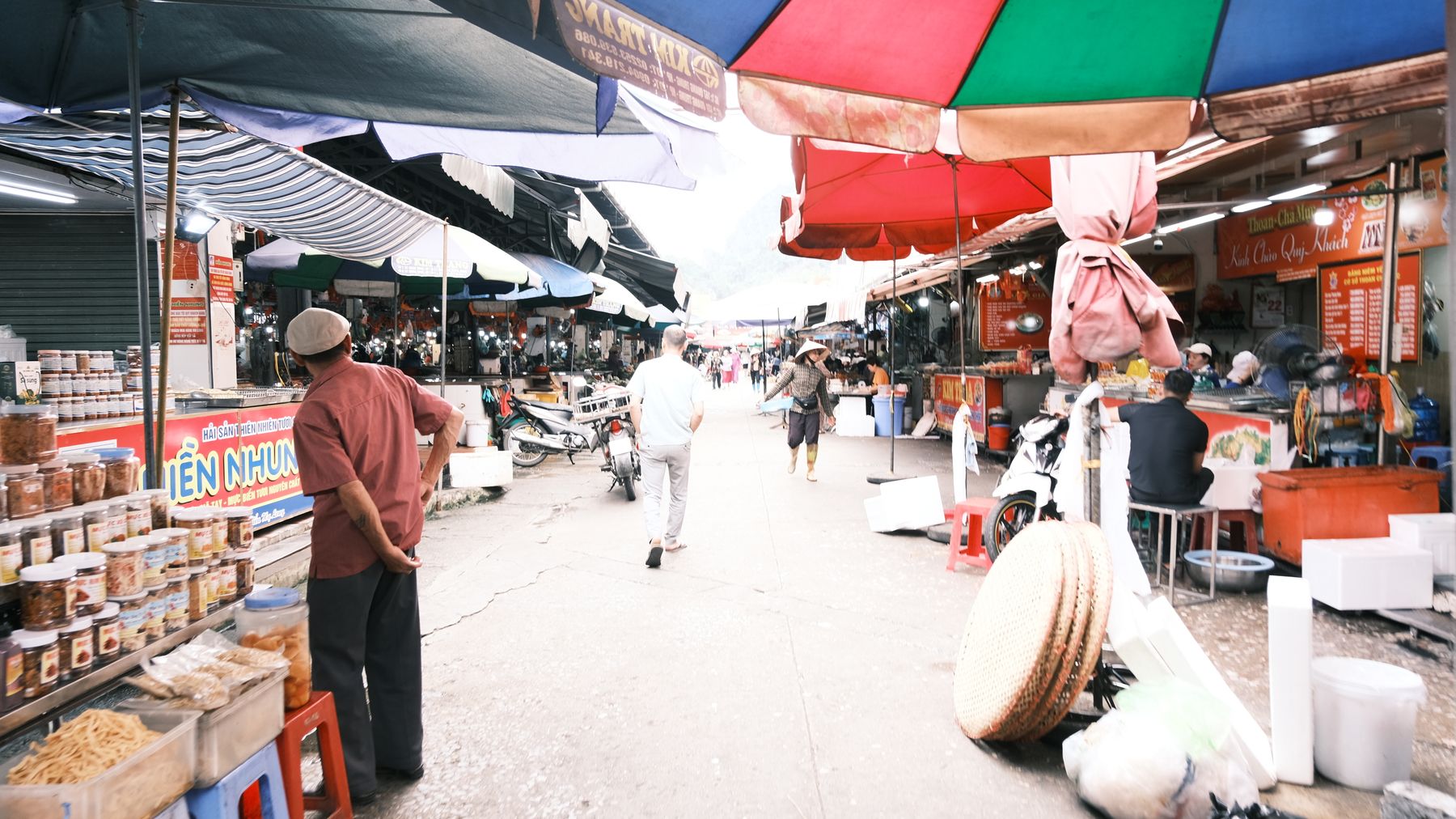
Photo by Đạt Nguyễn on Pexels
Pho Chua — the one that surprises people
"Pho chua" is not what the word "pho" usually signals. This northern dish — common in Ha Giang and Lang Son — is cold, assembled rather than cooked to order, and distinctly sour. A base of flat rice noodles is topped with sliced pork, pate, shrimp crackers, pickled papaya, and a tart dressing made with vinegar and garlic. The contrast of textures is the point. At Dong Van market you will find pho chua at a cluster of stalls near the covered section, priced at around 25,000–30,000 VND per bowl. It is refreshing after the richness of thang co.
Ruou Ngo — corn wine at 8 a.m.
"Ruou ngo" is corn-fermented rice wine, distilled locally and poured from recycled plastic bottles or repurposed glass jars. Alcohol content varies by batch — assume it is strong. Older H'Mong men drink it from small ceramic cups at the market as a matter of routine. You are welcome to join. A small cup from a vendor costs next to nothing; buying a 500ml bottle runs 30,000–50,000 VND depending on who is selling. If you are riding the Ma Pi Leng pass afterward, think that through.

Photo by Quang Nguyen Vinh on Pexels
Other things worth eating
Beyond the four main draws, the market has rotating food worth scanning for. Look for grilled corn cobs sold from charcoal braziers (10,000 VND), "banh day" — sticky rice cakes pounded and filled with black sesame paste — and occasionally "au tau" porridge, a bitter herb and buffalo meat congee that is a local cold-weather staple. Pickled vegetables, dried chili strings, and wild honey also appear in the dry goods section.
A note on the layout
The market is not organized in any obvious way. Food stalls cluster loosely near the center and along the eastern edge of the square. Animal trading — pigs, goats, sometimes horses — happens on the outer perimeter. The textile and clothing section, where H'Mong women sell embroidered fabric and indigo-dyed cloth, fills the northwest corner. Give yourself time to walk the full circuit before settling anywhere to eat.
What it costs
A full breakfast at the market — thang co, pho (쌀국수 / 越南河粉 / フォー) chua, men men, and two cups of corn wine — will cost you 80,000–120,000 VND. That is not a typo. The Dong Van market operates on a local economy, and prices reflect that. Pay what is asked; bargaining at community food stalls is not appropriate here.
Practical notes
Bring cash — there are no card readers at market stalls, and ATM access in Dong Van town is limited to one or two machines that occasionally run dry on weekends. The market is at roughly 1,000 m elevation, so mornings can be cold even in April; a light jacket earns its weight. Sunday only — show up any other day of the week and Dong Van's main square is quiet.
Last updated · May 26, 2026 · independently researched, never sponsored.