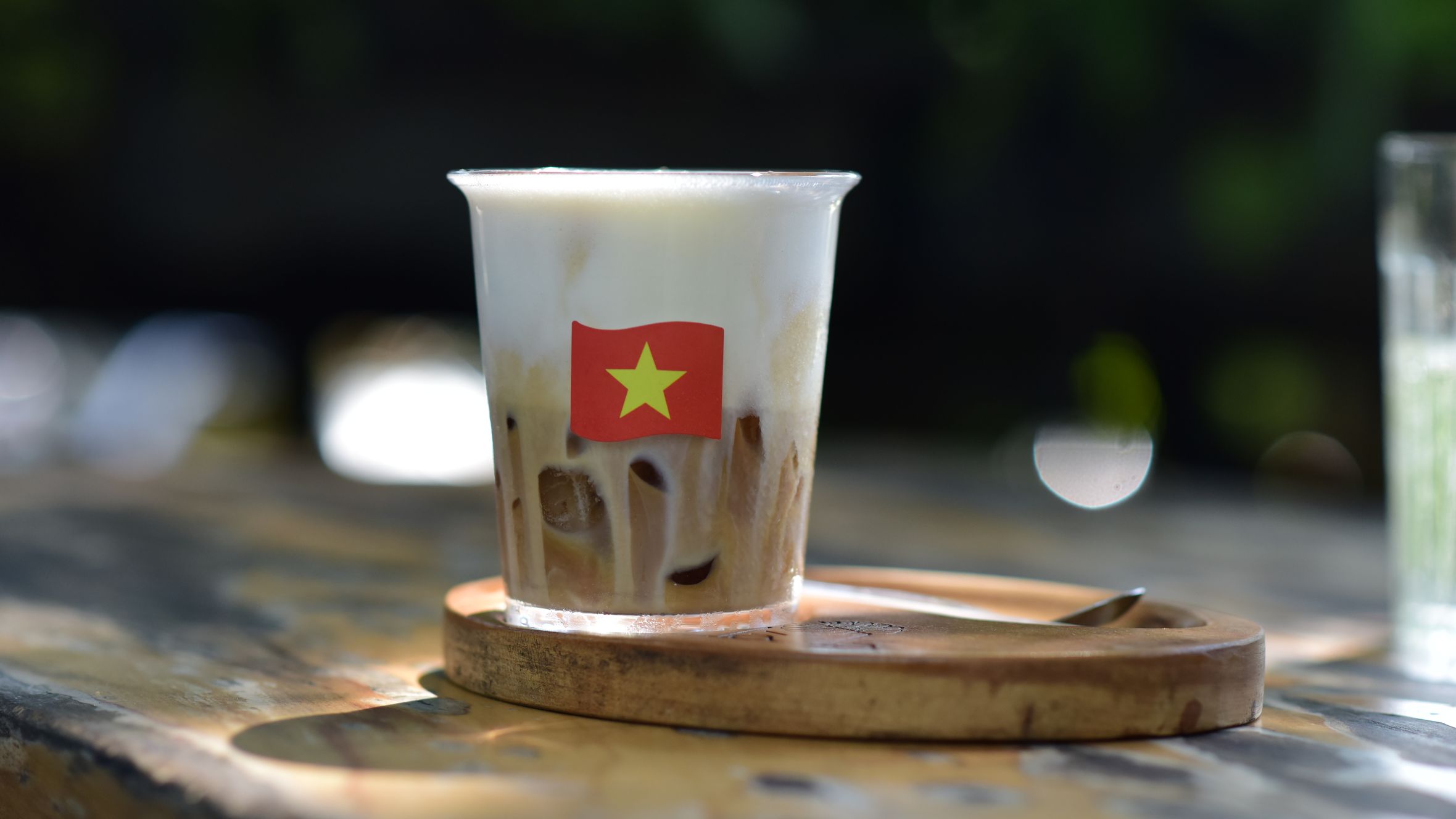
What egg coffee actually is
Egg coffee ("ca phe trung (에그커피 / 蛋咖啡 / エッグコーヒー)") is robusta coffee topped with a thick, sweet foam made from whisked egg yolk, condensed milk, sugar, and sometimes honey. The foam sits on top like a dense mousse. You eat it with a spoon first, then sip the coffee underneath.
The drink was invented at "Ca phe Giang" in Hanoi when fresh milk was scarce. The cafe's founder, Nguyen Van Giang, substituted egg yolk for milk, whisking it by hand into a frothy cream. The result stuck. Giang is still the most famous spot to try it, tucked down a narrow alley at 39 Nguyen Huu Huan in the Old Quarter. The year was 1946, and Giang was working as a bartender at the Sofitel Legend Metropole hotel. When milk ran out across the city, he started experimenting with egg yolk at home. He eventually left the hotel and opened his own cafe, selling the drink for a few dong a cup. Nearly eighty years later, his sons and grandchildren still run the place.
How it's made
The process: whisk one egg yolk with sweetened condensed milk and granulated sugar until it triples in volume and turns pale yellow. Pour hot robusta coffee slowly over the foam. The coffee sinks to the bottom; the egg cream floats on top.
Traditionally, the egg was hand-whisked, which took time and produced a coarser foam. Only hot versions were possible. Today, electric mixers create a finer, more stable foam, so you'll find iced egg coffee (에그커피 / 蛋咖啡 / エッグコーヒー) alongside the hot version. The cup often sits in a bowl of warm water to keep the foam from deflating.
The first few spoonfuls taste like coffee-flavored custard. The coffee at the bottom, after filtering through the egg layer, comes out concentrated and slightly sweet.
Most cafes use a "phin" — the small metal drip filter that sits on top of the cup and is standard for "ca phe sua da" and other Vietnamese coffee drinks. The phin produces a concentrated, slightly oily brew that holds its own against the rich egg layer. If the coffee were lighter — say, a pour-over or drip machine — the egg foam would overpower it completely. The ratio matters: roughly 40-50 ml of coffee to two tablespoons of egg cream. Too much foam and you're drinking dessert. Too little and it's just a regular coffee with a weird film on top.

Image by David McKelvey from Brisbane, Australia via Wikimedia Commons (CC BY-SA)
Variations beyond the original
Once cafes figured out the electric mixer trick, the format expanded. Now you'll see:
- Egg cocoa ("ca cao trung"): same whipped yolk technique, cocoa instead of coffee.
- Egg matcha ("tra xanh trung"): green tea base, egg foam on top.
- Egg mung bean ("dau xanh trung"): sweet mung bean paste drink with egg cream.
- Egg beer ("bia trung"): yes, really — whipped egg yolk on top of draft beer. You'll occasionally find this at "bia hoi" joints in the Old Quarter, though it's more novelty than daily habit.
All served hot or iced. The egg foam is the constant.
Some cafes in Saigon and Da Lat have started putting the egg foam on coconut milk coffee or even fruit smoothies. These are creative riffs, but they've drifted far from what Giang originally made. If you want to understand the drink, start with the plain hot version before chasing variations.

Image by mmmmngai@rogers.com via Wikimedia Commons (CC BY-SA)
Where to drink it
Ca phe Giang (39 Nguyen Huu Huan, Hoan Kiem) is the original. Opened in the late 1940s, still family-run. The alley entrance is easy to miss — look for the small sign near the corner of Hang Gai. Hot egg coffee runs around 30,000-35,000 VND. Opens early (7 a.m.), closes around 10 p.m. Expect a wait on weekends.
Dozens of other Old Quarter cafes now serve their own versions. Some use more sugar, some whisk the foam thinner, some swap in arabica. Giang's version is denser and less sweet than most imitators.
Cafe Dinh (13 Dinh Tien Hoang, second floor) overlooks Hoan Kiem Lake and has been around since the 1950s. Their egg coffee (35,000 VND) is lighter and sweeter than Giang's — more whipped cream than custard. The draw is the view: you sit on a low plastic stool on a cramped balcony watching motorbikes circle the lake below. Gets packed after 4 p.m.
Cafe Lam (60 Nguyen Huu Huan) is about 200 meters from Giang on the same street. Less famous, less crowded. Their version uses a touch more sugar, and the foam is slightly thinner. A good backup if Giang's line is out the door. Around 30,000 VND.
Loading T Cafe (8 Chan Cam, Hoan Kiem) caters to a younger crowd and does an iced coconut egg coffee (45,000 VND) that's become popular on social media. Not traditional, but decent if you want something cold on a summer afternoon when Hanoi hits 38 degrees.
CNN featured egg coffee in a 2018 segment on Hanoi street food, which brought a wave of tourists. If you go to Giang mid-morning on a Saturday, half the crowd will be holding phones.
Outside Hanoi, egg coffee has spread but it's not the same everywhere. Cafes in Hoi An and Da Nang serve it, but the drink belongs to Hanoi the way "pho" belongs to the city's morning routine or "bun cha" belongs to its lunch hour. Ordering egg coffee in Saigon is fine — some places do it well — but the concentration of good versions is highest within a square kilometer of Hoan Kiem Lake.
What to expect
Texture is the point here, not just flavor. The foam is thick enough to hold a spoon upright. It tastes like sweetened egg custard with a coffee aftertaste. The coffee underneath is strong, sometimes bitter if you let it sit too long.
If you don't like eggy desserts or find the idea of raw yolk off-putting, this won't convert you. But if you're comfortable with tiramisu or zabaglione, the concept isn't far off.
Order it hot the first time. The warm version shows the original intent — the foam stays creamy, the coffee stays bitter, and the contrast works. Iced versions are fine but the foam can stiffen and lose some of the mousse texture.
A full cup takes about 15-20 minutes to drink properly. Don't rush it. Spoon the top layer, let the flavors mix, then work your way down to the coffee. By the last third, the egg and coffee have blended together into something closer to a thick latte. That blended portion at the bottom is what regulars actually look forward to.
How to order (and what to say)
At Giang and most Old Quarter cafes, the staff speaks enough English to handle a simple order. But if you want to do it in Vietnamese, here's what works:
- "Cho toi mot ca phe trung nong" — Give me one hot egg coffee.
- "Cho toi mot ca phe trung da" — Give me one iced egg coffee.
- "It duong" — Less sugar (useful if the sweetness overwhelms you).
Point at the menu if pronunciation feels impossible. Nobody will judge you — tourists order egg coffee here all day long.
Most cafes won't ask you to customize. You get the house version: one size, one recipe. If you want egg cocoa or egg matcha, say "ca cao trung" or "tra xanh trung" instead. Expect to pay 30,000-45,000 VND at most places in the Old Quarter. Fancier cafes in Tay Ho or Ba Dinh district might charge 55,000-65,000 VND for the same drink with nicer seating.
Payment is almost always cash at the traditional spots. Giang doesn't take cards. Some newer cafes accept bank transfers via QR code, but bring small bills — 50,000 and 100,000 VND notes — to be safe.
Common mistakes tourists make
Stirring immediately. The whole point is the layered contrast — sweet egg cream on top, bitter coffee on the bottom. If you stir it into a uniform mix right away, you lose the texture experience. Eat the top first, sip the bottom second, then let them merge naturally toward the end.
Ordering iced on a cool day. Hanoi winters (December-February) drop to 12-15 degrees Celsius. A hot egg coffee in a cup sitting in warm water is one of the best cold-weather drinks in the city. Ordering iced when it's chilly means the foam sets too firm and the coffee tastes flat.
Expecting latte-style volume. The cup is small — maybe 150 ml total. This isn't a 400 ml Starbucks drink. It's concentrated and rich. One cup is enough. If you order two back-to-back, the sweetness will catch up with you.
Skipping the spoon. Some foreigners try to drink it like a normal coffee, tilting the cup. The foam is too thick for that — it sits on your lip like a mustache and the coffee underneath barely comes through. Use the spoon. It's there for a reason.
Going only to Giang. Giang is the original, and it's worth visiting once. But the quality of egg coffee across Hanoi is generally high. If Giang has a 30-minute wait and you're short on time, walk five minutes in any direction and you'll find another cafe doing a solid version. The Old Quarter has dozens.
Quick reference
- Vietnamese name: "ca phe trung"
- Price range: 30,000-65,000 VND depending on the cafe
- Best neighborhood: Hoan Kiem / Old Quarter, Hanoi
- Original cafe: Ca phe Giang, 39 Nguyen Huu Huan, open 7 a.m. - 10 p.m.
- Order hot first: "Cho toi mot ca phe trung nong"
- Order iced: "Cho toi mot ca phe trung da"
- Time to drink: 15-20 minutes (don't rush)
- Payment: Cash at traditional spots, QR transfers at newer cafes
- Best season: October-February (cool weather, hot cup, warm water bowl — perfect combination)
- Pairs well with: A "banh mi" from a nearby street cart or a plate of "banh cuon" from one of the Old Quarter's morning stalls
Final note
Egg coffee is one of those drinks that sounds like a gimmick but earns its reputation once you actually sit down with a cup. It came from scarcity — no milk, so someone used what was available — and turned into something Hanoi genuinely claims as its own. Order it hot, eat it slow, and don't overthink the raw egg part. Thousands of people drink it every morning in this city, and they're doing fine.
Last updated · May 29, 2026 · independently researched, never sponsored.