Hanoi has a habit of making certain foods feel like events. "Com" (young green sticky rice, harvested before the grain fully matures and then pounded to flat, chewy flakes) is one of them — and if you miss the window, you're waiting another year.
What Com Vong Actually Is
Com is made from glutinous rice harvested while the grains are still milky and green, typically in September and October. The raw grain is roasted gently over low heat, then pounded in stone mortars until it flattens into soft, fragrant flakes with a grassy, almost sweet smell that is genuinely unlike anything else in Vietnamese food.
The "Vong" part refers to Lang Vong — Vong Village — now absorbed into Cau Giay district in western Hanoi (하노이 / 河内 / ハノイ), historically the source of the best-quality com. Families there have been doing this for generations, and the craft is still largely hand-done. The pounding is physical and rhythmic, and in small workshops you can still hear it from the street.
The season runs roughly from mid-September through late October, sometimes bleeding into early November depending on the harvest. Outside that window, you won't find fresh com. Vendors who sell it in December are usually offering older stock, and it shows — the color dulls, the perfume fades, the texture goes waxy rather than yielding.
How Locals Eat It
There are two main contexts.
The first is straight, eaten simply with a ripe banana — specifically the small, finger-length "chuoi tieu" variety — and a pinch of coconut shred or sesame. You take a small mound of com, pair a bite with banana, and that's breakfast. It sounds minimal because it is. The combination works because the banana's sweetness offsets the grassy rawness of the rice, and the textures — soft flake against dense fruit — are better than they sound on paper.
The second is "xoi com": sticky rice steamed with com layered through it, often sold alongside "cha" (Vietnamese pork sausage) or "ruoc" (dried shredded pork). This is the more filling version and the one you're more likely to find at dedicated "xoi" stalls in Hanoi. It's a proper breakfast, not a snack.

Photo by Vietnam Tri Duong Photographer on Pexels
Where to Find It in Hanoi
Lang Vong Area, Cau Giay District
The most direct route is going to the source. Nguyen Phong Sac street and the lanes around Nghia Do ward still have small com vendors operating out of front rooms with no signage beyond a handwritten note and a stack of lotus-leaf parcels. Expect to pay around 30,000–50,000 VND per phan (a standard serving portion, roughly 150–200g). Bring cash, bring patience, go before 9am — most sell out.
Hang Than Street, Ba Dinh District
Hang Than is Hanoi's unofficial sweet and sticky-rice corridor, and in com season a few vendors here sell both plain com and xoi com. The stall near the junction with Nguyen Truong To has been consistent for several years. Prices here run slightly higher — 40,000–60,000 VND — but the lotus-leaf wrapping is tight and the com is usually same-day fresh.
Co Lan Com, Hang Bong Area
This is the name floating around local food forums in recent years. A small operation near the Old Quarter edge, open roughly 7am–10am, selling com by the phan wrapped in two layers of lotus leaf (the outer layer dry, the inner still green and fragrant). At around 45,000 VND it's not cheap by street food standards, but the quality is reliable. Sell-out by 9:30am is common on weekends.
What to Look For When Buying
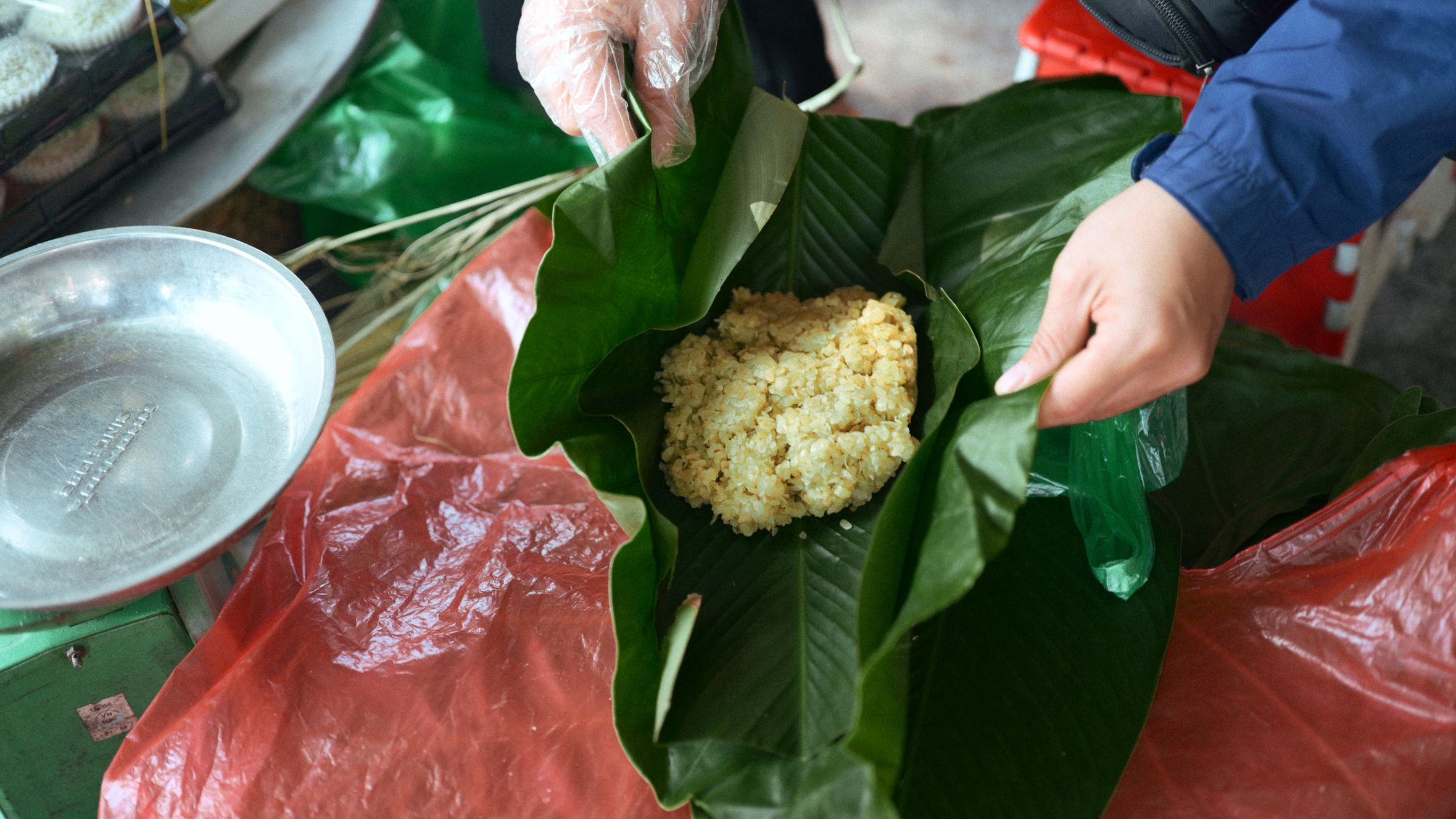
Good com is pale green to jade green, slightly moist-looking without being wet. The fragrance should hit you when the vendor unwraps the lotus leaf — that clean, grassy-sweet smell is the marker. If it looks grey-green or smells faintly sour, it's past its prime.
Avoid pre-packaged com sold in plastic bags at general food shops. The lotus leaf is part of the preservation method; plastic kills the aroma within hours.

Photo by Hiếu Vũ Vlog on Pexels
One Thing Worth Knowing
Com season in Hanoi tends to coincide with the city's most comfortable weather — the tail end of the rainy season easing into dry, mild autumn days. The streets around Hoan Kiem Lake smell like grilled corn and lotus flowers, the humidity drops, and suddenly a small parcel of pounded green rice eaten on a low stool feels like the right thing to be doing. That's not an accident. Hanoi's seasonal food culture is tightly calibrated to its climate, and com is one of the clearest examples.
If you're also exploring Hanoi's broader breakfast scene — banh cuon stalls open from 6am in the Old Quarter, or a glass of egg coffee mid-morning — com fits naturally as a first stop before the city fully wakes up.
Practical Notes
The com window is roughly September 15 to October 31; aim for early October for peak quality. Go before 9am at any vendor — afternoon stock is rare. Budget 30,000–60,000 VND per portion depending on location.
Last updated · Apr 2, 2026 · independently researched, never sponsored.