Hoang Su Phi sits in the western corner of Ha Giang province, about 100 km from Ha Giang city, in a landscape defined by terraced rice paddies carved into mountains by Dao, Nung, and La Chi communities over centuries. It doesn't get a fraction of the traffic that Sapa or the Ha Giang Loop pulls in, and that's precisely why it's worth the trip.
What Hoang Su Phi actually is
Hoang Su Phi is a rural district, not a single town. The district center — Vinh Quang — is a small market town with a few guesthouses and a petrol station. The draw is everything around it: a network of villages scattered across valleys and ridgelines, connected by narrow roads that wind through some of the most impressive rice terrace systems in Southeast Asia. The terraces here were recognized as a national heritage site in 2012. Unlike Sapa (사파 / 沙坝 / サパ), there's no cable car, no main strip of hotels, and no tour buses. You're largely on your own, which is the point.
Why travelers go
Three reasons. First, the terraces — particularly around Ban Luoc, Ban Phung, and Thong Nguyen communes — are genuinely extraordinary in scale and still actively farmed by local communities. Second, the ethnic diversity: Red Dao, Tay, Nung, La Chi, and Hmong villages sit within a few kilometers of each other, each with distinct architecture and dress. Third, the solitude. On a weekday outside harvest season, you might be the only foreigner in the entire district.
If you've already done the Ha Giang (하장 / 河江 / ハーザン) Loop and want to go deeper into the northern mountains without a tourist apparatus around you, Hoang Su Phi is the logical next step.
Best time to visit
The rice terraces peak in two windows. Late September to mid-October is the headline season — terraces turn gold before harvest, and the light in the mornings is extraordinary. This is the only period when Hoang Su Phi sees any real visitor numbers, mostly Vietnamese photographers. Late May to June, when paddies are freshly flooded and bright green, is quieter and nearly as photogenic.
Avoid November through February. The terraces are bare stubble, fog can sock in the valleys for days, and nighttime temperatures at elevation drop to 5-8°C. Roads can get slippery. March and April are transitional — pleasant weather, but the terraces aren't at their best.
How to get there
The nearest major hub is Hanoi, roughly 300 km away.
Option 1 — Bus to Ha Giang, then local transport. Sleeper buses from Hanoi's My Dinh station to Ha Giang city run overnight (7-8 hours, 250,000-350,000 VND). From Ha Giang city, local buses depart for Vinh Quang (Hoang Su Phi district center) in the morning — about 3-4 hours on winding mountain roads, around 100,000-150,000 VND. Total travel time from Hanoi: roughly 11-12 hours with the connection.
Option 2 — Motorbike from Ha Giang. Most people exploring this region are already on motorbikes. From Ha Giang city, take QL2 west then branch onto DT177. It's about 100 km, 3-4 hours depending on road conditions and stops. The road is paved but narrow with sharp switchbacks — experienced riders only.
Option 3 — Private car/driver from Ha Giang. A car with driver from Ha Giang city to Hoang Su Phi runs about 1,200,000-1,500,000 VND one way. Useful if you want to stop at viewpoints without worrying about parking a motorbike on a cliff edge.
There is no direct bus from Hanoi to Hoang Su Phi.
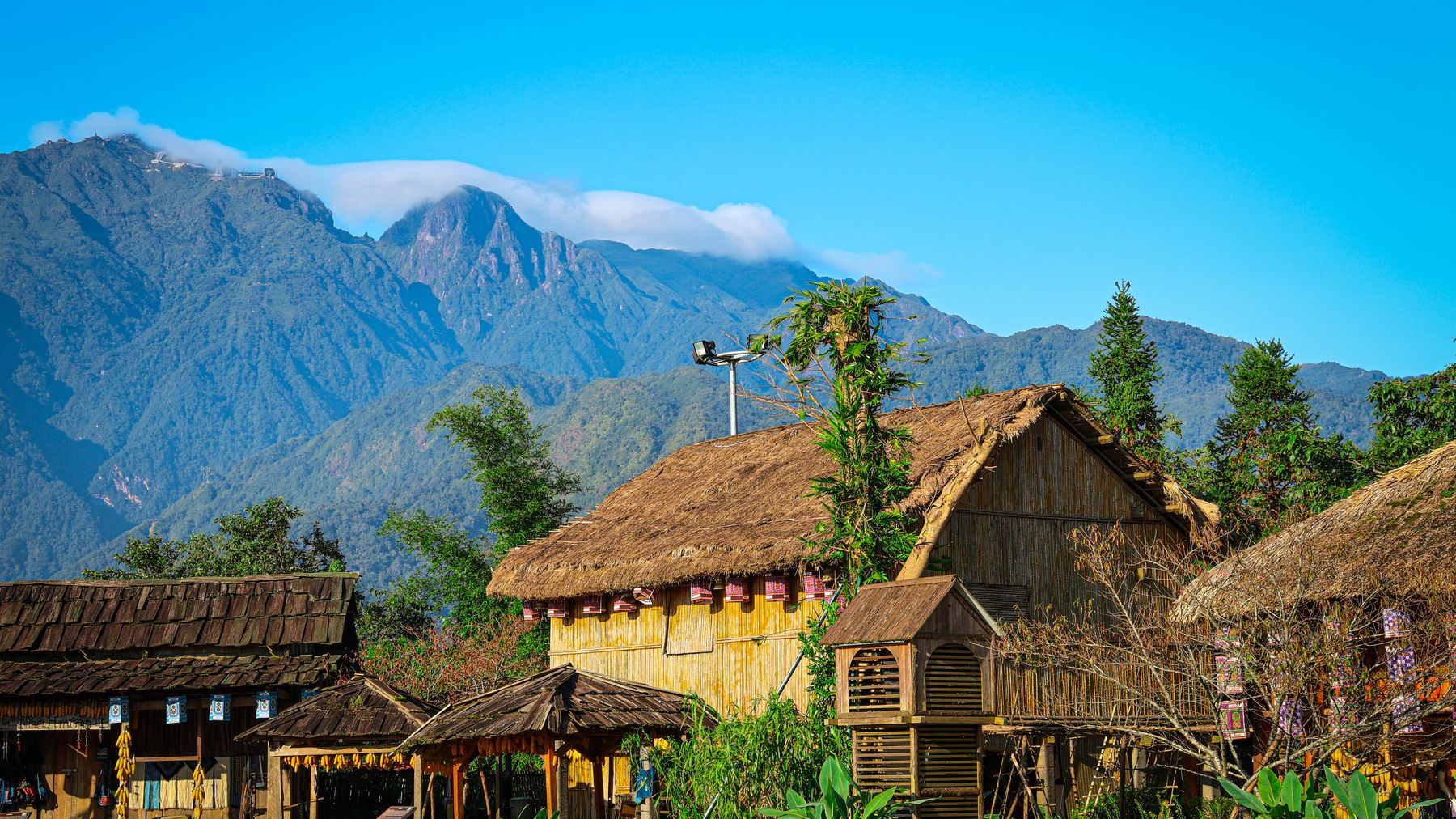
Photo by Haneul Trac on Pexels
What to do
Walk the terraces at Ban Luoc and Ban Phung
Ban Luoc has the most accessible terraces — you can park at the road and walk down into the paddies on footpaths between plots. Ban Phung, higher up, has wider panoramic views. No entrance fee. Give yourself 2-3 hours per village for a proper walk. Bring water; there's nothing to buy once you leave the road.
Visit Thong Nguyen for the Tuesday market
The weekly market in Thong Nguyen draws Dao, Nung, and La Chi villagers from surrounding hills. It's a trading market, not a tourist market — livestock, tobacco, fabric, and produce. Get there by 7 AM; by 10 it's winding down. If your visit doesn't land on a Tuesday, the smaller Vinh Quang daily market still gives a sense of local commerce.
Hike to Chieu Lau Thi peak
At 2,402 m, Chieu Lau Thi is the highest point in the district. The hike takes a full day — most people hire a local guide from Nam Ty commune (around 500,000-700,000 VND for the day). The trail passes through bamboo forest and cloud forest before opening up above the treeline. Not technical, but steep and slippery after rain. Start early.
Drive the loop road through Ho Thau and Nam Ty
If you have a motorbike, the loop from Vinh Quang through Ho Thau, Nam Ty, and back is about 60 km of mountain road through villages and terraces. Budget a half day. The road surface varies — mostly concrete with patches of dirt. Stop at Ho Thau for views down into a wide valley that rarely appears in any guidebook.
Soak in the hot springs at Ban Muong
A natural hot spring near Ban Muong village, basic but functional — concrete pools fed by a sulfur spring. Free or a small donation to the local family maintaining it. Not a spa experience, but after a day of hiking or riding, the warm water earns its keep.
Where to eat
Restaurant options are limited. In Vinh Quang, a handful of "com binh dan" (everyday rice) shops serve the basics — rice, greens, pork, soup — for 30,000-50,000 VND. Look for "thang co", a sour organ meat hotpot that's the signature communal dish of the northern highlands. It's an acquired taste — earthy, funky, served bubbling — but it's the real local food here. "Xoi ngu sac" (five-color sticky rice), dyed with natural plant extracts, shows up at markets and homestays, especially during festivals.
If you're staying at a homestay, dinner is typically included — home-cooked meals with whatever's in season. This is often the best food you'll eat in the district.
Where to stay
Homestays are the main option and the best way to experience the area. Expect 200,000-400,000 VND per person per night including dinner and breakfast. Ban Luoc and Thong Nguyen have the most established homestay options. Rooms are simple — mattress on the floor, shared bathroom, maybe hot water.
In Vinh Quang town, a couple of basic guesthouses ("nha nghi") charge 150,000-300,000 VND per night. Don't expect much beyond a bed and a fan. There are no hotels or resorts in the district.

Photo by Vietnam Hidden Light on Pexels
Practical tips locals would tell you
- Carry cash. There are one or two ATMs in Vinh Quang but they're unreliable. No card payments anywhere in the district. Bring enough VND from Ha Giang or Hanoi.
- Fuel up in Vinh Quang. Petrol stations outside town are scarce. Top off your tank before heading into the villages.
- Dress in layers. Mornings at elevation are cold even in September. By noon the sun is strong. A light rain jacket doubles as a wind layer on motorbike rides.
- Learn a few phrases. English is effectively nonexistent here. Basic Vietnamese — "xin chao", "cam on", "bao nhieu" — goes a long way. Google Translate's offline Vietnamese pack is worth downloading before you lose signal.
- Respect the terraces. Walk on the paths between paddies, not through them. These are working farms, not photo sets.
Common mistakes to avoid
- Coming for just one night. You need at least two full days to see Ban Luoc, Thong Nguyen, and one hike or loop drive. Three days is better.
- Assuming Ha Giang Loop tours include Hoang Su Phi. Most standard loop itineraries skip it entirely — it's west of the main loop route. You need to plan this as a separate detour or a standalone trip.
- Riding in without motorbike experience. The roads demand confidence on switchbacks, gravel patches, and blind corners shared with water buffalo. If you're not comfortable on mountain roads, hire a driver.
- Expecting Sapa-level infrastructure. No spas, no Western restaurants, no English menus. That's the trade-off for having the place largely to yourself.
Practical notes
Hoang Su Phi rewards patience and flexibility. Weather changes fast, roads close after heavy rain, and the best moments — fog lifting off a valley at dawn, a farmer waving you over for tea — aren't on any itinerary. Budget more time than you think you need, and bring a good attitude about cold showers.
Last updated · May 29, 2026 · independently researched, never sponsored.