If you've spent time eating your way through southern Vietnam (베트남 / 越南 / ベトナム) and somehow skipped "hu tieu", you've missed the dish that quietly rivals pho for daily eating frequency down here. It's cheaper, faster, and more variable — and the debate over which style is best runs as deep as any food argument in the country.
Where Hu Tieu Comes From
Hu tieu's lineage is tangled in the best possible way. The name derives from the Teochew Chinese "hu tiaw" — a noodle soup tradition brought by Chaoshan immigrants who settled across the Mekong Delta (메콩 델타 / 湄公河三角洲 / メコンデルタ) from the 17th century onward. From there it absorbed Khmer flavors and techniques as it moved through Cambodia (then Kampuchea) and back into southern Vietnam via the delta provinces. The result is something that doesn't belong cleanly to any one culinary tradition, which is probably why it works so well.
You won't find hu tieu in Hanoi noodle shops. It is, with rare exceptions, a southern dish — rooted in the delta, refined in Saigon, and still most alive in the provinces between the city and the Cambodian border.
The Three Styles Worth Knowing
Hu Tieu My Tho
My Tho, the capital of Tien Giang province about 70 km southwest of Saigon, claims the most famous regional variant. My Tho-style hu tieu uses thin, slightly chewy rice noodles — sun-dried before cooking, which gives them a firmer texture than the fresh noodles used elsewhere. The broth is built on pork bones and dried squid, giving it a sweetness and depth that's distinctly different from a pho broth. Toppings typically include sliced pork, pork liver, shrimp, and quail eggs. Crispy fried shallots go on last.
The noodles here are almost always served in the broth ("nuoc" style), and the garnish plate — bean sprouts, lime, fresh herbs — is smaller and less central than what you'd get with, say, "bun bo Hue". The dish doesn't need heavy doctoring. The broth does the work.
Hu Tieu Nam Vang
Nam Vang is the Vietnamese name for Phnom Penh, and this style traces its lineage directly to the Teochew communities of Cambodia. It arrived in Saigon in significant numbers after 1979 when ethnic Chinese families relocated across the border. Nam Vang style uses a cleaner, lighter pork-and-prawn broth and is generously loaded: pork mince, whole prawns, pork liver, pork intestine if you want it, and occasionally fish balls. A raw egg cracked into the hot soup is traditional in some shops — stir it in quickly and it poaches in the broth.
In Saigon's District 5 and District 6, Nam Vang-style hu tieu carts and shophouses are still concentrated in the old Cholon neighborhoods. Prices run around 45,000–65,000 VND a bowl depending on the protein load.
Hu Tieu Kho (Dry Style)
This is the version that surprises people who assume noodle soup means, well, soup. Hu tieu kho is served without broth — the noodles are tossed in a mixture of lard, fish sauce, and a little sugar, then loaded with toppings. A small cup of concentrated broth comes on the side for sipping or adding as you go. The texture is closer to a Singaporean "bak chor mee" than anything you'd recognize as Vietnamese noodle soup.
Dry hu tieu has become the style most visible in Saigon's cafe-restaurant hybrids catering to younger crowds. It's worth ordering at least once because the flavor is more direct — nothing is diluted by a large volume of liquid — and the toppings feel more intentional on a dry noodle base.
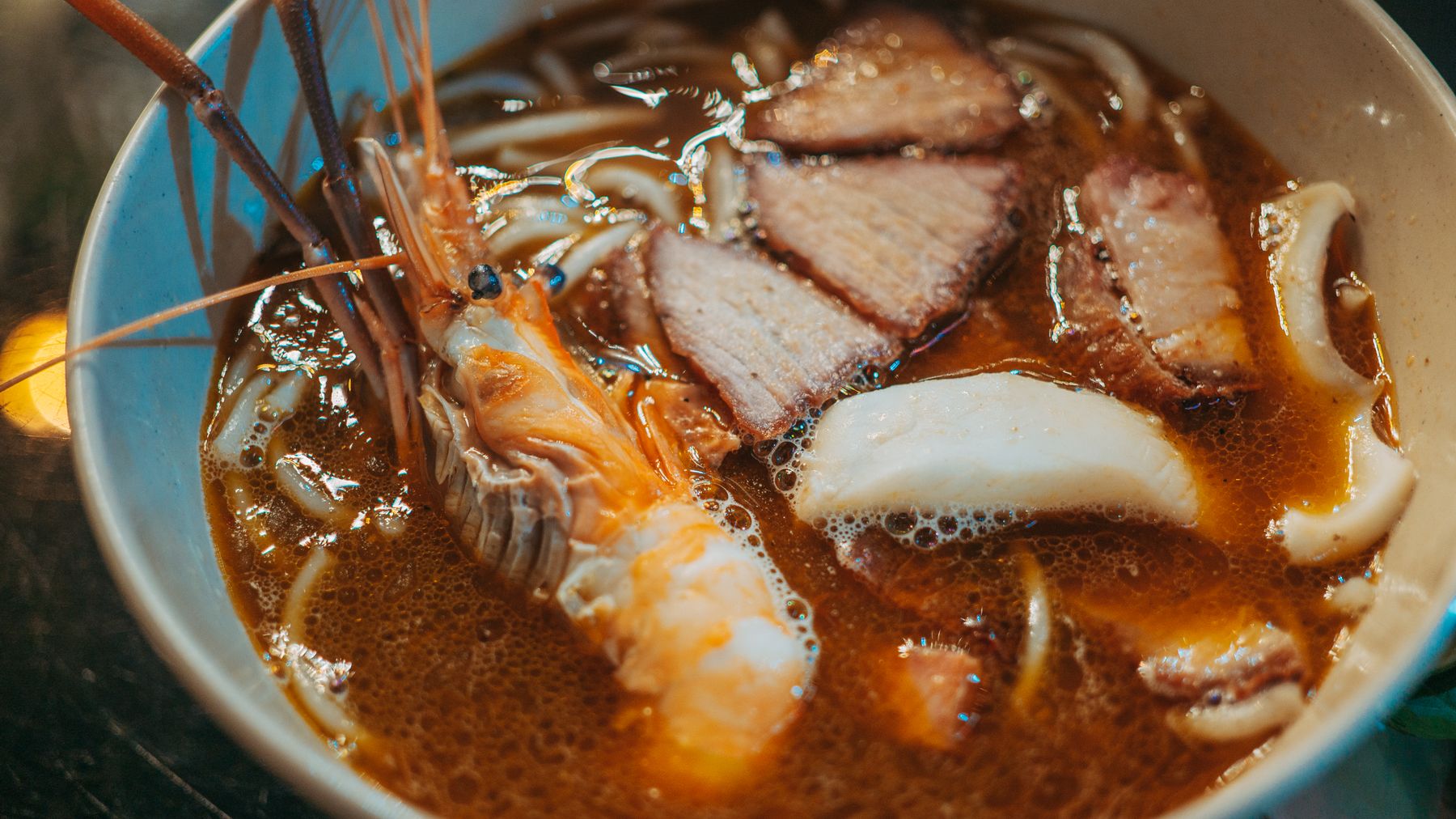
Photo by FOX ^.ᆽ.^= ∫ on Pexels
The Noodle Itself
Hu tieu noodles are made from rice flour and are translucent when cooked, slightly glossy. In My Tho they're thin and firm. In Saigon shops they vary from thin to medium. Some shops — particularly those with Teochew heritage — use yellow egg noodles ("mi") either instead of or mixed with the rice noodles; ordering "hu tieu mi" gets you that mix. It's worth trying.
How to Order
Walk into any hu tieu shop and you'll usually be asked one or two things: "nuoc hay kho?" (soup or dry?) and what toppings you want. Most places offer a standard bowl and let you add extras. Point at what you see other people eating if the menu is handwritten and illegible. The base bowl — pork and broth — is always the cheapest entry point. From there:
- Tom = shrimp
- Gan = liver
- Long = intestine
- Trung cut = quail eggs
- Bo vien = beef balls (less common, but some shops carry them)
Ask for "it mo" if you want less lard or fat. Most shops won't mind.

Photo by Vietnam Tri Duong Photographer on Pexels
Where to Try a Canonical Version
Hu Tieu My Tho — Quan Thanh Xuan, My Tho: A decades-old shophouse on the main market strip near Trung Luong, about a 10-minute walk from the My Tho bus terminal. The broth is the reason people drive down from Saigon on weekends. Opens at 5:30 AM, often sold out by 9.
Hu Tieu Nam Vang — Hu Tieu Nam Vang Ly Lieu, Saigon: On Nguyen Trai Street in District 5, this is one of the older Cholon-area shops still using the original recipe brought over from Phnom Penh. The raw egg cracked into the bowl is non-negotiable here. Around 55,000 VND for a standard bowl with prawns.
Hu Tieu Kho — Tiem Hu Tieu Cay Boi, Can Tho: In the heart of Can Tho's market district, this small spot does a dry hu tieu with pork mince and fried shallots that holds up well against anything you'll find in Saigon. A good reason to explore Can Tho beyond the floating market.
Practical Notes
Hu tieu is a morning and midday dish — most good shops close by early afternoon, and the broth at 7 AM is always better than the broth at noon. Budget 40,000–70,000 VND for a full bowl with toppings at a reputable spot. In My Tho specifically, a food-focused half-day trip from Saigon is entirely reasonable: 70 km on the expressway, bowl of noodles, back by lunch.
Last updated · May 29, 2026 · independently researched, never sponsored.