Le Mat sits about 7 km northeast of Hanoi's Old Quarter, past the Long Bien Bridge and into a stretch of Red River lowlands that most visitors never bother with. It doesn't look like much from the road — low houses, a few hand-painted signs, motorbikes parked outside what appear to be ordinary family restaurants. But Le Mat has been Vietnam (베트남 / 越南 / ベトナム)'s most famous snake-farming and snake-cooking village for at least 500 years, and on weekend evenings the place fills up with Hanoians who've been coming here their whole lives.
If you're vegetarian, this is not your afternoon. If you're curious about how northern Vietnamese rural food culture actually works, it is worth the 25-minute xe om ride.
What Le Mat Is, and What It Isn't
Le Mat is not a tourist trap dressed up as a village experience. There are no entrance fees, no staged demonstrations, no English menus. The restaurants — most of them family-run, many operating out of the front room of someone's house — cater almost entirely to Vietnamese customers. You'll hear groups of older men from Hanoi (하노이 / 河内 / ハノイ) ordering round after round, and extended families celebrating birthdays at long plastic tables under fluorescent lights.
The snakes served here are farmed, not wild-caught. Cobras ("ho mang") and rat snakes are the most common, raised in concrete pits on the village properties. This matters for anyone with concerns about wildlife trade — Le Mat's industry is traditional and regulated, not poaching.
The Meal Itself
Ordering at a Le Mat restaurant involves choosing your snake live, which the kitchen then prepares across seven or eight courses from a single animal. The full sequence — what locals call "ruou ran" for the snake wine that opens the meal, through to a final broth — is designed to use every part.
A typical progression at a mid-range Le Mat restaurant:
- Snake blood mixed with rice wine — served first, warm, in a small glass. More ritual than dramatic.
- Grilled snake skin — crackling texture, mild flavor, eaten with a dipping sauce of salt, pepper, and lime.
- Steamed snake meat with ginger — the clearest expression of the actual flavor, which is lean and slightly gamey, closer to frog than chicken.
- Fried snake bones — crunchier than you expect, good with bia hoi if you've ordered a bucket.
- Snake congee ("chao ran") — the meal's gentle close, a rice porridge cooked with the carcass bones, scattered with fried shallots.
Prices depend on the species and the size. A full cobra meal for two to four people runs roughly 600,000–1,200,000 VND depending on the snake's weight. Rat snake meals start lower, around 350,000 VND. Nobody will pressure you to order the most expensive option.

Photo by Duong Nguyen on Pexels
The Surrounding Rural Food Culture
Le Mat is technically within Hanoi's Long Bien District now, but the food culture of the broader Vinh Phuc and northeastern Hanoi periphery is its own thing — distinct from the city's more polished "pho" and "bun cha" canteen scene.
A few things worth knowing if you're eating your way through this area:
Field crab dishes
"Bun rieu" in this part of the north gets made with freshwater field crab paste the way it was before the dish became standardized across the city. Small roadside shops near Dong Anh and Soc Son serve versions that are coarser, sourer, and more heavily tomato-laden than what you'll find inside Hanoi's ring roads. Worth stopping for if you're passing through on the way back from a day trip.
Com nieu
"Com nieu" — rice cooked in a clay pot until the bottom crust chars — shows up at rural lunch spots throughout this region. The crust gets broken off and fried separately, served alongside pickled vegetables and braised pork. It's the kind of thing that has no fancy presentation and costs around 50,000–80,000 VND per person.
Banh cuon made to order
Northern "banh cuon" — steamed rice rolls filled with minced pork and wood-ear mushroom — is particularly good in market villages around Vinh Phuc province. The rice batter is thinner than you'll get in Hanoi tourist spots, and it's rolled directly off the steaming cloth in front of you. Look for stalls that open at 6am and are sold out by 9.
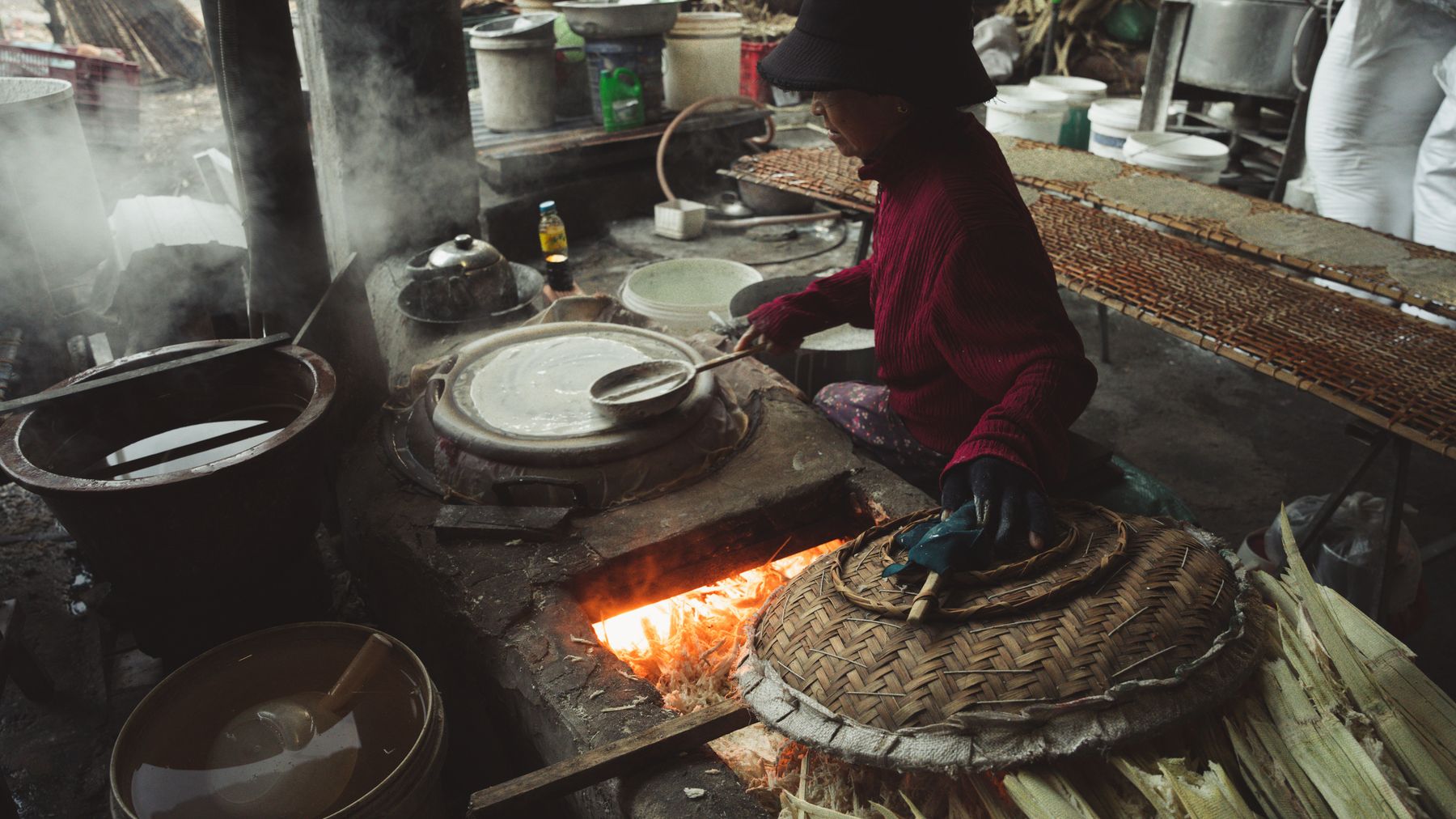
Photo by Long Bà Mùi on Pexels
Getting There and Practical Notes
From Hanoi's Old Quarter, Le Mat is straightforward on a motorbike: cross Long Bien Bridge, continue north on National Highway 1 through Gia Lam, then follow signs toward Viet Hung and Le Mat village. Google Maps navigates it reliably. Grab or Be will send drivers there without issue, though some app drivers unfamiliar with the village may need the Vietnamese name confirmed: Lang Le Mat, Long Bien.
Restaurants operate daily but are busiest Friday through Sunday evenings from around 5pm. Come on a weekday lunch if you want a quieter meal where you can actually talk to the kitchen staff.
If snake isn't what you came for, the village is still worth a short walk — the communal house (dinh lang) dates to the Le dynasty and the surrounding alleyways look almost nothing like the Hanoi most visitors see.
Practical Notes
Bring cash; no Le Mat restaurant accepts card. Budget 150,000–300,000 VND per person for a shared snake meal with drinks. If you're driving yourself, note that the roads through Long Bien District narrow considerably after dark — give yourself extra time back.
Last updated · May 26, 2026 · independently researched, never sponsored.