
Saigon's Municipal Theatre — known locally as "Nha Hat Thanh Pho" — sits at the bottom of Dong Khoi Street like an ornate full stop at the end of the city's most famous boulevard. It's one of the few French colonial buildings in Ho Chi Minh City that still does exactly what it was built for: putting on performances.
What it is and how it got here
The theatre opened in 1900 as the Opéra de Saïgon, designed by French architect Eugène Ferret in a flamboyant Beaux-Arts style. Think columns, stucco reliefs, carved goddesses, wrought-iron details — the kind of building the French built when they wanted to remind themselves they were still in France. It seated about 800 and hosted opera, ballet, and theatre for Saigon (사이공 / 西贡 / サイゴン)'s colonial elite.
Over the decades, the building served as the lower house of South Vietnam's legislature before returning to its performing-arts role after 1975. A major restoration in the late 1990s brought back much of the original facade detail. Today it seats around 500 and hosts everything from traditional Vietnamese music to contemporary dance and the long-running acrobatic show A O Show.
Why travelers go
Most visitors come for one of two reasons. First, the exterior — it's one of the most photogenic buildings in Saigon, especially at night when the facade is lit up against the backdrop of Dong Khoi's neon. Second, the shows. Unlike a lot of historic theatres that have been turned into museums or event halls, Nha Hat Thanh Pho (쌀국수 / 越南河粉 / フォー) runs a real performance calendar. If you're spending a few days in Saigon and want something to do after dark that isn't a rooftop bar, this is it.
The building also anchors the heart of District 1's French colonial quarter. Within a five-minute walk you've got the Notre-Dame Cathedral, the Central Post Office, and the Continental Hotel. It's a natural stop on any walking tour of central Saigon.
Best time to visit
Saigon is warm year-round, so the theatre works in any season. That said, the dry season (December through April) is more comfortable for walking around the area. Evening performances typically start at 18:00 or 20:00 — the facade photographs best right after sunset, around 18:00–18:30.
If you want to catch a specific show, book a few days ahead during peak tourist season (December–February and July–August). Midweek performances are easier to get into than Friday or Saturday nights.
How to get there
From Tan Son Nhat Airport, a taxi or Grab to Nha Hat Thanh Pho takes 30–50 minutes depending on traffic. Expect to pay 150,000–200,000 VND by car. From Ben Thanh Market — which many travelers use as a central reference point — it's a straight 10-minute walk northeast along Le Loi Street.
If you're staying in the backpacker area around Bui Vien (Pham Ngu Lao), it's about a 15-minute walk or a 25,000–35,000 VND Grab bike ride. The theatre sits right at the intersection of Dong Khoi and Le Loi, so almost any taxi driver knows it by name.

Photo by Quang Vuong on Pexels
What to do
Catch the A O Show
This is the signature production — a contemporary circus-style show combining acrobatics, dance, and bamboo props that tells the story of Vietnam's shift from rural to urban life. It's been running for years and remains genuinely good. Tickets range from 630,000 VND to 1,500,000 VND depending on seating. Book through the Lune Production website or at the box office.
Photograph the facade at night
The building is dramatic after dark. The best angle is from directly across the street on the pedestrian plaza, shooting back toward the illuminated columns. If you walk up Dong Khoi about 50 meters, you can frame the theatre against the modern skyline behind it.
Walk the Dong Khoi corridor
Dong Khoi runs from the theatre north toward the Saigon River. It's Saigon's answer to a European boulevard — bookshops, galleries, old hotels, and a few overpriced cafes. The walk to the river takes about 15 minutes. Along the way you'll pass the old Hotel Majestic, several lacquerware shops, and a few excellent Vietnamese coffee spots where you can sit with a "ca phe sua da" and watch the street.
Visit the nearby public square
The open plaza in front of the theatre — Lam Son Square — fills up with families and couples in the evenings. It connects directly to Nguyen Hue Walking Street, a wide pedestrian boulevard that runs to the river and is worth strolling, especially on weekends when street performers set up.
Check the performance calendar
Beyond A O Show, the theatre hosts occasional "ca tru" and traditional music performances, visiting dance companies, and cultural events around Tet / 越南春节 / テト) and Mid-Autumn Festival. The schedule rotates, so check the Lune Production or HCMC Opera House listings a week before your visit.
Where to eat nearby
You're in the heart of District 1, so options run from street food to fine dining. For something genuinely local, walk five minutes south to the cluster of "com tam" stalls on Ly Tu Trong Street — broken rice with grilled pork, a fried egg, and fish sauce, usually 40,000–55,000 VND. It's the working lunch of Saigon.
For something lighter, head to one of the "banh mi" carts near the intersection of Le Loi and Pasteur. A solid banh mi in this area costs 25,000–35,000 VND. If you want to sit down, Quan Bui on Ngo Duc Ke (a seven-minute walk) does refined Vietnamese dishes — "goi cuon", caramelized clay-pot fish, banana blossom salad — at around 120,000–250,000 VND per dish.
Where to stay
The theatre is in the most expensive hotel district in Saigon, but there's range.
- Budget: Guesthouses on Bui Vien or De Tham streets, 15 minutes on foot. Dorm beds from 150,000 VND, private rooms from 400,000 VND.
- Mid-range: Plenty of 3-star hotels on and around Dong Khoi. Expect 800,000–1,500,000 VND per night.
- Splurge: The Park Hyatt is literally across the plaza from the theatre. The Continental — where Graham Greene wrote parts of The Quiet American — is next door. Rates start around 4,000,000 VND.
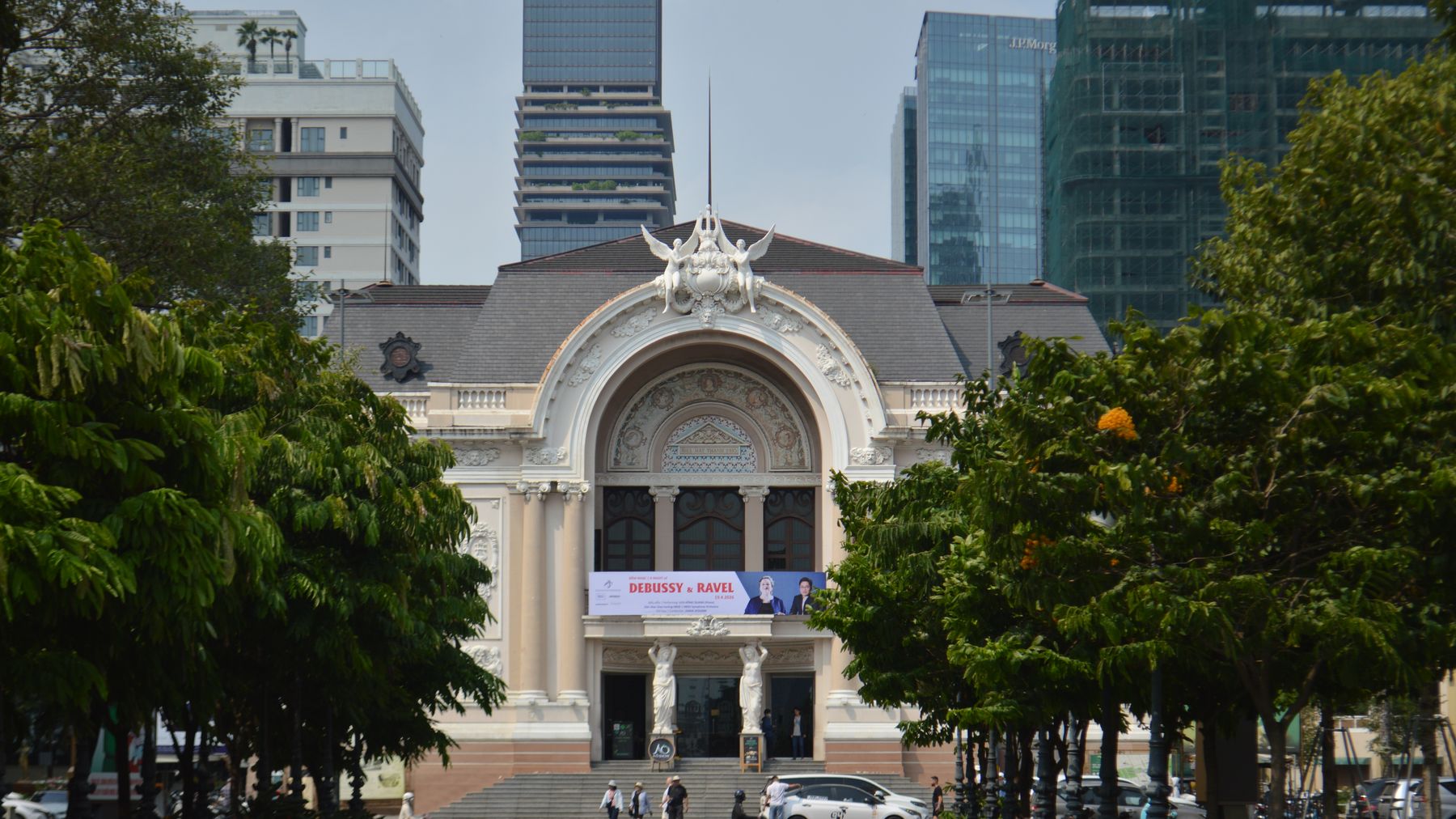
Photo by Valeria Drozdova on Pexels
Practical tips locals would tell you
- The theatre interior is only accessible during performances — you can't walk in during the day to look around unless there's an open rehearsal or exhibition.
- Dress code is relaxed by European standards. Clean clothes and closed shoes are fine; no one expects a suit.
- If you're buying tickets at the box office, cash in VND is easiest. Card machines exist but aren't always reliable.
- The area around the theatre gets crowded on weekend evenings. If you want photos without crowds, come on a Tuesday or Wednesday.
Common mistakes to avoid
- Assuming it's always open. Some travelers show up midday expecting a tour. There isn't one. Check the show schedule and plan accordingly.
- Overpaying for food on Dong Khoi itself. The restaurants directly on the boulevard charge tourist prices. Walk one or two streets over — Ly Tu Trong, Hai Ba Trung, Mac Thi Buoi — and prices drop sharply.
- Skipping it because "it's just a building." From outside, sure. But a 90-minute show inside a restored 1900 opera house, with a plate of com tam beforehand and a ca phe sua da after, is one of the better evenings you can spend in Saigon.
Practical notes
Nha Hat Thanh Pho is at 7 Lam Son Square, District 1, Ho Chi Minh City. The nearest landmark everyone knows is Ben Thanh Market, about 800 meters southwest. Budget 2–3 hours for a show plus dinner nearby, or 30 minutes if you're just walking past for photos.
Last updated · May 29, 2026 · independently researched, never sponsored.








