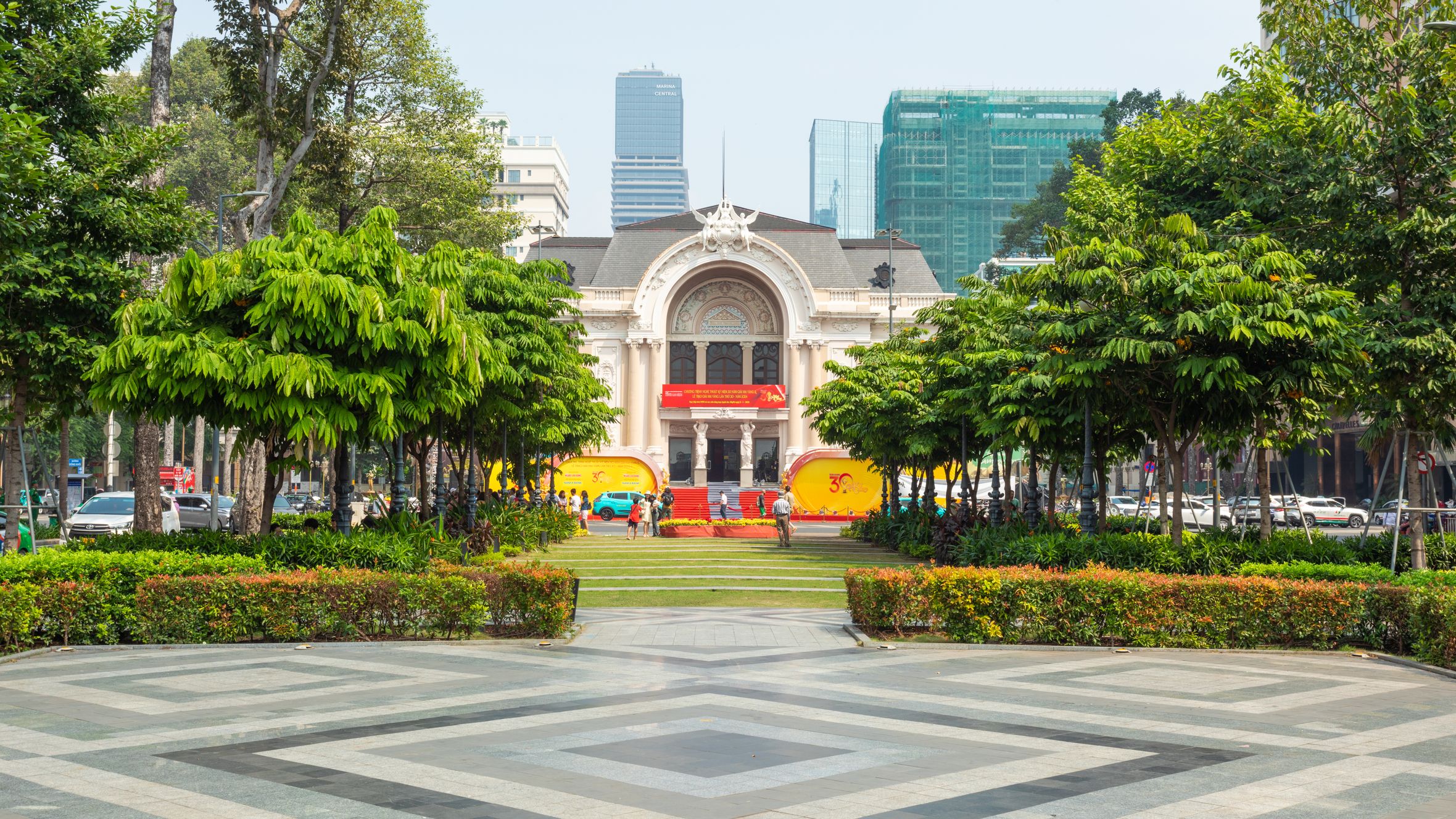
Hai Phong's Opera House — "Nha hat thanh pho" to locals — sits at the end of a wide, tree-lined boulevard in the center of Vietnam's third-largest city. It's smaller and quieter than its Hanoi and Saigon counterparts, which is exactly why it's worth a stop.
What It Is and How It Got Here
Built in 1912 during the French colonial period, the Hai Phong Opera House follows the same neoclassical template as the opera houses in Hanoi and Ho Chi Minh City (호치민시 / 胡志明市 / ホーチミン市) — stone facade, arched windows, columns flanking the entrance. The design borrows from late 19th-century French provincial theaters rather than the grander Parisian model. It seats around 400 people.
The building anchors the eastern end of Quang Truong Nha Hat (Theater Square), a public plaza that doubles as the city's social living room. On any given evening you'll find families, couples on motorbikes, and kids chasing each other across the open space. The theater itself has been renovated several times, most recently in the early 2000s, and the pale yellow exterior with white trim is kept in good shape.
Unlike Hanoi (하노이 / 河内 / ハノイ)'s Opera House, which hosts regular ticketed performances, the Hai Phong version operates on a more sporadic schedule — concerts, cultural shows, and municipal events happen here, but not nightly. The real draw for travelers is the building itself and the square around it.
Why Travelers Go
Hai Phong doesn't get a fraction of the tourist traffic that Hanoi or Ha Long Bay pull in, and that's part of the appeal. The Opera House is one of the best-preserved French colonial buildings in northern Vietnam, and you can actually stand in front of it and take photos without dodging tour groups. The square is pleasant for an evening walk, and the surrounding blocks — with their mix of crumbling shophouses and renovated cafes — give you a sense of what Hanoi's Old Quarter might have felt like twenty years ago.
If you're passing through Hai Phong on your way to Cat Ba island or Ha Long Bay, the Opera House area is the most logical place to spend a few hours in the city.
Best Time to Visit
Hai Phong is hot and humid from May through September, with heavy rain in July and August. The most comfortable months are October through December — temperatures sit around 20-25°C, humidity drops, and the light is good for photos. March and April are also fine, though occasional drizzle rolls in.
If you want to catch a performance, check around national holidays or festival periods. The Hai Phong "Do Son" buffalo fighting festival (9th lunar month, usually October) sometimes coincides with cultural programming at the theater. During Tet, the square gets decorated and fills up with locals.

Photo by Duy Nod on Pexels
How to Get There
From Hanoi, Hai Phong is about 120 km east — roughly two hours by car or bus.
- Bus: Frequent departures from Hanoi's Gia Lam or Nuoc Ngam stations. Tickets run 80,000-120,000 VND. Buses drop you at Niem Nghia station in Hai Phong; from there, a Grab to the Opera House is about 30,000-40,000 VND.
- Train: A slow but scenic option. Hanoi to Hai Phong takes about 2.5 hours. Tickets from 75,000 VND for a hard seat. The Hai Phong train station is roughly 2 km from the Opera House — walkable or a quick motorbike taxi.
- Car/Grab: The Ha Noi-Hai Phong expressway cuts the drive to under two hours. A one-way Grab from central Hanoi runs around 800,000-1,000,000 VND.
The Opera House sits on Hoang Van Thu street, right in the city center. You can't miss it — the boulevard leads straight to the facade.
What to Do
Walk the Square and Surrounding Streets
Theater Square is compact but photogenic, especially in the late afternoon when the light hits the facade. The streets radiating out — Dien Bien Phu, Hoang Van Thu, Tran Hung Dao — have some of the city's best French-era architecture. Give yourself 30-45 minutes to wander.
Check for Performances
The theater occasionally hosts traditional music ensembles, including "ca tru" performances and folk music from the northern delta region. There's no reliable online schedule — your best bet is asking at the box office or checking the Hai Phong Department of Culture's social media pages. Ticket prices are usually nominal, 50,000-150,000 VND.
Visit Hai Phong Museum
About 500 meters south of the Opera House on Dien Bien Phu street, the city museum occupies another colonial-era building. It covers local history and culture, including the city's role as a major port. Free or near-free admission. Worth 30 minutes.
Evening Coffee on the Square
A handful of cafes line the streets around the plaza. Grab a seat at one facing the theater. A "ca phe sua da" here costs 20,000-30,000 VND, and the people-watching is better than most places in Hanoi simply because nobody is watching you back.
Day-Trip to Do Son or Cat Ba
If you have a full day, combine the Opera House visit with a trip to Do Son beach (20 km south) or catch the speedboat to Cat Ba island (about 45 minutes from Binh wharf, 200,000-250,000 VND).
Where to Eat Nearby
Hai Phong has its own food identity, separate from Hanoi. Two dishes to prioritize:
- "Banh da cua" — the city's signature noodle soup, made with wide, dark-red rice noodles in a crab-based broth, topped with fried shallots, herbs, and sometimes pork ribs. Try it at any of the small shops on Cat Dai street, about 1 km from the theater. A bowl costs 35,000-50,000 VND.
- "Nem chua" — Hai Phong's fermented pork rolls are tangier and firmer than versions from Thanh Hoa. Street vendors sell them wrapped in banana leaves near Tam Bac market, a 10-minute walk north of the square. Around 5,000-10,000 VND per piece.
For a sit-down meal, the restaurants along Tran Phu street serve solid "bun ca" (fish noodle soup), another Hai Phong specialty.

Photo by Pham Huan on Pexels
Where to Stay
The Opera House area has the widest range of accommodation in the city.
- Budget: Guesthouses and mini-hotels on Minh Khai street — 250,000-400,000 VND/night. Basic but clean.
- Mid-range: Several 3-star hotels within walking distance of the square, 500,000-900,000 VND/night. Manoir Des Arts Hotel, a converted colonial building a few blocks away, is a solid pick.
- Upscale: Avani Hai Phong Harbour View is the most polished option nearby, from around 1,200,000 VND/night.
Practical Tips
- The Opera House is primarily an exterior attraction unless a show is on. Budget 1-2 hours for the building and surrounding area, not a full day.
- Hai Phong is a working port city, not a resort town. Streets are busy, air quality varies, and signage is mostly in Vietnamese. That's the charm — this is real urban Vietnam without the tourist infrastructure filter.
- Grab works well in Hai Phong. Download it before you arrive.
Common Mistakes
- Skipping Hai Phong entirely on the way to Cat Ba or Ha Long Bay. The city deserves at least a half-day. The food alone justifies a stop.
- Expecting nightly performances at the Opera House. It's not programmed like a western concert hall. Check ahead or treat it as an architectural visit.
- Visiting midday in summer. The square has almost no shade. Come in the morning or after 4 PM.
Last updated · May 29, 2026 · independently researched, never sponsored.






