Da Lat's most photographed building isn't a palace or a pagoda — it's a pastel-pink Catholic church with a copper rooster perched on its bell tower. Locals call it Nha Tho Con Ga (the Rooster Church), and it sits right at the center of town where every road in Da Lat seems to eventually lead.
What it is and how it got here
Officially named the Cathedral of the Immaculate Conception, the church was built between 1931 and 1942 during the French colonial period. The architect was a priest named Nicolas Couvrat-Desvergnes, and the design borrows heavily from 17th-century European church architecture — think arched stained-glass windows imported from Grenoble and a 47-meter bell tower visible from blocks away.
The rooster on top isn't decorative whimsy. It's a "weathervane" in the Gallic tradition — French churches historically placed a rooster (the national symbol of France) atop their steeples. This one is about 0.66 meters tall and made of copper alloy. Over the decades, the nickname stuck harder than the official one. Ask anyone in Da Lat (달랏 / 大叻 / ダラット) for "Nha Tho Con Ga" and they'll point you straight there. Ask for the Cathedral of the Immaculate Conception and you'll get a blank stare.
The church sits at 15 Tran Phu Street, right on the hill overlooking the central market area. It remains an active parish — Mass is held daily, and the building serves roughly 2,000 local Catholic parishioners.
Why travelers go
It's not just the architecture. The church grounds sit on one of Da Lat's higher points, so the views across the city's pine-covered hills are genuinely good — especially in the late afternoon when the fog starts rolling in. The building itself is one of the best-preserved French colonial structures in the Central Highlands (중부 고원 / 中部高原 / 中部高原), and the pink exterior against Da Lat's perpetually overcast sky photographs better than you'd expect.
More practically, Nha Tho Con Ga is a useful orientation landmark. It's walking distance to the Da Lat central market, Xuan Huong Lake, and most of the city's cafes and guesthouses. You'll probably pass it multiple times during any trip.
Best time to visit
Da Lat's weather is mild year-round — that's the whole reason the French built a hill station here — but the best months to visit are November through March. Skies are clearer, rain is rare, and daytime temperatures hover around 18-22°C. The church looks best in morning light, roughly 7:00-9:00 AM, when the sun hits the eastern facade and the pink walls practically glow.
Avoid visiting during Sunday morning Mass (usually 5:15 AM, 7:00 AM, and 9:30 AM) unless you're attending the service. The church interior is closed to casual visitors during worship. Weekday afternoons between 2:00 and 4:00 PM tend to be quietest.
How to get there
From Saigon, the most common route is a bus from the Mien Dong bus station. The ride takes about 6-7 hours and costs 200,000-280,000 VND depending on the operator. Thanh Buoi and Phuong Trang are the reliable names. Buses drop you at Da Lat's main bus station on Yersin Street, from which Nha Tho Con Ga is about 1.5 km uphill — a 25,000 VND taxi ride or a 20-minute walk.
If you fly, Lien Khuong Airport is 30 km south of Da Lat. Airport shuttle buses run for about 50,000 VND per person, or a taxi costs around 250,000-300,000 VND to the city center.
Once in Da Lat, the church is central enough that you can walk from most hotels. If you're staying near Xuan Huong Lake, it's a 10-minute walk up Tran Phu Street.

Photo by Thái Trường Giang on Pexels
What to do
Walk the interior
The 70 stained-glass windows are the real draw inside. They were fabricated in France and shipped over during construction — remarkably, most survived the war years intact. The light filtering through them in the morning is the kind of thing that makes you slow down and actually look. The vaulted ceiling and stone columns have a quiet weight to them that most of Da Lat's newer attractions can't match.
Climb the hill behind the church
The rear of the church grounds slopes upward into a small garden area. From here you get a clear sightline over Da Lat's rooftops, Xuan Huong Lake, and the surrounding pine forests. It's a low-effort viewpoint that doesn't require a motorbike ride to the edge of town.
Visit the side cemetery
Most visitors miss the small graveyard adjacent to the church. It contains tombs of French and Vietnamese clergy dating back to the 1940s. The inscriptions — some in French, some in Vietnamese — are a quiet reminder of Da Lat's layered history.
Photograph the rooster at golden hour
The copper rooster catches the last light of the day around 4:30-5:00 PM (depending on season). Standing on Tran Phu Street looking up at the bell tower gives you the classic shot. Bring a longer lens if you want the rooster in detail — it's higher up than it looks from the ground.
Walk downhill to the central market
Nha Tho Con Ga connects naturally to Da Lat's night market and central market area via a 5-minute downhill walk. This is one of those destinations that works best as part of a larger walking loop rather than a standalone visit.
Where to eat nearby
Da Lat's signature street food is "banh trang nuong" — sometimes called Vietnamese pizza, which is a rice paper round grilled over charcoal with egg, dried shrimp, scallions, and chili sauce. Vendors set up along the streets near the central market every evening. Expect to pay 15,000-25,000 VND per piece.
For something more substantial, try "banh canh" — thick tapioca noodle soup served with pork knuckle or crab. There are several good spots within a few blocks of the church on Le Dai Hanh Street. A bowl runs about 35,000-50,000 VND.
Da Lat also takes its coffee seriously. The city is surrounded by arabica plantations, and the local cafe culture reflects it. An egg coffee or a "ca phe sua da" at one of the hillside cafes on Tran Phu is a good way to kill thirty minutes after visiting the church.
Where to stay
Da Lat has accommodation at every price point. Budget guesthouses near the market area run 200,000-400,000 VND per night. Mid-range hotels on Phan Dinh Phung or Bui Thi Xuan streets — walking distance to the church — go for 500,000-900,000 VND. A handful of boutique places on the hills above Xuan Huong Lake charge 1,200,000-2,500,000 VND and usually include breakfast.
Staying within 1 km of the church puts you in Da Lat's most walkable zone, which matters because traffic on the narrow hillside streets can be chaotic.
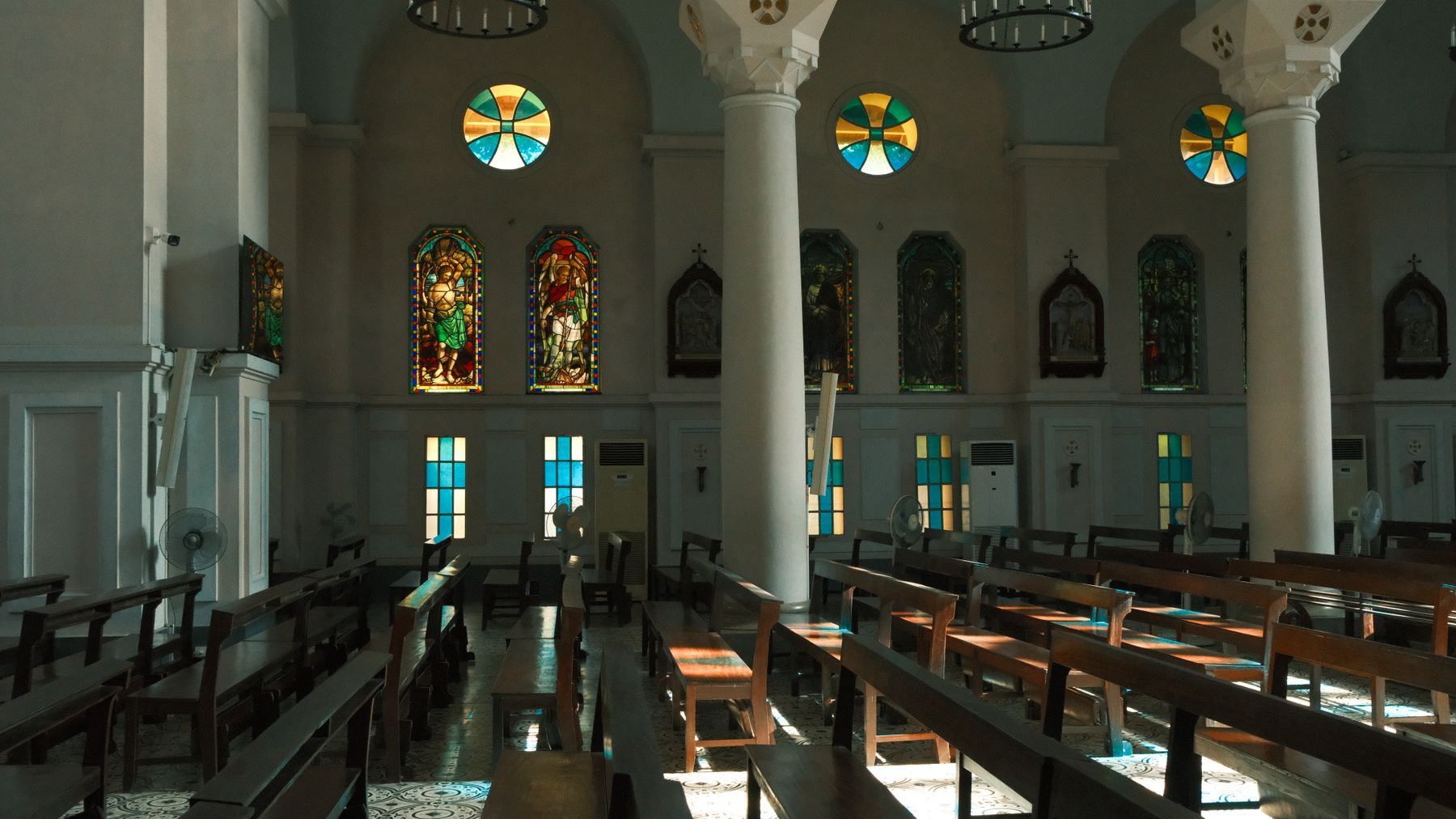
Photo by Thuan Pham on Pexels
Practical tips locals would tell you
- Bring a light jacket. Da Lat sits at 1,500 meters elevation. Even in summer, mornings and evenings drop to 15-17°C. Tourists in shorts and flip-flops stand out.
- The church is free to enter but donations are appreciated. There's a small box near the entrance.
- Dress modestly if you plan to go inside — covered shoulders and knees. This is enforced more strictly on Sundays.
- Parking a motorbike on Tran Phu Street near the church costs 5,000 VND. Don't leave your helmet on the bike.
Common mistakes to avoid
- Showing up during Mass and trying to photograph the altar. This is an active church, not a museum. Check the schedule posted at the entrance.
- Only seeing it at night. The exterior is lit after dark, but the interior and stained glass are only worth seeing in daylight.
- Rushing through in 15 minutes. The church itself takes 15 minutes, sure — but the grounds, the cemetery, the surrounding streets, and the walk to the market below turn it into a solid hour if you let it.
Practical notes
Nha Tho Con Ga is open daily, generally from 5:00 AM to 7:00 PM, with closures during Mass times. There's no entrance fee. It pairs naturally with a morning spent around Xuan Huong Lake and the Da Lat central market, both less than a kilometer away on foot.
Last updated · May 26, 2026 · independently researched, never sponsored.