What Phu My Hung actually is
Phu My Hung is a planned urban area in District 7 of Saigon, about 8 km south of the backpacker zone around Bui Vien. Built on reclaimed marshland starting in the mid-1990s as a joint venture between Vietnam (베트남 / 越南 / ベトナム) and a Taiwanese development firm, it was one of the country's first large-scale modern townships. Wide boulevards, gated compounds, international schools, and a concentration of East Asian restaurants define the neighborhood.
Locals sometimes call it "Phu My Hung" as shorthand for the entire southern stretch of District 7, though technically it refers to the development company and its central zone around Crescent Mall and the Crescent Lake.
If you're expecting Old Quarter charm or French colonial facades, recalibrate. This is Saigon (사이공 / 西贡 / サイゴン)'s version of a new-build Asian suburb — clean, orderly, and surprisingly good for eating.
Why travelers bother
Most short-stay tourists skip Phu My Hung entirely, and honestly, if you only have two days in Saigon, you probably should too. But if you're spending a week or more in the city, or you're a food-obsessed traveler, there are real reasons to come down here.
The area has Saigon's densest cluster of Korean, Japanese, and Taiwanese restaurants — many run by first-generation immigrants cooking for their own communities rather than tourists. The lakeside parks are genuinely pleasant for a morning walk, a rarity in a city where sidewalks are usually occupied by motorbikes and plastic chairs. And the contrast with central Saigon gives you a fuller picture of how the city actually works — not every neighborhood is neon signs and "banh mi" carts.
Best time to visit
Saigon's weather doesn't vary dramatically, but November through March is the most comfortable window — less rain, slightly lower humidity. Phu My Hung is particularly nice during these months because you'll actually want to walk outside along the Crescent Lake promenade without melting.
Avoid the weeks around Tet / 越南春节 / テト) (Vietnamese Lunar New Year, usually late January or early February). Many Korean and Japanese restaurants close for extended holidays, and the area feels emptied out as expat families travel.
Weekday mornings are quieter. Weekend evenings around the Crescent Mall area get busy with local families.
How to get there
From central Saigon (District 1, near Ben Thanh Market), a taxi or Grab car takes 20–35 minutes depending on traffic. Expect to pay 80,000–130,000 VND one way. Rush hour (7–9 AM, 5–7 PM) can push that toward 45 minutes.
Bus route 35 runs from Ben Thanh Market down Nguyen Huu Tho street into the heart of Phu My Hung for 6,000 VND, but it's slow — plan 45–60 minutes. Motorbike taxis via Grab Bike cost 30,000–50,000 VND and are faster if you're comfortable on two wheels.
There's no metro line here yet, though one is planned. For now, ride-hailing is the practical choice.
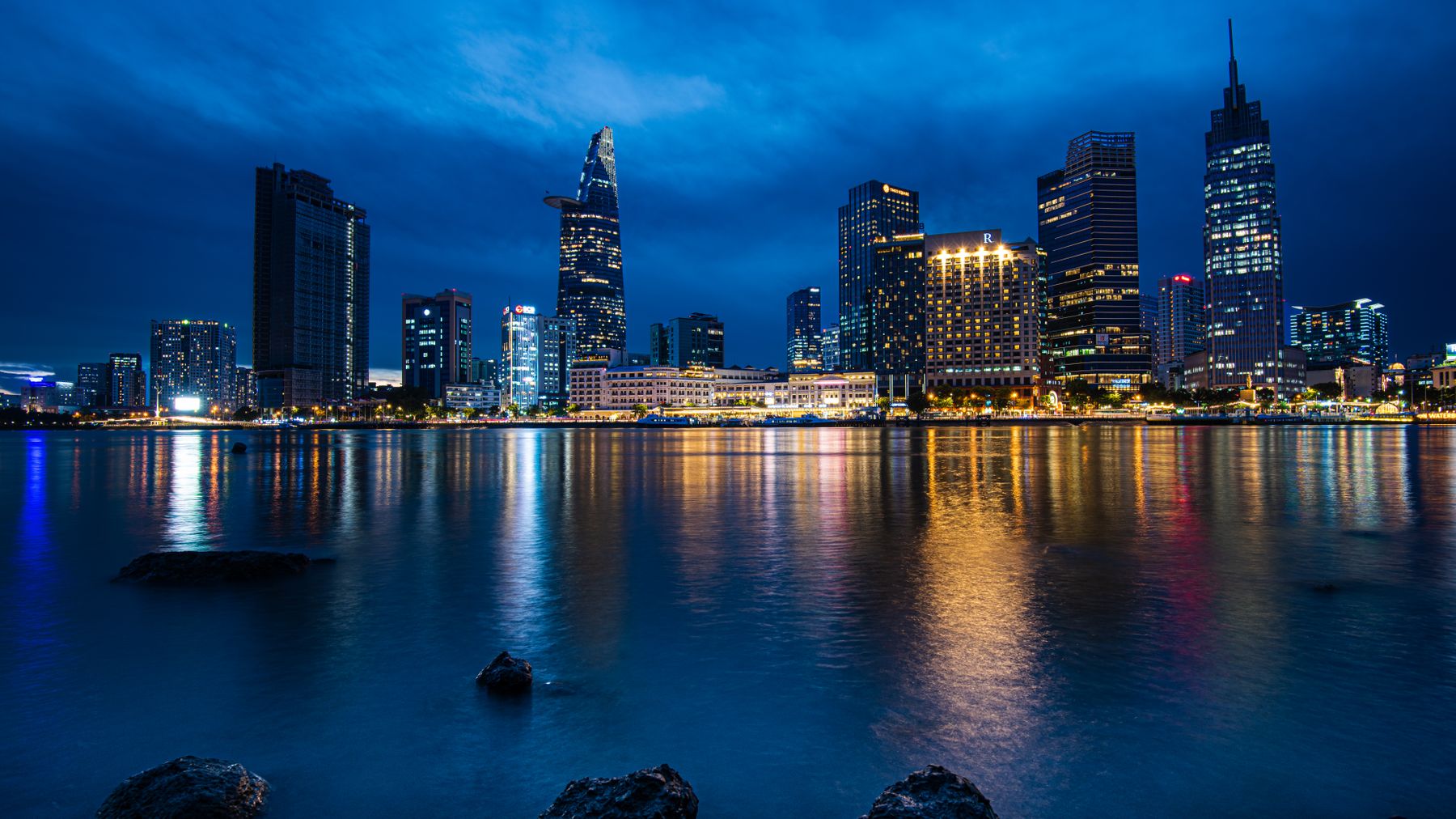
Photo by Đạt Đào on Pexels
What to do
Walk the Crescent Lake promenade
The curved pedestrian path around the Crescent Lake (Ho Trang An) is about 1.5 km and lined with cafes. Go before 8 AM to see residents doing tai chi and jogging, or after 6 PM when the buildings light up across the water. It's one of the few spots in Saigon where you can walk without dodging traffic.
Eat your way through Korea Town
The blocks around Sky Garden and Hung Vuong 3 apartment complex form an unofficial Korea Town. Restaurants like Seoul Garden BBQ and the no-frills joints on Phan Khiem Ich street serve "kimchi jjigae" and grilled pork belly to a largely Korean clientele. Prices run 120,000–250,000 VND per person — cheaper than equivalent spots in District 1.
Browse the SC VivoCity and Crescent Mall
SC VivoCity (on Nguyen Van Linh) has a decent Japanese supermarket on the lower level where you can pick up imported snacks, matcha, and bento boxes. Crescent Mall across the way is more upscale — useful for air conditioning and a Vietnamese coffee at one of the cafe chains overlooking the lake.
Visit the Ton Duc Thang Museum nearby
Not in Phu My Hung proper but a short detour on the way back to District 1, this small museum on the riverside is free and rarely crowded. It covers local history with a focus on the southern resistance period — worth 30 minutes if you're passing through.
Day-trip pairing with District 4 street food
District 4 sits between District 1 and District 7. On the way to or from Phu My Hung, stop on Vinh Khanh street for some of Saigon's best seafood — grilled "oc" (snails), tamarind crab, and "banh khot" (tiny crispy shrimp pancakes) at 50,000–100,000 VND per plate. It pairs well with a Phu My Hung morning.
Where to eat in Phu My Hung
Beyond the Korean strip, seek out a bowl of "hu tieu" — the southern-style pork and seafood noodle soup — at one of the local shops on Ton Dat Tien street. A bowl runs 45,000–60,000 VND. Phu My Hung also has reliable "com tam" (broken rice with grilled pork) joints along the edges of the residential blocks, particularly on Le Van Thiem street. Look for the ones with the longest queue of motorbike drivers at lunch.
For something different, the Japanese bakeries around Panorama building sell "shokupan"-style milk bread and pastries that rival anything in Tokyo's suburbs.
Where to stay
Most travelers won't base themselves in Phu My Hung — District 1 or District 3 are better for first-timers. But if you're here for business or prefer quiet:
- Budget: Limited options. A few guesthouses on the periphery of District 7 go for 350,000–500,000 VND/night.
- Mid-range: Serviced apartments around Crescent Mall run 800,000–1,500,000 VND/night and often include a small kitchen.
- Upper: Hotel Nikko Saigon, right in the Phu My Hung core, targets Japanese business travelers. Rooms from around 2,000,000 VND/night.

Photo by Vuong on Pexels
Practical tips locals would tell you
- Grab, not walking. Phu My Hung is spread out and designed for cars. Blocks are long, shade is limited, and sidewalks sometimes just end. Use Grab Bike to hop between spots.
- Bring cash for small restaurants. The malls take cards, but the Korean and Vietnamese street-level joints are often cash-only.
- Lunchtime is peak. The best local food stalls sell out by 1 PM. Come at 11:30 if you want the full selection.
- Language: English is less common here than in District 1. Korean signage is everywhere. Google Translate's camera function helps with menus.
Common mistakes to avoid
- Expecting a tourist district. There are no hostels, no tour desks, no one handing out bar crawl flyers. This is a residential area where people live and eat well. Adjust your expectations.
- Coming only for the malls. The malls are fine, but you can find malls anywhere. Come for the food and the neighborhood texture.
- Skipping District 4 on the way. The route between District 1 and Phu My Hung passes right through District 4's street food corridor. Not stopping is a missed opportunity.
Practical notes
Phu My Hung works best as a half-day detour from central Saigon, ideally combined with lunch. It won't make anyone's highlight reel, but if you're the kind of traveler who likes seeing how a city actually functions beyond the tourist core, it's a worthwhile ride south.
Last updated · May 29, 2026 · independently researched, never sponsored.