What is Quan Hoa and why should you care?
Quan Hoa is a rural district tucked into the limestone-karst landscape on the edges of the greater Hai Phong area in northern Vietnam. It doesn't appear on most tourist radars, and that's precisely the point. If you've already done Ha Long Bay and Ninh Binh (닌빈 / 宁平 / ニンビン) and want something rougher around the edges — less polished, more lived-in — Quan Hoa is worth the detour.
The area sits along river valleys flanked by karst hills, with small villages, weekly markets, and rice paddies that shift color through the seasons. It's not a place with a checklist of attractions. It's a place you go to slow down, eat well, and see how the northern Vietnamese countryside actually works when it's not performing for tourists.
Brief history
Quan Hoa has historically been an agricultural and fishing area, shaped by the Red River Delta's network of waterways. The district's economy still revolves around rice cultivation, aquaculture, and small-scale trade. Local temples and communal houses ("dinh") date back several centuries, reflecting the deep roots of village life in the north. There's no single famous monument here — the appeal is the texture of the whole place rather than any one landmark.
Why travelers go
Most visitors who end up in Quan Hoa are either cycling through the northern delta, looking for a base to explore the countryside outside Hai Phong proper, or chasing specific food experiences. The area is also a natural stopover if you're traveling overland between Hanoi, Hai Phong, and the coast.
What you get here: karst scenery that's less dramatic than Ninh Binh but also less crowded, village markets where you're the only foreigner, and a pace that makes even Hai Phong city feel hectic.
Best time to visit
The sweet spot is October through December — the air is cool and dry, rice harvest is underway or just finished, and the light over the paddies in the late afternoon is genuinely good. March through May is also pleasant before the summer humidity kicks in.
Avoid June through August if you can. The heat is heavy, rain comes in sudden downpours, and some of the smaller roads around the district turn muddy. It's not impassable, but it's less enjoyable on a motorbike or bicycle.

Photo by Quang Nguyen Vinh on Pexels
How to get there
From Hanoi (하노이 / 河内 / ハノイ), the most practical route is to take a bus or drive to Hai Phong first — about 120 km, roughly two hours by car or express bus from My Dinh or Gia Lam stations. Bus tickets run 80,000–120,000 VND depending on the operator.
From Hai Phong city center, Quan Hoa is another 30–45 minutes by motorbike or local bus heading inland. A Grab car from central Hai Phong will cost around 150,000–200,000 VND one way. If you're renting a motorbike in Hai Phong (around 120,000–150,000 VND per day), that's the most flexible option for exploring the district's back roads.
There's no train station in the district. The nearest railway stop is Hai Phong station.
What to do
Ride the back roads by motorbike or bicycle
The narrow roads winding between rice paddies and limestone outcrops are the main draw. There's no set route — just pick a direction and follow the smaller paths. You'll pass through villages with communal houses, fish ponds, and roadside tea stalls. A half-day loop of 30–40 km covers a good cross-section.
Visit a village market
Local markets operate on rotating schedules, typically every five days. They're not tourist markets — expect baskets of river fish, vegetables, "nem chua" (fermented pork rolls), betel nut, and household goods. Get there before 8 AM for the full experience. Ask your guesthouse host for the nearest market day.
Explore a riverside "dinh" (communal house)
Several villages maintain centuries-old communal houses that serve as the social and spiritual center of community life. These wooden structures with curved roofs are usually open to respectful visitors. Look for the ones along the riverbanks — they're typically the oldest and best-maintained.
Walk along the river
The waterways here are working rivers — fishing boats, small ferries, aquaculture pens. An early morning walk along the banks gives you a front-row seat to daily life. Some stretches have basic paths; others require walking along the raised dykes between paddies.
Stop at a local pagoda
Small Buddhist pagodas dot the district, usually set against limestone hills. None are famous in the way Bai Dinh or Tran Quoc Pagoda are, but they're peaceful and almost always empty. The caretakers will often invite you for tea.
Where to eat nearby
Hai Phong is famous for "banh da cua" — a crab noodle soup made with wide, reddish-brown rice noodles. You'll find versions of it in Quan Hoa's small town centers, usually for 25,000–35,000 VND a bowl. It's the signature dish of the region, and the local versions are less fussy than what you get in Hai Phong city.
Also look for "banh mi" carts — the Hai Phong style uses a slightly different bread and often includes a pate that's more aggressively seasoned than the Saigon version. A sandwich costs 15,000–20,000 VND.
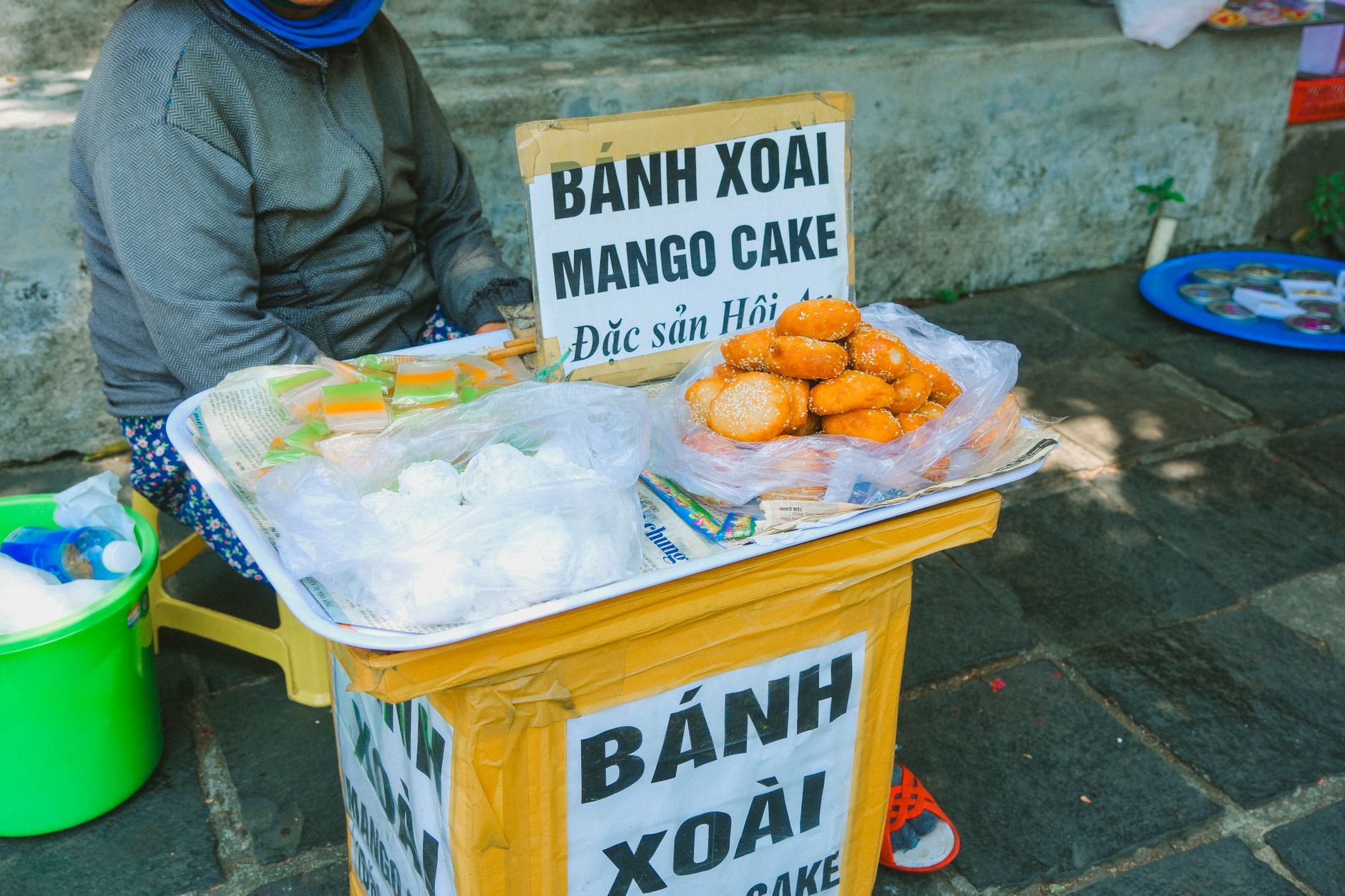
For something more substantial, look for "com binh dan" (everyday rice meals) shops near any market area. Point at what looks good, sit on a plastic stool, and expect to pay 30,000–40,000 VND for a full plate with meat and vegetables.

Photo by Vietnam Tri Duong Photographer on Pexels
Where to stay
Accommodation in Quan Hoa is basic. You're looking at local guesthouses ("nha nghi") in the 150,000–300,000 VND per night range. Rooms are clean but simple — expect a fan, hot water, and not much else. Wi-Fi is hit or miss.
If you want more comfort, base yourself in Hai Phong city and day-trip to Quan Hoa. Hai Phong has a decent range of hotels from 400,000 VND budget rooms to proper mid-range options around 800,000–1,200,000 VND.
Practical tips locals would tell you
- Carry cash. There are very few ATMs in the district and almost no card payment. Withdraw in Hai Phong before heading out.
- Learn a few Vietnamese phrases. English is essentially nonexistent here. "Xin chao" (hello), "Cam on" (thanks), and pointing go a long way.
- Bring sunscreen and a hat. Shade is sparse on the open roads between villages.
- Fill up your motorbike tank in town. Fuel stops are infrequent once you're on the back roads.
- Download offline maps. Google Maps works, but cell signal drops in some of the more remote stretches.
Common mistakes to avoid
Don't come expecting a curated tourist experience. There are no ticket offices, no English signage, and no tour buses. That's the appeal, but it also means you need to be self-sufficient.
Don't try to cover too much in one day. The roads are slow — 20 km/h is a realistic average on the smaller paths. Plan for a relaxed pace rather than an ambitious route.
Don't skip Hai Phong city entirely. Spending a night there before or after gives you access to the city's excellent seafood, its French colonial architecture, and a proper cup of Vietnamese coffee at one of the old-school cafes downtown.
Practical notes
Quan Hoa works best as a one- or two-day side trip from Hai Phong rather than a standalone destination. Pair it with a visit to Cat Ba island or a loop through the northern delta for a well-rounded trip through this part of the north. The less you plan, the more you'll find.
Last updated · May 29, 2026 · independently researched, never sponsored.