Thanh Hoa province doesn't show up on most travel itineraries, which is part of the appeal. Thac Voi — literally "Elephant Waterfall" — sits in the heavily forested western hills of the province, a genuine day trip or overnight destination that rewards the drive with cool air, layered rock pools, and a crowd-free afternoon.
What Thac Voi is and why it's called that
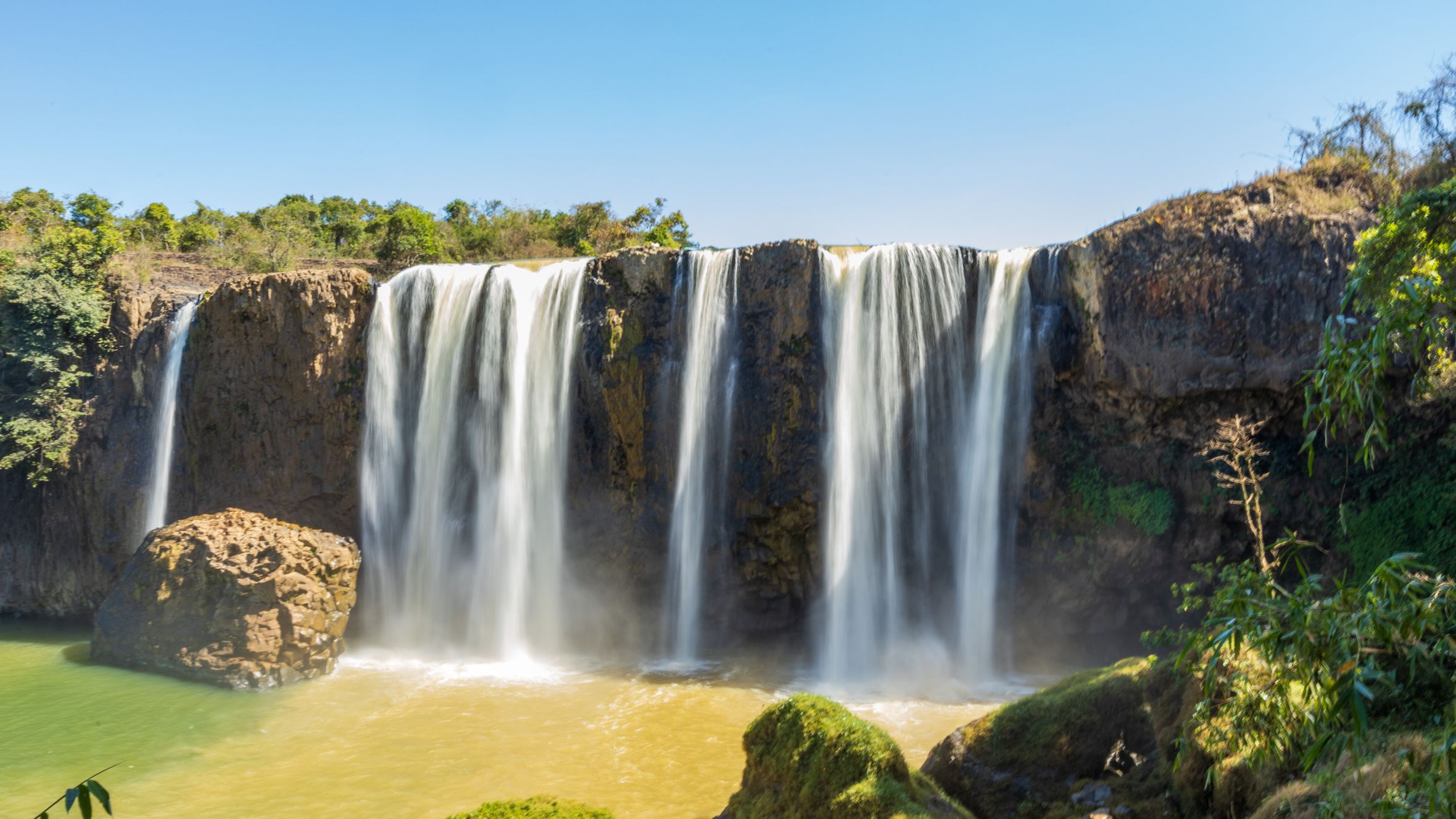
Thac Voi is a multi-tiered waterfall located in Thuong Xuan district, roughly 100 km southwest of Thanh Hoa city. The falls drop through several levels of mossy rock, with the main cascade around 25-30 meters high. The name comes from the shape of a large boulder near the base that, depending on your imagination and the light, resembles an elephant drinking from the pool below.
The area is part of a broader stretch of forest that connects toward the Laotian border, and the surrounding Thuong Xuan district is home to ethnic Thai and Muong communities. Locals have used the pools around the falls for generations — this isn't a recently "discovered" tourism site, just one that hasn't been heavily commercialized.
Why travelers go
People come here for the simplicity of it. There's no entrance complex with souvenir shops and selfie platforms. You walk a forested trail, you reach the falls, you swim if the water level is right. The rock pools at the lower tiers are shallow enough to sit in, and the surrounding forest keeps the temperature noticeably cooler than Thanh Hoa city, especially in summer. If you're traveling through the central coast and want a break from beaches and temples, this is one way to get it.
Birdwatchers and anyone who likes butterflies will find the trail rewarding — the diversity picks up in the wet months.
Best time to visit
The sweet spot is September through November, when the rainy season has filled the falls but the trails aren't washed out. The cascade is most dramatic in October, after the heaviest rains. December through February is drier and cooler, which makes for comfortable hiking but thinner water flow.
Avoid the peak of the rainy season in July and August if you don't want to deal with muddy trails and possible flash flooding in the lower pools. March through May is hot and increasingly dry — the falls can slow to a trickle by late April in a low-rainfall year.
How to get there from Thanh Hoa city
From Thanh Hoa city center, the drive to Thuong Xuan district takes around 2 to 2.5 hours via QL47 heading west. The road is paved the whole way but narrows significantly in the last 15-20 km.
- Motorbike rental from Thanh Hoa city runs about 120,000-180,000 VND/day. This is the most flexible option. Fill up before leaving town — fuel stops thin out past Lang Chanh.
- Private car or taxi to the trailhead area costs roughly 800,000-1,200,000 VND round trip, depending on your negotiation and whether the driver waits.
- Local bus to Thuong Xuan town leaves from Thanh Hoa bus station (around 60,000-80,000 VND), but from there you'll still need a "xe om" (motorbike taxi) for the last stretch, roughly 30,000-50,000 VND.
There's no Grab coverage once you leave Thanh Hoa city, so arrange return transport in advance.

Photo by Quang Nguyen Vinh on Pexels
What to do
Hike the trail to the main falls
The trail from the parking area to the base of the main cascade is about 1.5 km through dense canopy. It takes 30-45 minutes at a relaxed pace, with some uneven rocky sections. Wear shoes with grip — flip-flops are a recipe for a twisted ankle.
Swim in the lower rock pools
Below the main falls, water collects in a series of natural pools carved into the rock. In the wet season, these are deep enough to swim in. In drier months, they're more like wading pools, but still cold enough to feel refreshing after the walk in.
Visit a Thai village nearby
Several ethnic Thai communities live in the Thuong Xuan area. Some families in villages along the main road offer basic homestays and can arrange meals of local food — sticky rice steamed in bamboo tubes, grilled stream fish, and forest greens. This isn't organized tourism; it's more like knocking on a door and asking politely. A few words of Vietnamese help.
Walk the upper trail for views
A rougher trail continues above the main falls to a viewpoint overlooking the valley. It adds another 45 minutes to an hour and the path is steep in sections, but the panoramic view of the forested hills is the payoff. Best in the early morning before haze builds.
Photograph the butterflies
This sounds niche, but in September and October, the trail is genuinely thick with butterflies — dozens of species congregating around puddles on the path. Macro lens optional but rewarding.
Where to eat nearby
Don't expect restaurants at the falls. Eat before or after in Thuong Xuan town or along the road back toward Thanh Hoa.
- "Com lam" — sticky rice cooked inside bamboo tubes — is the local specialty in the Thai villages around Thuong Xuan. Often served with grilled pork or dried buffalo meat. A full meal at a roadside stall runs 40,000-70,000 VND.
- Back in Thanh Hoa city, seek out "nem chua" — the province's famous fermented pork rolls, wrapped in banana leaf. They're sold everywhere and make a solid snack. The area around Cho Thanh Hoa (Thanh Hoa market) is a reliable place to find fresh batches.
Where to stay
- Thuong Xuan homestays: Basic rooms in Thai stilt houses, 150,000-300,000 VND per night. Don't expect hot water or air conditioning. Do expect genuine hospitality and possibly rice wine.
- Guesthouses in Lang Chanh or Thuong Xuan town: Simple but functional, 200,000-400,000 VND. Rooms have fans, some have AC.
- Thanh Hoa city hotels: If you prefer a proper bed and reliable WiFi, stay in the city and day-trip it. Budget hotels start around 300,000 VND; mid-range options with breakfast run 500,000-800,000 VND.

Photo by Hiếu Vũ Vlog on Pexels
Practical tips locals would tell you
- Bring your own water and snacks. There's nothing for sale at the falls.
- Mosquito repellent is not optional, especially in the wet months.
- The trail gets slippery after rain. A walking stick — even a branch picked up trailside — helps.
- Mobile signal (Viettel) is patchy near the falls but usually works in Thuong Xuan town.
- If you're driving a motorbike, watch for water buffalo on the road in the last 20 km. They don't move for horns.
Common mistakes to avoid
- Going in the dry season and being disappointed. If it hasn't rained in weeks, the falls can look underwhelming. Check recent photos from Vietnamese travel groups on Facebook before committing to the trip.
- Not arranging return transport. Getting to the falls is straightforward, but getting back can leave you stranded if your driver doesn't wait and there's no phone signal.
- Underestimating the distance. It's only 100 km from Thanh Hoa city, but the winding roads in the last stretch slow things down. Budget a full day, not a quick afternoon.
- Littering. This should go without saying, but the site has no cleanup crew. Whatever you carry in, carry out.
Practical notes
Thac Voi works best as part of a broader Thanh Hoa province trip — combine it with the coast at Sam Son beach or the historical sites around Hoa Lu and Ninh Binh (닌빈 / 宁平 / ニンビン) to the north. It's a quiet, low-key destination that rewards people who don't mind a bit of dirt on their shoes and the absence of a gift shop.
Last updated · May 26, 2026 · independently researched, never sponsored.