Thap Tuong Long sits on a hillside in Do Son, the coastal district of Hai Phong that most visitors only associate with beaches and weekend getaways. The tower is a relatively recent reconstruction of a Ly Dynasty-era structure, but the site itself has genuine historical weight — and on a clear day, the panorama from the hilltop justifies the detour.
What it is and why it matters
The original Tuong Long tower was built during the Ly Dynasty, roughly in the 11th century, as part of a network of Buddhist structures along Vietnam (베트남 / 越南 / ベトナム)'s northern coast. Like many historical sites in the north, it was destroyed over the centuries through war and neglect. What stands today is a modern reconstruction completed in 2017, built on the original foundation site on Ngoc Son mountain in Do Son.
The tower rises nine stories — about 42 meters — and follows traditional Vietnamese Buddhist architecture. Inside, each floor holds Buddhist statues and carvings referencing Ly Dynasty art. The complex around the tower includes a pagoda courtyard, bell pavilion, and a ceremonial gate. It is not ancient in the way that, say, the Imperial Citadel Thang Long in Hanoi is ancient. But the location is historically verified, the craftsmanship is serious, and the hilltop setting overlooking the East Sea gives it a presence that most modern temple builds lack.
Note for trip planning: following the recent administrative merger, the former Hai Duong province is now part of greater Hai Phong. Thap Tuong Long remains in the Do Son area, which has always been Hai Phong proper — so this change doesn't affect how you get there.
Why travelers go
Most foreign visitors to Hai Phong skip Do Son entirely, heading straight for Cat Ba island. That's fair — Cat Ba is excellent. But if you have a spare half-day, Thap Tuong Long offers something different from the usual northern Vietnam temple circuit. The hilltop is quieter than comparable sites around Hanoi (하노이 / 河内 / ハノイ), the tower's height gives you genuine coastal views rather than the usual courtyard-and-incense-smoke experience, and the surrounding Do Son peninsula has its own low-key charm.
Vietnamese visitors come here for pilgrimage, especially during lunar festivals. For everyone else, it is a clean, well-maintained site with actual elevation — which in the flatlands of the Red River Delta counts for something.
Best time to visit
September through November is ideal. The summer heat has broken, skies tend to be clearer than during the humid months of June through August, and you avoid the drizzly grey of December through February. Weekdays are noticeably less crowded than weekends year-round.
If you visit during Tet or other major lunar holidays, expect large crowds of Vietnamese pilgrims. The atmosphere is lively but the stairs up the tower get congested.
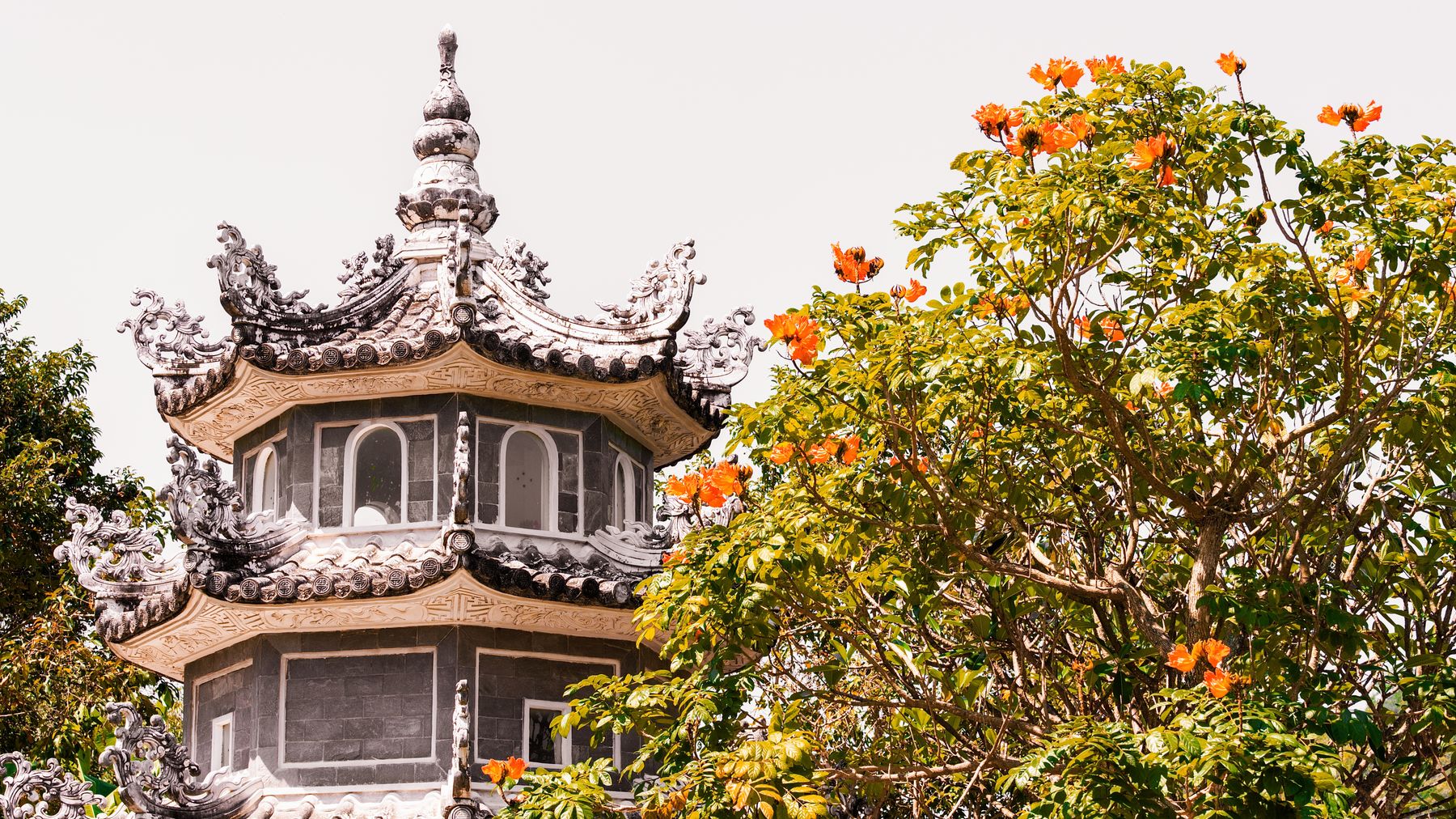
Photo by ㅤ quang vinh ㅤ on Pexels
How to get there from Hanoi
Hai Phong is the obvious staging point. From Hanoi, you have two solid options:
- Bus: Frequent departures from My Dinh or Giap Bat bus stations. The ride takes about 2 hours on the expressway. Tickets run 90,000–120,000 VND depending on the operator. Hoang Long and Phia Bac are reliable.
- Train: Hanoi to Hai Phong station, roughly 2.5 hours. Tickets from about 75,000 VND for a hard seat. The train is slower but more comfortable and drops you closer to the city center.
From Hai Phong city center to Do Son, it is another 20 km southeast. A Grab car costs around 150,000–200,000 VND one way. Local buses (route 01) run to Do Son for about 10,000 VND but take longer and drop you at the Do Son bus station, from which you would still need a xe om or short taxi ride to the tower complex.
Total door-to-door from central Hanoi: plan for about 3–3.5 hours.
What to do at the site
Climb the tower
The staircase inside winds up all nine floors. Each level has a small balcony or window opening. The views improve dramatically above the fifth floor — the top level gives you a 360-degree sweep over the Do Son coastline, the harbor, and on clear days, the outlines of Cat Ba in the distance. Budget 30–40 minutes for a relaxed climb with stops.
Walk the pagoda complex
The grounds around the base include a main worship hall, gardens, and stone carvings. The bell pavilion is worth a pause. The whole complex is well maintained and relatively compact — you can see it all in 20 minutes.
Hike the hillside paths
Ngoc Son hill has a few trails that loop through pine and casuarina trees around the tower complex. Nothing strenuous, but a pleasant walk with partial sea views. Good for stretching your legs after the drive from Hai Phong.
Visit Do Son beach afterward
Do Son's beaches are not the country's finest, but Beach Zone 2 (Khu 2) is decent for a quick swim or a seafood lunch with your feet in the sand. It is about 3 km from the tower.
Catch sunset from the hilltop
If your timing works, the westward views from the tower complex at dusk are genuinely good. The light over the estuary and the silhouettes of fishing boats make it worth lingering.
Where to eat nearby
Do Son is known for seafood, not refined cuisine. Head to the string of restaurants along the beachfront road for fresh crab, mantis shrimp, and grilled clams — expect to pay 200,000–400,000 VND per person for a full spread.
For something more specific to Hai Phong, seek out "banh da cua" — a crab noodle soup made with flat red-brown rice noodles that is the city's signature dish. You will find better bowls in Hai Phong city center than in Do Son, so save this for the return trip. A bowl runs 35,000–50,000 VND.
If you pass through central Hai Phong, the city also does a solid "banh mi" — the local style uses a slightly different bread and generous pate. Stalls near Tam Bac lake are a reliable bet.

Photo by Hugo Heimendinger on Pexels
Where to stay
Most travelers base themselves in Hai Phong city center and visit Thap Tuong Long as a half-day trip. Budget hotels in Hai Phong run 300,000–500,000 VND per night; mid-range options around 700,000–1,200,000 VND.
If you want to stay in Do Son itself, there are beachfront hotels and resorts ranging from 400,000 VND for basic rooms to 2,000,000+ VND for the nicer properties. Do Son is quiet on weekdays and busy on weekends — book ahead if arriving on a Saturday.
Practical tips
- Dress modestly at the tower and pagoda. Shoulders and knees covered. This is an active place of worship.
- Bring water. The climb is not extreme but there is no vendor inside the tower itself.
- Entry is free as of early 2025, though donation boxes are present.
- Shoes off when entering worship halls at the base complex, not inside the tower itself.
- Combine with a trip to Cat Ba if you have a full day — the Got ferry terminal is about 25 km from Do Son.
Common mistakes to avoid
Don't come expecting a preserved ancient monument — this is a reconstruction, and if you arrive thinking otherwise you will be disappointed. Appreciate it for what it is: a well-executed modern build on a historically significant site with excellent views.
Don't visit only on a weekend afternoon — the parking area fills up and the tower staircase gets slow with large tour groups. Early morning or weekday visits are a different experience entirely.
Don't skip Hai Phong city center entirely. The old French Quarter streets near the opera house, a bowl of banh da cua, and an afternoon vietnamese coffee at one of the old shophouse cafes make the city worth a few hours on its own.
Last updated · May 26, 2026 · independently researched, never sponsored.