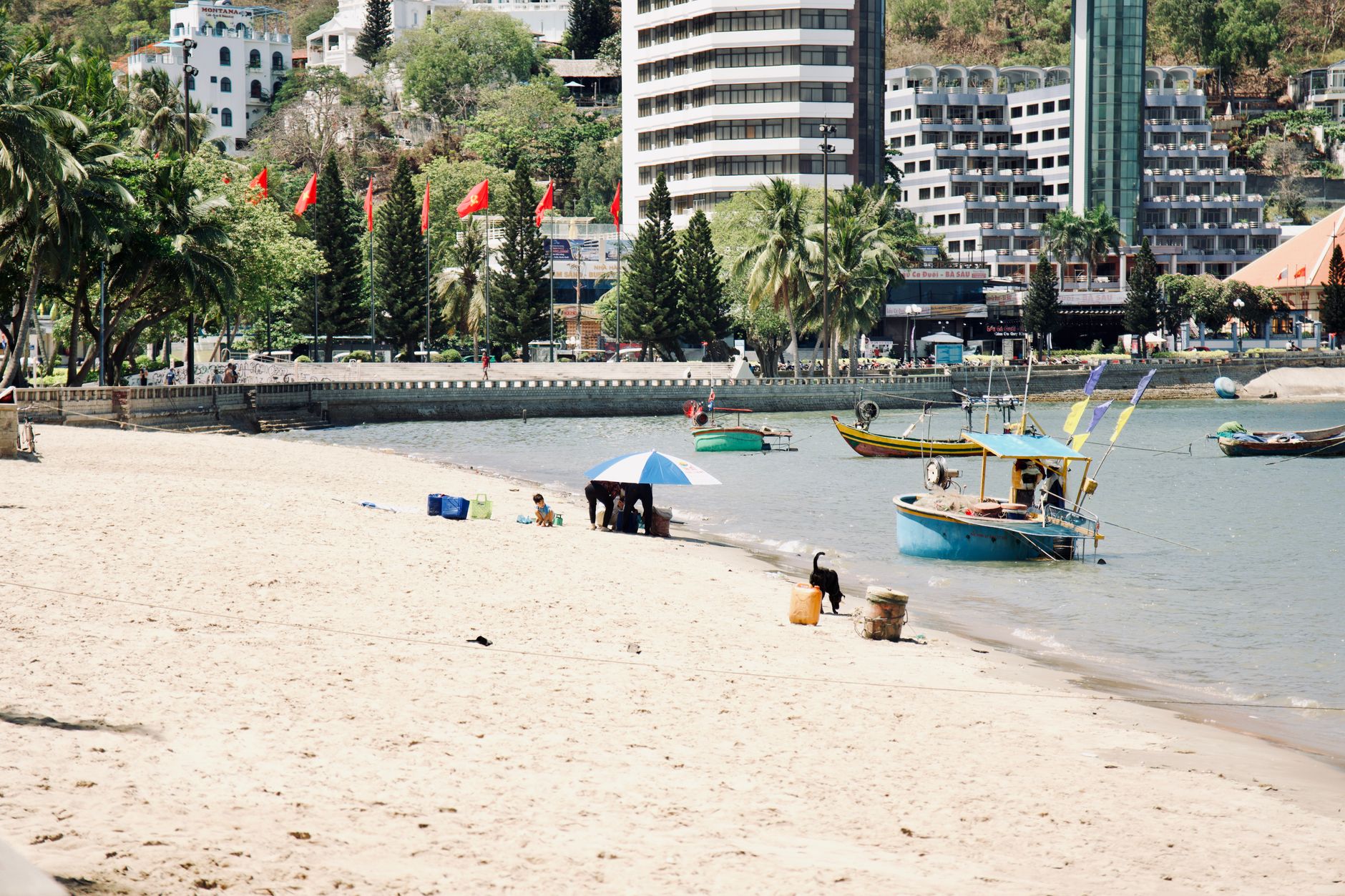
The restaurants with 4.8 stars and 300 reviews in Vung Tau are fine. But the cook who's been ladling "bun rieu" at the back of Cho Vung Tau since 1991 has never once been tagged on Instagram, and her bowl is better. Here's how to eat like someone who actually lives here.
Why the No-Name Places Are Usually the Better Ones
Vung Tau (붕따우 / 头顿 / ブンタウ) is a weekend city. Saigon empties out on Friday nights and flows 125 km southeast to the coast. That means most of the visible, sign-fronted restaurants on Tran Phu and Quang Trung are calibrated for day-trippers who won't be back for a month. The cook in the alley, by contrast, is feeding the same retired fisherman, the same motorbike repair guys, the same schoolteachers every single day. She can't get away with a bad bowl. Consistency is her only marketing.
This is the logic that should guide your eating.
Cho Vung Tau — Go Before 7am
Vung Tau's central market, roughly bounded by Nam Ky Khoi Nghia and Xo Viet Nghe Tinh streets, is the obvious starting point. But most visitors arrive after 9am, by which time the best stalls have sold out and packed up.
Get there between 5:30 and 7am. Walk past the produce section toward the interior food court. Look for the woman with the largest crowd and the smallest table. That's almost always the right call.
What you'll find changes by day, but regulars come for "banh canh cha ca" — thick udon-style noodles in a clear broth with fried fish cake. A bowl runs about 30,000–35,000 VND. There are no menus. Point at what the person next to you is eating if you're unsure.
The fish cake is local — Vung Tau sits on a working fishing bay — and the difference between fresh-made cha ca here and the rubbery discs you get at tourist-facing places is significant.
The Alley Behind Lang Ca Ong
Lang Ca Ong is the whale temple on Hoang Hoa Tham street — a legitimate cultural site worth seeing on its own. "Ca Ong" (Mr. Whale) veneration is a coastal tradition across southern Vietnam (베트남 / 越南 / ベトナム); fishermen here still conduct annual ceremonies.
But the alley immediately behind and beside the temple complex has a cluster of lunch stalls that run from about 10am to 1pm, then vanish. No signs. Plastic chairs on the pavement.
The thing to order here is "com tam" — broken rice — but specifically the version assembled by the stall closest to the temple's rear gate. She does a pork chop that's been marinated in lemongrass long enough to actually taste it, not just smell it. Plate with egg, pickled daikon, and fish sauce: 45,000 VND. She doesn't have a phone number. She'll be there tomorrow if the weather's decent.

Photo by Quang Vuong on Pexels
Noodle Soups That Move
One category of Vung Tau street food that confuses visitors is the "ganh hang rong" — the roaming vendor who carries two baskets on a shoulder pole. You'll see them in the residential blocks north of the Back Beach (Bai Sau), particularly around the Thang Tam and Nguyen An Ninh area in the early morning.
These vendors typically sell one thing: "hu tieu" or "bun thang"-adjacent soups assembled on the spot from a charcoal-heated pot slung between the baskets. A bowl runs 25,000–30,000 VND. Flagging one down feels awkward the first time; just make eye contact and hold up one finger. They'll stop.
The broth is usually pork-based, cleaner and lighter than what you get at a fixed stall because the vendor can't afford to waste a drop — they carry everything they have.
Banh Mi at the Traffic Circle, Not the Shop
There's a well-reviewed "banh mi" shop on Le Loi that does fine work. Skip it on weekday mornings and instead find the woman with the cart at the roundabout where Le Hong Phong meets Nguyen Truong To, operating from around 6 to 8:30am.
Her bread comes from a bakery two streets over and arrives still warm. The pate is house-made. She assembles maybe 15–20 sandwiches an hour and has no incentive to rush. Price: 20,000–25,000 VND depending on fillings. She is not on any app. There is no QR code.

Photo by Vuong on Pexels
How to Find These Places Yourself
The method is simple and works everywhere in Vietnam, not just Vung Tau:
Watch for plastic chairs at ankle height. The lower the seating, the more local the crowd, as a general rule.
Follow utility workers. Construction crews, garbage collectors, and motorbike mechanics eat early, eat cheap, and eat well. If five of them are crouched around the same cart at 6:30am, there's a reason.
Ask at your guesthouse, not your hotel. Hotel staff will send you somewhere with an English menu. A family guesthouse owner will tell you where she actually buys breakfast.
Learn two phrases: "Cho toi mot to" (one bowl for me) and "O day co gi ngon?" (what's good here?). Pronunciation will be rough but the effort is noticed and usually rewarded with an actual recommendation, not a tourist deflection.
What to Expect
No English. No card payments — bring small bills, 10,000 and 20,000 VND denominations. No guarantee the stall will be there next month; these are informal operations tied to the health and schedule of one person. Eat what's in front of you without overthinking it.
The food will occasionally be uneven. Occasionally a stall will be closed. That's part of it. The average quality across twenty of these places beats the average quality across twenty reviewed restaurants on any platform, and the cost is a third of the price.
Practical Notes
Vung Tau's street food scene is most active on weekday mornings before 8am and again at the early dinner hour around 5–6pm. Weekends bring more competition from Saigon visitors, and some stall operators take Sunday off entirely. A rented motorbike (around 120,000–150,000 VND per day from guesthouses near the Back Beach) is the only practical way to cover the ground needed to eat this way properly.
Last updated · May 29, 2026 · independently researched, never sponsored.