
Banh chung is not just festival food. It is the single dish most Vietnamese northerners would point to if you asked them to name something that belongs to their culture, full stop. Understanding it tells you more about Vietnam (베트남 / 越南 / ベトナム) than most museum visits will.
The Legend Behind the Shape
The origin story traces back to the Hung Kings era — the semi-mythological period that the Hung Kings Festival commemorates each spring. Prince Lang Lieu, the eighteenth son of King Hung the Sixth, was the poorest of the royal children and could not afford rare ingredients when the king asked his sons to prepare a dish worthy of heaven. He dreamed of using glutinous rice — the most honest, abundant food of the land — to create two cakes: one round, representing the sky, and one square, representing the earth.
The king chose Lang Lieu's cakes above all the elaborate offerings his wealthier brothers brought. The square cake became banh chung (반쯩 / 粽子 / バインチュン). The round one, still eaten in the south and central regions, is "banh tet".
The shape is not decorative. Every fold of the dong leaf (a broad, dark-green leaf from the Phrynium plant) is deliberate, and the square form is meant to echo the Vietnamese concept of the earth as a flat, four-cornered plane. When you sit down to eat banh chung at Tet / 越南春节 / テト), you are, at least symbolically, eating the earth.
What Goes Into It
A canonical banh chung has three components layered inside the glutinous rice: split mung beans ("dau xanh"), fatty pork belly ("thit lon"), and sometimes a scattering of black pepper. The mung beans are soaked, steamed, and mashed into a dense paste. The pork is cut into thick slices and often marinated lightly with fish sauce and shallots.
The rice itself — "gao nep", short-grain glutinous — is soaked overnight before assembly. It is not seasoned heavily; the flavor comes from the leaves as much as the filling. After a long boil, the dong leaves leach a faint grassiness into the rice that gives banh chung its distinctive color: a deep, matte olive-green that you will not get from banana leaves or plastic wrap.
Variants exist. "Banh chung gac" swaps plain glutinous rice for rice mixed with "gac" fruit pulp, which turns the exterior a dramatic rust-red and adds a slight sweetness — common at weddings and the first days of Tet when color matters. "Banh chung chay" replaces the pork with additional mung bean or mushroom for vegetarian households. Some rural producers in the north add taro or chestnuts to the filling, though purists in Hanoi tend to find that unnecessary.
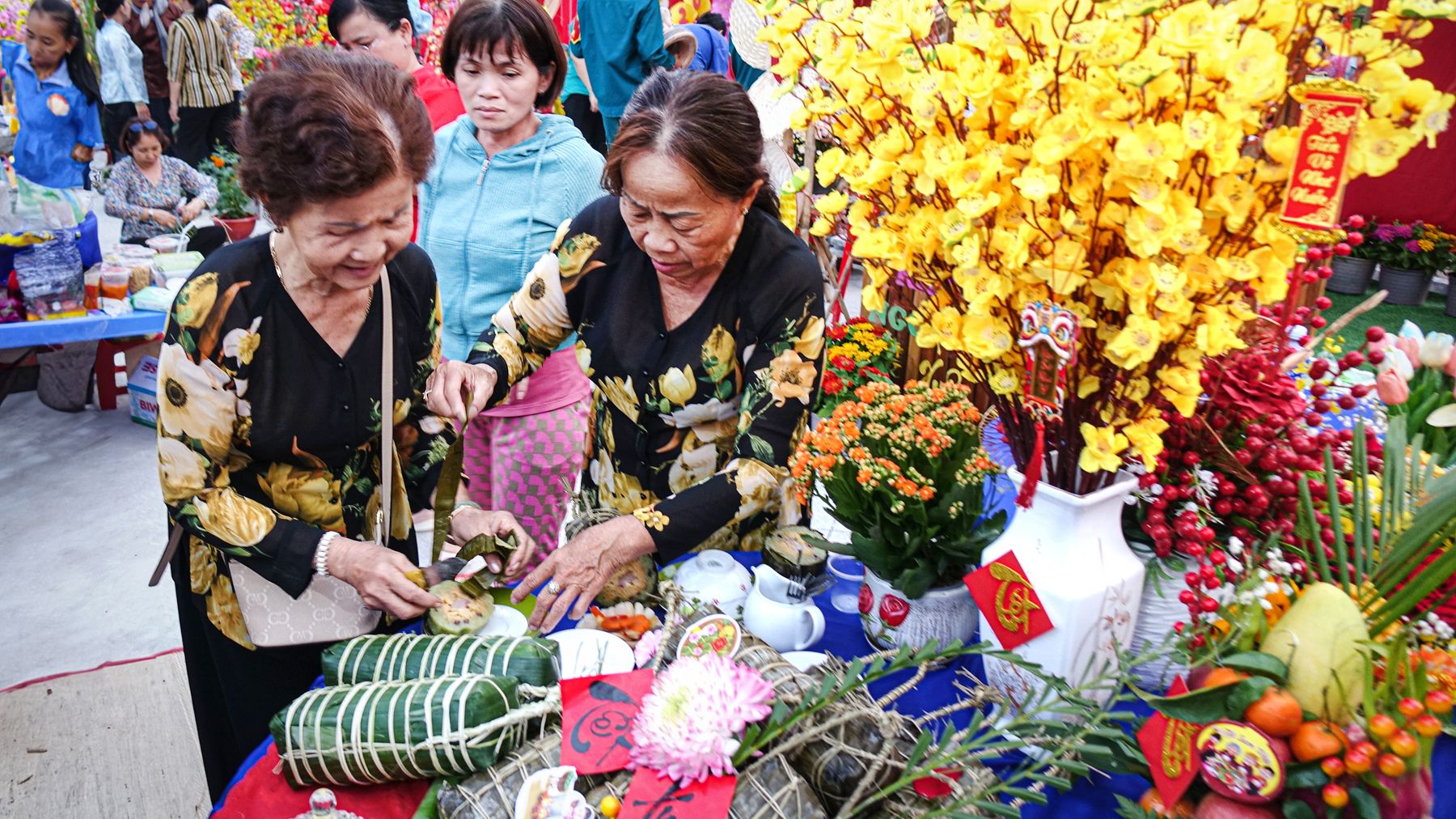
Photo by Vyvan BÙI VY VÂN on Pexels
How It Is Made
Assembling banh chung is a family operation. The leaves are laid in a cross pattern inside a square wooden mold. Rice goes in first, then mung bean paste, then a slab of pork, then more mung bean, then more rice. The leaves are folded over and tied tightly with "lac" (bamboo strips or string) in a grid pattern that holds everything square during cooking.
The cakes are boiled — not steamed — in a large pot for eight to twelve hours. Overnight boiling is traditional, and in villages north of Hanoi you will still see families feeding wood fires through the night on the 28th and 29th of the lunar month before Tet. The long cook time is what transforms the separate layers into a unified, slightly sticky block that slices cleanly.
After boiling, the cakes are pressed under a heavy board to squeeze out excess water and compact the shape. A well-made banh chung will hold its form when unwrapped and sliced, the white-green rice firm at the edges and the mung bean layer pale yellow and smooth at the center.
Why It Matters at Tet
During Tet, banh chung sits on the ancestral altar alongside fruit, incense, and rice wine. It is offered before it is eaten. That sequencing matters — the cake is first a gift, then a meal.
On the practical side, banh chung was designed to last. Kept in a cool spot (or refrigerated today), a properly made cake can stay edible for two to three weeks. During the days when families had limited kitchen access during festival periods, that durability was essential. Today, people still pan-fry leftover slices from the 4th or 5th day of Tet — the outside crisps up and the interior softens further, arguably better than the original.

Photo by Nguyen Truong Khang on Pexels
Where to Try a Canonical Version
Tranh Khuc Village, Hanoi outskirts
The village of Tranh Khuc, roughly 10 km south of Hoan Kiem Lake, has been making banh chung for several generations and supplies much of Hanoi during Tet. Outside of the festival period, some households still take orders. Expect to pay around 50,000–70,000 VND per cake for a hand-wrapped version using proper dong leaves. Worth calling ahead.
Dong Xuan Market, Hanoi Old Quarter
Dong Xuan Market has vendors selling banh chung year-round from the food stalls on the ground floor and the surrounding street hawkers. Quality varies — look for cakes that are uniformly green and feel dense when pressed, not soft. Prices run 35,000–50,000 VND. The closer you get to Tet, the fresher the stock turns over.
Ba Dinh Square area vendors, Hanoi
The streets around Ba Dinh Square and the nearby Tran Quoc Pagoda neighborhood have a cluster of traditional food stalls that reliably stock banh chung from northern suppliers. If you are visiting the Temple of Literature or One Pillar Pagoda, you will pass within a few blocks of these vendors without trying.
Practical Notes
Banh chung is sold vacuum-packed in supermarkets across Vietnam but the texture suffers — the rice firms up unevenly and the leaf flavor disappears. If you are buying to take home, a freshly boiled cake wrapped in its original leaves, sealed in a zip-lock bag, will survive a 24-hour journey fine. Slice with a string rather than a knife for cleaner cuts: loop the string around the cake and pull through.
Last updated · May 29, 2026 · independently researched, never sponsored.



