Vietnam Wayfarer
Food & DrinkDestinationsItinerariesTravel Tips
Newsletter
Home/Food & Drink
Food & Drink

Banh Chung: Square Sticky Rice Cake for Tet

"Banh chung", the square sticky rice cake wrapped in green leaves, is the centerpiece of every Vietnamese "Tet" table. Here's what goes into it and how to eat it.

May 4, 2026·4 min read
#Banh Chung#Tet#Sticky Rice#Lunar New Year#Traditional Food#Hanoi
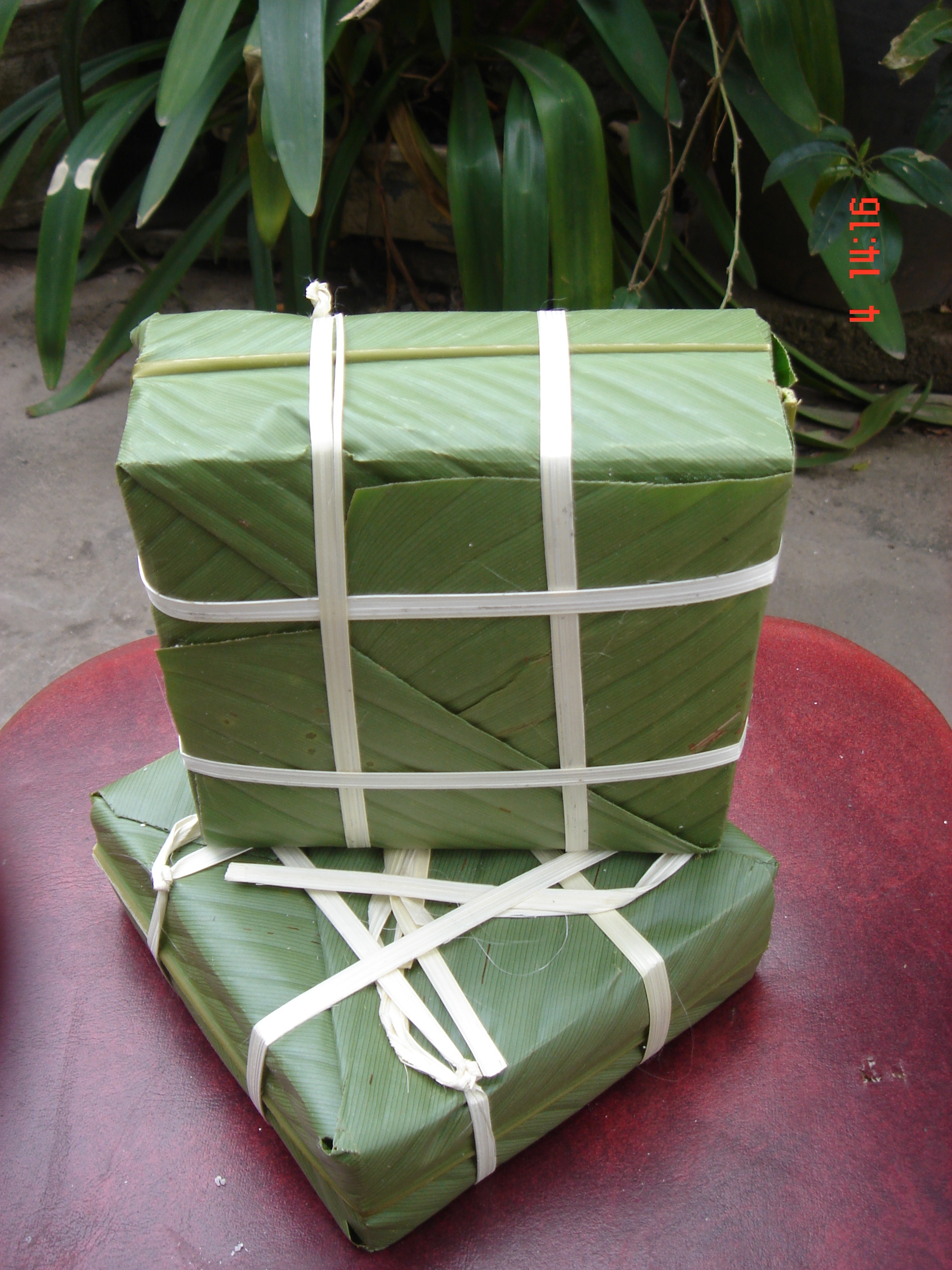
Banh chung
Image via Wikipedia (Banh chung, CC BY-SA)

Why banh chung matters at Tet

"Banh chung" is the non-negotiable centerpiece of the Vietnamese Lunar New Year altar. Square, heavy, green-wrapped, and filled with sticky rice, mung bean, and pork — if your family doesn't make or buy at least a pair of these for "Tet", you're doing it wrong. The name "chung" means steaming, though you actually boil them for hours (sometimes 10-12 hours straight). The square shape represents Earth; the round "banh giay" cake represents Heaven. Together they honor ancestors and the natural world that sustains Vietnam's wet-rice culture.

The legend of Prince Lang Lieu

Banh chung's origin story is one of the few Vietnamese food legends that every kid learns in school. Prince Lang Lieu, the 18th son of the 6th Hung King, was poor — his mother had died, his household was small. When the king announced a contest to choose an heir based on the best offering to the ancestors, Lang Lieu's twenty-one brothers went hunting and trading for exotic delicacies. Lang Lieu had no money for that.

One night he dreamed of a divine being who told him: "Nothing is more precious than rice. Pound glutinous rice into a round cake for Heaven, wrap it in leaves into a square cake for Earth, with a savory filling inside — this will show filial piety." Lang Lieu woke up and got to work. He selected pristine glutinous rice, wrapped it in green leaves with a mung bean and pork filling, and boiled it into square cakes (banh chung). He also made round cakes from pounded sticky rice (banh giay).

When the princes presented their offerings, the king tasted Lang Lieu's simple cakes and declared them superior to all the mountain-and-sea delicacies. He used them to worship the ancestors, decreed that Vietnamese families should make them every Tet, and passed the throne to Lang Lieu. The festival was even called "Tet Lieu" after him for a time.

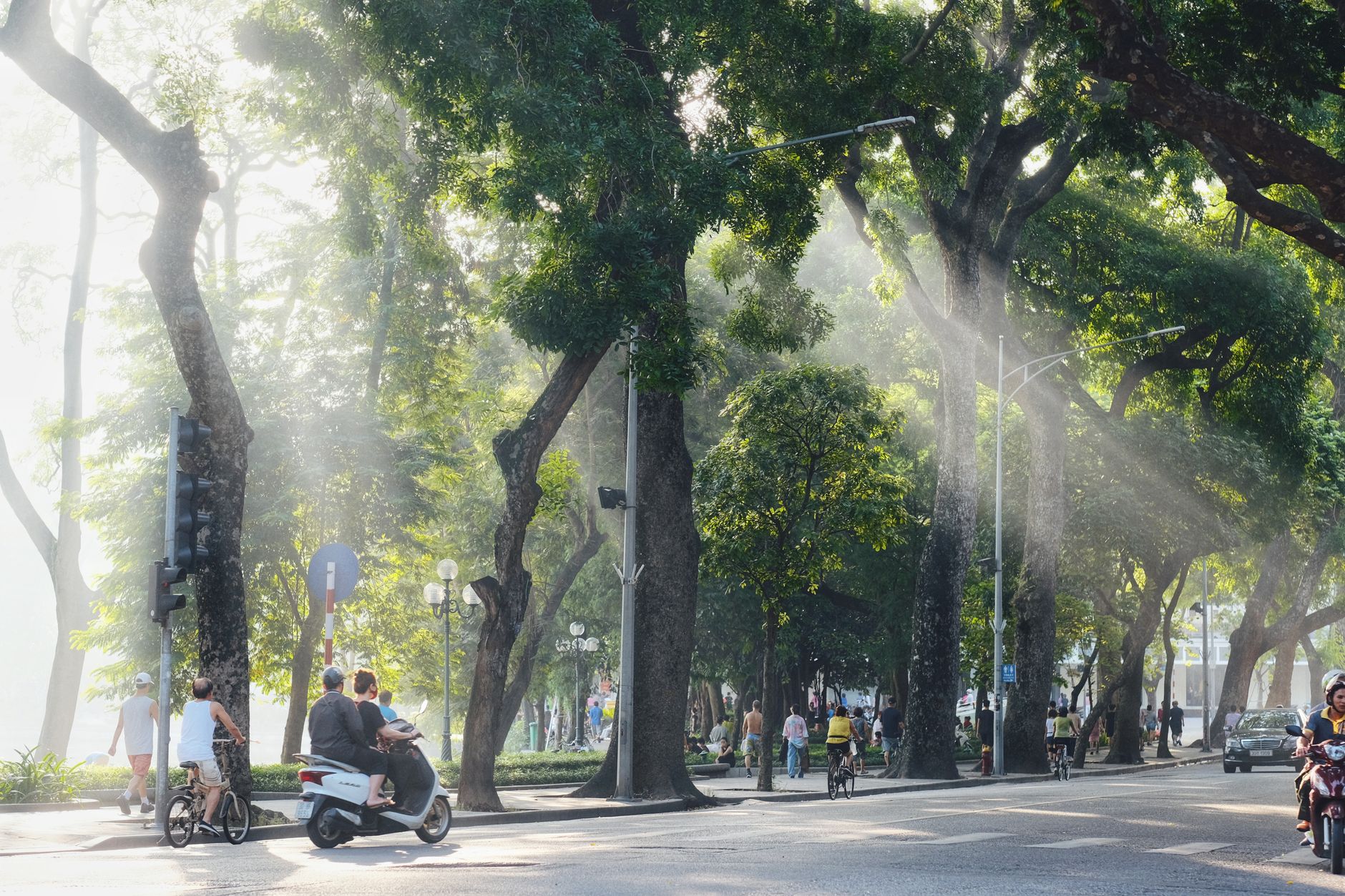
Hanoi Montage

Image by Cheong. Original uploader was Cheong Kok Chun at en.wikipedi via Wikimedia Commons (CC BY-SA)

What goes into a proper banh chung

Wrapping leaves: Fresh "la dong" (phrynium leaves) are the standard. You want young, large, uniform, unripped leaves with a vibrant green color. Some regions use "la chit", banana leaves, or even "la bang" if dong leaves are unavailable.

Ties: Thin bamboo strips called "lat giang", soaked in saltwater or steamed to soften them. You'll need strong hands — tying banh chung tight enough that it holds its shape through 10 hours of boiling is an art.

Glutinous rice: Rice from the main harvest, ideally "nep cai hoa vang" or highland varieties. The grains should be large, round, consistently sticky, and fragrant when fresh.

Mung beans: The best come from the midland hills of Thanh Hoa, Nghe An, Ha Tinh, Phu Tho — fragrant and crumbly when cooked. After harvest, they're sun-dried, winnowed clean, and stored in ceramic jars.

Pork: Pork belly ("thit ba chi") from traditional "lon i" pigs raised on natural bran and vegetables, no growth hormones. The fat-to-lean balance keeps the filling rich and moist. Do NOT use fish sauce to marinate the pork — it causes the cake to spoil faster. Just salt and black pepper.

Spices: Black pepper, salt. In old Hanoi, some families used cardamom or "ca cuong" essential oil in the filling, but that's rare now.

Color: The green tint comes from placing the darker side of the dong leaf against the rice. Some cooks add pandan leaf or galangal juice for aroma and a jade-green color. Commercial vendors have been caught using battery acid in the boiling water to force a brighter green — don't do that. Home cooks report that a galvanized iron pot (not aluminum) helps achieve good color safely.

Hanoi Vietnam The-omnipresent-plastic-chairs-01

Image by CEphoto, Uwe Aranas via Wikimedia Commons (CC BY-SA)

How to eat banh chung

On the Tet altar, banh chung and banh giay appear in pairs. Some families remove the outer leaves, rewrap the cakes in fresh leaves, and tie them with red string before offering. When it's time to eat, cut banh chung diagonally using the same bamboo string it was tied with — this ensures every piece has an even amount of filling. Or cut it horizontally, which gives the middle slices more filling.

Serve with pickled onions ("dua hanh"), fish sauce, or soy sauce with a little pepper. After Tet, when the cake hardens, pan-fry slices in oil until golden and crispy. Eat with pickled vegetables and "gio lua" (Vietnamese pork sausage) to cut the richness.

In Thanh Hoa, Nghe An, and Ha Tinh, people dip banh chung in molasses. A folk rhyme: "Peel the banh chung / For the teacher to dip in molasses."

Banh chung dai (long banh chung)

In the midland and mountain provinces — Phu Tho, Vinh Phuc, Bac Ninh, Bac Giang, parts of Hanoi — the square banh chung is mostly reserved for ceremonial offerings. Daily eating favors the long, cylindrical version called "banh chung dai" or "banh tay". Same ingredients, different shape. Cut it into horizontal slices called "dong banh."

You might also like
Imexpharm đồng hành hội nghị dược sĩ nhà thuốc tại Đà Nẵng - Báo VnExpress Sức khỏe
Travel Tips

Vietnam Pharmacy Guide: What to Buy, What to Skip, and How to Ask

May 5, 2026 · 4 min
Hanoi skyline with Ba Vi Mountain in the distance
Travel Tips

Dress Code in Vietnam: What to Wear at Temples, Beaches, and Restaurants

May 5, 2026 · 4 min

Going to Vietnam? Eat and travel smarter.

Monthly: new dishes, off-the-beaten-path destinations, and itineraries — straight to your inbox. No spam. Unsubscribe anytime.

Join 0 expats. (We just launched.)

More from Hanoi

Other articles covering this city.

Hoi An Old Town lanterns over the Thu Bon River
Travel Tips

Drinking Water in Vietnam: What's Safe, What Isn't, and Why

Tap water isn't safe to drink straight from the tap in Vietnam. Here's what you need to know about bottled water, ice, brushing teeth, and hot drinks.

May 5, 2026·4 min read
Sapa terraced rice fields and waterfall
Travel Tips

Eating with Food Allergies in Vietnam: Peanuts, MSG, Fish Sauce & Gluten

Peanuts hide in desserts and sauces, MSG seasons nearly everything, and fish sauce is in almost every savory dish. Here's how to navigate Vietnamese food safely.

May 5, 2026·5 min read
Hanoi skyline with Ba Vi Mountain in the distance
Travel Tips

Wifi and Internet in Vietnam: What to Expect and How to Stay Connected

Free wifi is nearly everywhere in Vietnamese cities, but speeds drop in rural areas. Here's what works, where to find it, and what to pay.

May 5, 2026·3 min read

More from Northern Vietnam

Other articles covering the same region.

Mai Châu
Itineraries

3 Days in Mai Chau Valley: A Homestay Weekend from Hanoi

Cycle through rice paddies, sleep in a stilt house, and learn White Thai weaving in this laid-back valley 140 km southwest of Hanoi. A real alternative to the tourist treadmill.

May 5, 2026·4 min read
Sa Pa
Itineraries

5 Days in Northwest Vietnam Mountains: Mai Chau, Sapa, Ha Giang

A tight loop through Vietnam's three best mountain destinations: homestays in Mai Chau, trekking in Sapa, and the Ha Giang Loop. Achievable if you skip Hanoi.

May 5, 2026·5 min read
Ninh Bình province
Itineraries

3 Days in Ninh Binh: Trang An, Tam Coc & Bai Dinh

A compact northern itinerary combining Ninh Binh's limestone karst boat tours, ancient temples, and cave hikes. Mix cave exploration, cycling villages, and pagoda complex visits.

May 5, 2026·5 min read

More in Food & Drink

More articles from the same category.

View all in Food & Drink →
Ruou can
Food & Drink

Ruou Can: Vietnam's Communal Rice Wine Ritual

Ruou can is a fermented rice wine shared through cane tubes from a single earthenware jar—a ritual drink of Vietnam's ethnic minorities in the Central Highlands and Northwest, where hospitality and community are sipped together.

May 5, 2026·2 min read
Ruou nep
Food & Drink

Ruou Nep: Vietnam's Fermented Glutinous Rice Pudding

Ruou nep is a mildly alcoholic pudding or drink made from fermented glutinous rice, particularly beloved in northern Vietnam. Learn how it's made, its regional varieties, and where to find it.

May 5, 2026·2 min read
Nuoc mia
Food & Drink

Nuoc Mia: Vietnam's Ice-Cold Sugarcane Juice

Sugarcane juice, or "nuoc mia," is the sound and smell of every Vietnamese street. Fresh stalks crushed through a motorized press, poured over ice, sometimes with a squeeze of kumquat—it's one of the cheapest, most refreshing drinks you'll find, available everywhere from Hanoi's Old Quarter to a rural roadside stall.

May 5, 2026·3 min read
Vietnamese tea
Food & Drink

Vietnamese Tea: A Guide to Green, Lotus, and Heritage Brews

From thousand-year-old trees to delicate lotus-scented leaves, Vietnamese tea reflects centuries of tradition. Learn where to find the best teas, how to brew them, and why green tea dominates the culture.

May 5, 2026·4 min read
Lotus tea
Food & Drink

Lotus Tea: Six Ways to Drink Vietnam's National Flower

Lotus tea takes many forms in Vietnam—from flower-scented green tea to seed brews and root infusions. Each preparation honors the lotus plant's delicate flavors and deep cultural roots.

May 5, 2026·3 min read
Vietnamese iced coffee
Food & Drink

Vietnamese Iced Coffee: From Phin to Egg Coffee

"Ca phe sua da" — Vietnamese iced coffee — is built on three pillars: dark robusta beans, a metal phin filter, and sweetened condensed milk. Learn how to brew it and explore nine regional variations from egg coffee to salt coffee.

May 5, 2026·4 min read
View all in Food & Drink →
← Older
Nem Chua: Vietnam's Funky Fermented Pork You Need to Try
Newer →
Hu Tieu: Vietnam's Soul Noodle Soup

Popular this week

  1. 1
    Itineraries
    2 Weeks in Vietnam: The Perfect First-Timer's Itinerary
    Apr 21, 2026 · 16 min
  2. 2
    Food & Drink
    Saigon Street Food Tour: 12 Dishes You Must Try in Ho Chi Minh City
    Apr 17, 2026 · 10 min
  3. 3
    Food & Drink
    Pho in Hanoi: The 7 Bowls That Are Actually Worth Lining Up For
    Apr 25, 2026 · 11 min
  4. 4
    Itineraries
    3 Days in Hoi An: The Complete Itinerary (With Where to Eat)
    Apr 4, 2026 · 12 min
  5. 5
    Destinations
    The Ha Giang Loop: A Complete 4-Day Motorbike Adventure Guide
    Apr 29, 2026 · 14 min
Get the monthly digest

New dishes, destinations, and itineraries — once a month.

Subscribe →
Vietnam Wayfarer

Insider guides to Vietnam — food, travel, and regional specialties most foreigners never find. Independent, no sponsored content without disclosure.

Topics

  • Food & Drink
  • Destinations
  • Itineraries
  • Travel Tips

Resources

  • Newsletter
  • Contact
  • Affiliate Disclosure
  • Privacy
  • Search

Get the Newsletter

Monthly: dishes, destinations, itineraries — straight to your inbox.

© 2026 Vietnam Wayfarer. All rights reserved.

We use minimal analytics + ads (no personal tracking). See our privacy policy.