
Cat Cat Village (Ban Cat Cat) is a Black Hmong settlement carved into the Muong Hoa Valley, about 2km downhill from Sapa town center. It's the most visited village in the area — and that reputation cuts both ways. Yes, it's touristy. But it's also genuinely beautiful, culturally rich if you look past the souvenir stalls, and one of the easiest treks you can do in the Sapa region without hiring a guide or committing to a multi-day homestay.
What it is
Cat Cat has been a Hmong village for over 100 years. The French built a hydroelectric station here in the colonial era — you can still see its ruins near the base of the waterfall. The village sits at roughly 1,200m elevation, terraced into a steep valley with rice paddies dropping away on both sides. Around 80 households live here permanently, though the village now doubles as a managed tourist attraction with a ticket gate, paved paths, and performance stages.
Note for trip planning: Lao Cai province recently merged administratively with Yen Bai province. For travelers, nothing changes on the ground — Sapa (사파 / 沙坝 / サパ) is still Sapa, the roads are the same, and all signage still references Lao Cai.
Why travelers go
Three reasons, mostly. First, the walk down from Sapa town is genuinely scenic — terraced rice fields, bamboo groves, and mountain views that reward you at every turn. Second, the waterfall (Tien Sa) at the bottom of the village is impressive after rain. Third, it's a soft introduction to Hmong culture: indigo-dyed textiles, traditional weaving demonstrations, and daily cultural performances with live music.
It's not wilderness trekking. If you want remote villages and zero tourists, head to Y Ty or Ta Xua instead. Cat Cat is for the traveler who has one day in Sapa and wants a taste of the valley without a 15km hike.
Best time to visit
The rice terraces look best in two windows: late May to June (bright green, freshly planted) and September to early October (golden, pre-harvest). These are the postcard moments.
Winter (December–February) brings fog, cold drizzle, and occasional frost. The terraces are bare and brown. It's atmospheric in a moody way, but not photogenic. Weekday mornings year-round are quieter — by 10am on weekends, tour groups fill the main path.
Avoid Vietnamese public holidays, especially Tet and the September 2 long weekend. The village gets overwhelmingly crowded.

Photo by Kevin Vasquez A on Pexels
How to get there
From Sapa town center, walk south on Fansipan Road, then follow signs downhill. The walk takes 20–30 minutes one way. The return climb is steeper — budget 40 minutes going back up, or grab a motorbike taxi (xe om) from the bottom for 30,000–50,000 VND.
If you're coming from Hanoi, the fastest route is the Noi Bai–Lao Cai expressway to Sapa — about 4.5 hours by private car or 5–6 hours by bus. Sleeper buses from My Dinh bus station run nightly (around 350,000–450,000 VND). From Lao Cai city, it's another 35km winding road up to Sapa.
Entrance fee: 100,000 VND per person at the ticket gate (as of 2024). Keep your ticket — staff check it at multiple points.
What to do
Walk the main trail
The paved path winds downhill through the village past Hmong houses, textile workshops, and food stalls. It ends at the Tien Sa Waterfall and the old French hydroelectric ruins. Total distance is about 3km round-trip with roughly 200m elevation change.
Watch the cultural show
Free performances happen on the main stage (usually 9:30am and 2:00pm). Hmong musicians play traditional instruments — the "khen" (mouth organ) is the standout. Shows last about 20 minutes.
Buy textiles directly
If you want Hmong textiles, this is a reasonable place to buy. Look for hand-embroidered pieces rather than machine-made imitations. A hand-stitched indigo cushion cover runs 150,000–300,000 VND. Haggling is expected but don't be aggressive — these are village artisans, not market traders.
Side trail to Muong Hoa Valley
At the bottom of Cat Cat, a trail continues into the broader Muong Hoa Valley toward Y Linh Ho and Lao Chai villages. If you have energy, walking another 2–3km takes you into much quieter territory. No extra ticket needed.
Where to eat
Inside the village, food stalls sell grilled corn (10,000 VND), "thang co" (a Hmong horse-meat hotpot — acquired taste), and "com lam" (bamboo-tube sticky rice, 20,000–30,000 VND). For a proper meal, head back up to Sapa town. Nha hang A Quynh on Thac Bac Road does solid "pho" and stir-fried local greens. Good Day Sunshine near the church square serves decent Vietnamese coffee and banh mi.
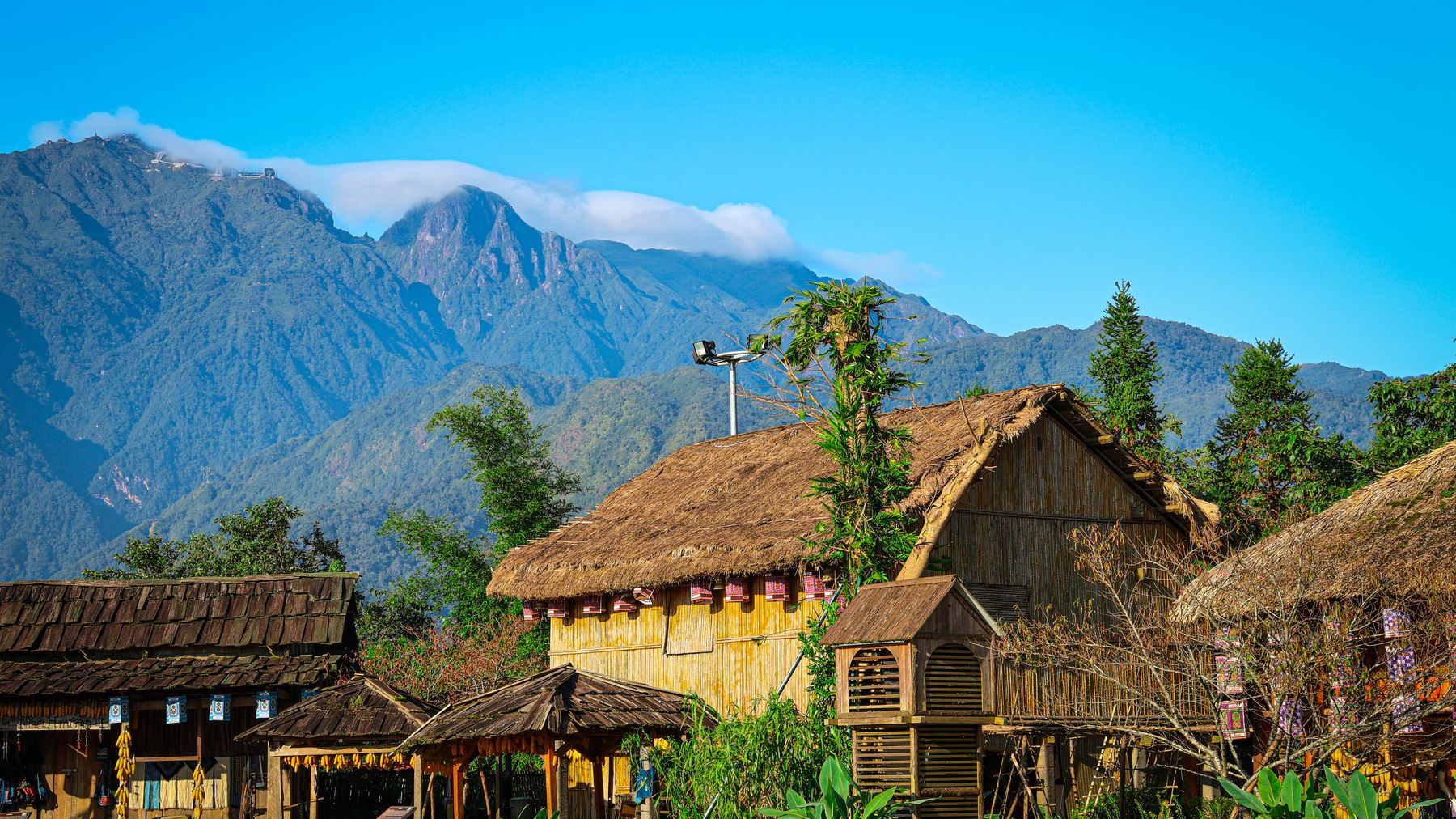
Photo by Haneul Trac on Pexels
Where to stay
Don't stay inside Cat Cat village itself — there's no accommodation. Stay in Sapa town (2km uphill) or in a homestay along the Muong Hoa Valley road.
Budget: Sapa Capsule Hotel or The Local Hostel — dorm beds from 120,000 VND/night.
Mid-range: Sapa Clay House or Topas Ecolodge (the latter is outside town but has valley views worth the 15-minute drive).
Splurge: Hotel de la Coupole by MGallery — French-colonial fantasy architecture, heated pool, roughly 2,500,000 VND/night.
Common mistakes
- Wearing flip-flops. The path is paved but steep and slippery after rain. Trail shoes or sneakers with grip.
- Going at midday. Morning light is better for photos, and afternoon tour buses make the narrow paths congested.
- Skipping the lower section. Many visitors turn around at the first photo spot. The waterfall and ruins are at the bottom — commit to the full loop.
- Expecting wilderness. Cat Cat is a managed site. If the souvenir stalls bother you, keep walking past them. The edges of the village and the continuation toward Muong Hoa are where the crowds thin.
Practical notes
Bring cash — no ATMs inside the village and card acceptance is nonexistent. Wear layers if visiting between October and March; the valley is 3–5°C cooler than Sapa town once you're in the shade. Allow 2–3 hours for a relaxed visit, or a full half-day if you continue into the Muong Hoa Valley. Cat Cat pairs well with a morning here and an afternoon trip to the Sapa Love Waterfall or Ham Rong Mountain.
Last updated · May 26, 2026 · independently researched, never sponsored.





