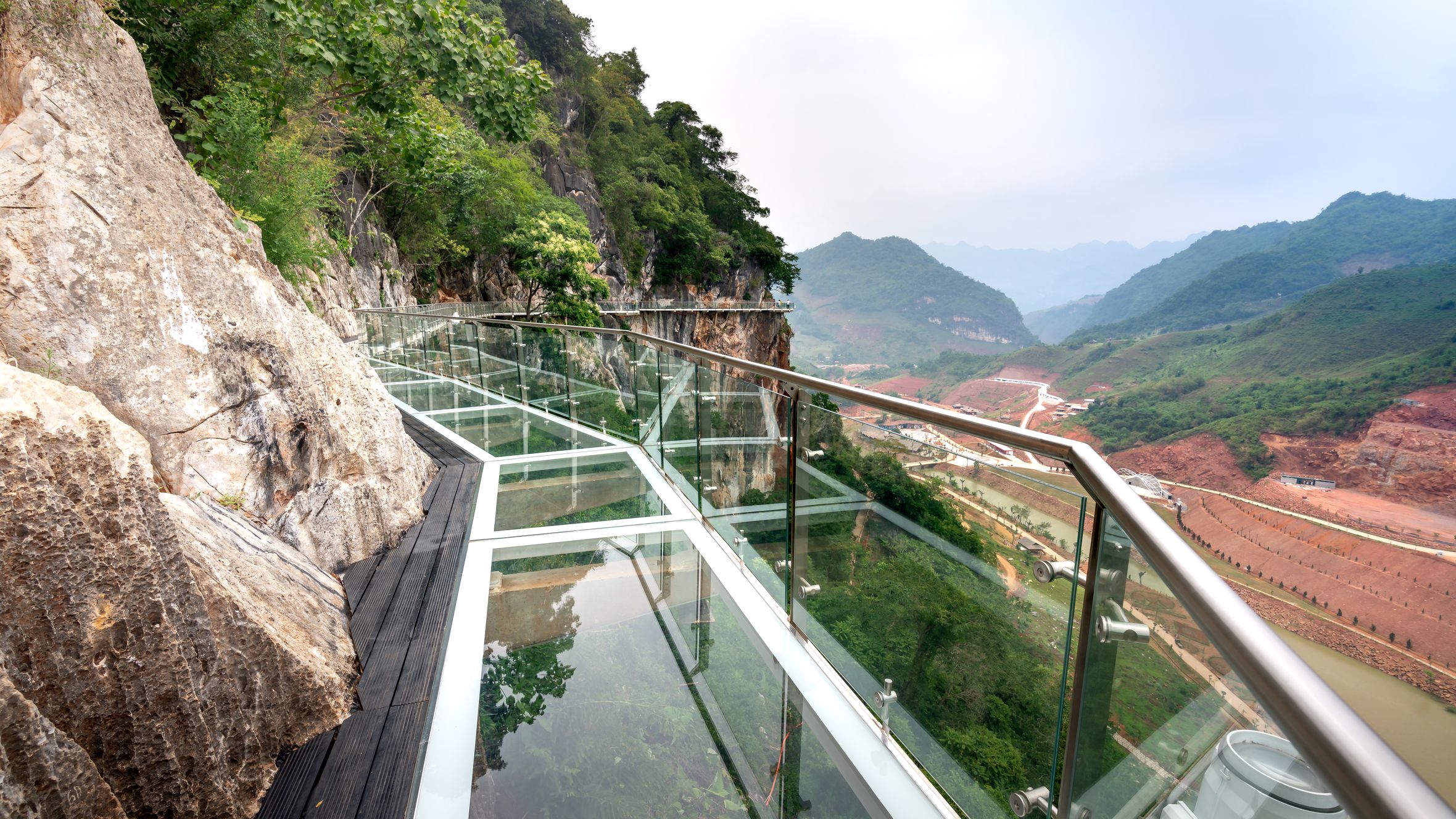
Rong May Glass Bridge sits at roughly 2,200 meters above sea level in O Quy Ho Pass, straddling the border of Lai Chau and Lao Cai provinces. It's one of the highest glass-bottomed bridges in Southeast Asia, and unlike a lot of Vietnam (베트남 / 越南 / ベトナム)'s newer tourist builds, it actually delivers on the experience.
What it is and how it got here
"Cau kinh Rong May" translates loosely to Dragon Cloud Glass Bridge — named for the way clouds roll through the valley below, sometimes sitting right at your feet. The complex opened in 2019 and has expanded since then to include a glass-floored skywalk, a coaster ride, ziplines, and viewing platforms bolted into the cliff face. The bridge itself spans about 60 meters across a gorge, with transparent panels underfoot and a vertical drop that'll make your knees question their loyalty.
The whole setup is built into the mountainside along the O Quy Ho Pass road, one of Vietnam's great mountain passes and the main route connecting Lai Chau town to Sapa.
Why travelers go
The draw is simple: elevation and exposure. Standing on the glass bridge with nothing but cloud and valley below you is a visceral thing. On clear mornings, you can see Fansipan and the Hoang Lien Son range stretching out in every direction. On cloudy days — which are frequent — you're literally inside the weather, which has its own strange appeal.
It's also a practical stop. If you're riding motorbike between Sapa (사파 / 沙坝 / サパ) and Lai Chau (or doing the full northwest loop through Ha Giang and back), Rong May is right on the road. You don't detour for it; you pass through it.
Best time to visit
October to December is the sweet spot. Skies are clearest, temperatures are cool but manageable (12-18°C at this altitude), and the rice terraces in surrounding valleys have just been harvested, giving the landscape a golden, stubbled look.
March to May is the second-best window — wildflowers are out along O Quy Ho, and mornings tend to be clear before afternoon clouds roll in.
Avoid June through August if you want views. Heavy rain and thick fog can shut the bridge down entirely, and even when it's open, you'll be staring into a white wall. The coaster and ziplines also close during storms.
How to get there
The bridge is about 18 km from Sapa town center, heading west on the QL4D (O Quy Ho Pass road). From Lai Chau town, it's roughly 80 km east on the same road.
From Sapa: The easiest base. Hire a motorbike (150,000-200,000 VND/day from most hostels) and ride the pass yourself — it takes about 40 minutes. The road is paved and in decent shape, though watch for fog and trucks on blind corners. A taxi or private car runs around 350,000-500,000 VND one way.
From Hanoi: Take a sleeper bus to Sapa (roughly 300,000-400,000 VND, 5-6 hours overnight) and arrange transport from there. Direct buses to Lai Chau town also run from My Dinh bus station, but they're less frequent and the onward ride to the bridge adds time.
By motorbike on the northwest loop: If you're riding from Ha Giang down through Mu Cang Chai and into Sapa or Lai Chau, the bridge is a natural stop on the O Quy Ho stretch. Budget half a day.

Photo by Quang Nguyen Vinh on Pexels
What to do (specifically)
Walk the glass bridge
The main event. Ticket price is 200,000 VND for adults (as of late 2024, prices adjust periodically). The bridge is wide enough that you won't feel crowded except on major holidays. Wear shoes with grip — they'll give you cloth shoe covers at the entrance to protect the glass, and these can be slippery.
Ride the mountain coaster
A 2 km alpine coaster track that winds down through the forest. Separate ticket, around 200,000 VND. It's genuinely fun — you control your own speed with a hand brake, and the track dips through tree canopy with valley views opening up on turns. Not a thrill ride, but satisfying.
Try the zipline
Two zipline routes cross the gorge. The longer one runs about 400 meters. Around 150,000-250,000 VND depending on which line. The harness setup is professional and regularly inspected — this isn't a backyard operation.
Walk the cliff-side skywalk
A glass-floored path bolted into the rock face, separate from the bridge. It wraps around a cliff section with drop-offs on three sides. Included in some combo tickets, or around 100,000 VND standalone.
Just sit and watch the clouds
There's a cafe and seating area near the entrance with views down the valley. Vietnamese coffee here costs about 30,000-40,000 VND — not cheap by local standards, but you're paying for the altitude. On a morning when the clouds are cycling through the gorge, it's worth the markup.
Where to eat nearby
The complex has a small food court with standard tourist fare — nothing remarkable. Better to eat before or after.
In Sapa, hunt down a bowl of "pho" with local black cardamom — several shops on Cau May Street serve it, and the spice profile is different from what you'll find in Hanoi. A bowl runs 40,000-60,000 VND.
If you're heading toward Lai Chau town, stop at one of the roadside "com" (rice) joints along the QL4D past the bridge. Grilled stream fish with rice and greens is the local move — 50,000-70,000 VND for a full plate. Look for places where truck drivers are already eating; the food turnover is faster and the fish is fresher.
Where to stay
Most travelers base in Sapa, where accommodation ranges from 150,000 VND dorm beds to 2,000,000+ VND boutique rooms. The town has everything from backpacker hostels to properly nice hotels.
If you want something quieter, a few homestays operate in villages between Sapa and the bridge along the O Quy Ho road — expect 300,000-500,000 VND per night with dinner included. Ask around in Ta Giang Phinh or Sin Chai.
Lai Chau town has basic hotels in the 200,000-400,000 VND range, but there's less reason to stay there unless you're continuing west.
Photo by Quang Nguyen Vinh on Pexels
Practical tips
- Arrive before 9 AM. Cloud cover builds through the day. Early morning gives you the best chance of clear views and the smallest crowds.
- Bring a layer. Even in summer, 2,200 meters means wind and temperature drops. A light jacket is non-negotiable.
- Combo tickets save money. If you plan to do the bridge, coaster, and zipline, ask about combo pricing at the ticket window — they're not always advertised but usually available.
- Charge your phone. There's no charging station inside the complex and you'll burn battery on photos and video.
- Fuel up in Sapa. There's no reliable gas station between Sapa and the bridge if you're on a motorbike.
Mistakes to avoid
Going on a Vietnamese public holiday. Tet / 越南春节 / テト), September 2nd, April 30th — the bridge gets packed and wait times stretch past an hour. Weekdays are dramatically better.
Skipping it because you think it's a tourist trap. The infrastructure is commercial, sure, but the geography is real. The gorge, the altitude, the clouds — none of that is manufactured. Don't let the ticket booth put you off.
Rushing through. Budget at least 2-3 hours. People who zip across the bridge and leave in 30 minutes miss the coaster, the skywalk, and the strange pleasure of watching weather systems move through a valley from above.
Practical notes
Rong May Glass Bridge is open daily, typically 7:00 AM to 5:30 PM, though hours shorten in bad weather. Cash is accepted at the ticket counter; card payment is unreliable. If you're combining this with a Sapa visit or a wider northwest loop, it slots in naturally without eating a full day.
Last updated · May 29, 2026 · independently researched, never sponsored.




