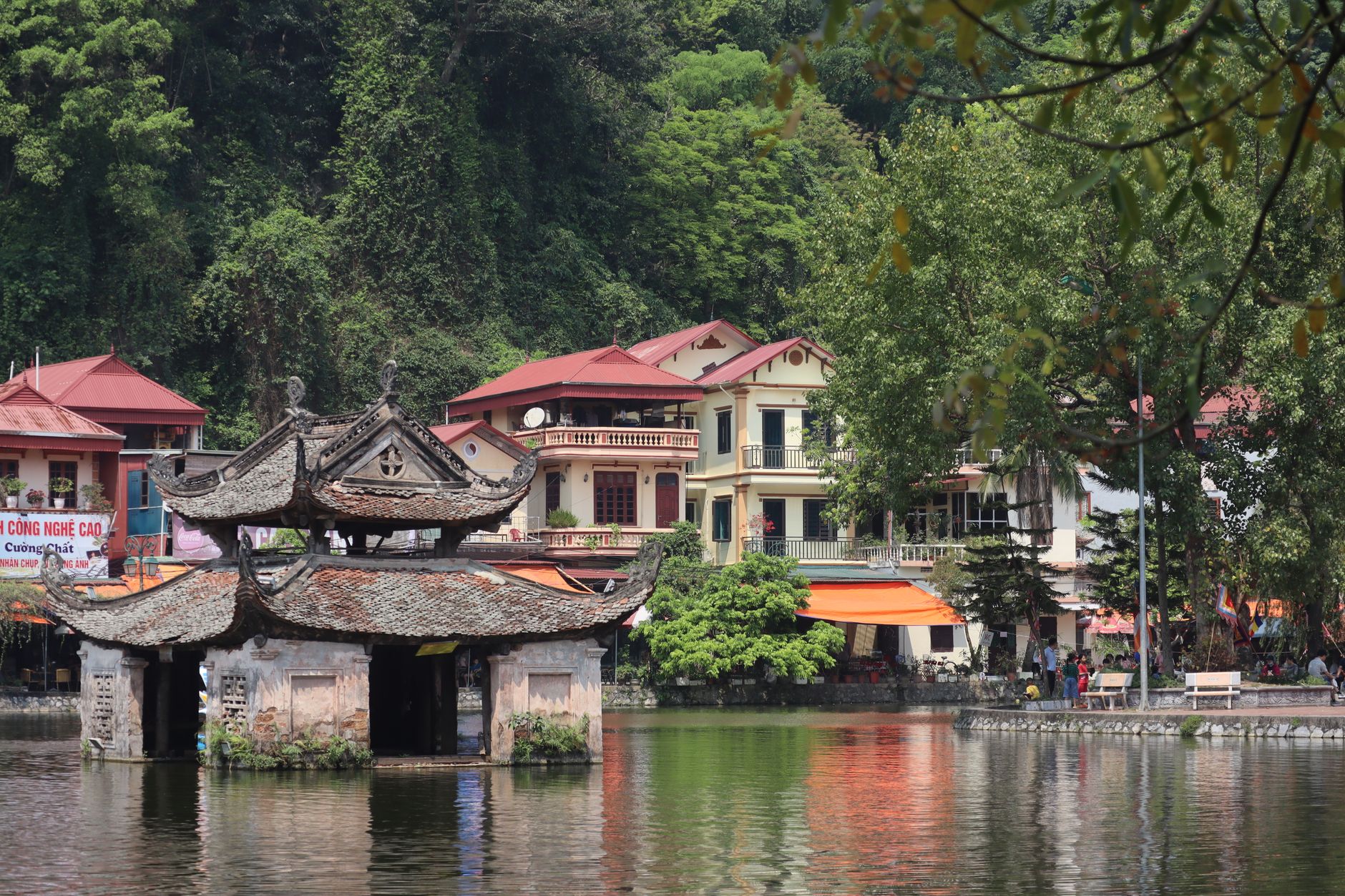
What it is
Cau Ngoi Hai Anh is a wooden covered bridge — "cau ngoi" literally means tile-roofed bridge — sitting in Hai Anh commune, Hai Hau district, in what is now part of Ninh Binh (닌빈 / 宁平 / ニンビン) province. Built in the early 16th century during the Le Dynasty, it's one of the oldest surviving covered bridges in northern Vietnam and one of only a handful nationwide that still uses its original post-and-beam timber construction beneath a tiled roof.
The bridge spans a small canal, roughly 9 meters long and 2.5 meters wide, with seven bays formed by wooden pillars. The roof is classic Red River Delta architecture — curved clay tiles over a heavy timber frame, with carved dragon motifs at the ridge ends. Unlike the more famous Japanese Covered Bridge in Hoi An, this one sees almost no international visitors. Most days it's just locals crossing on motorbikes or sitting in its shade.
Why travelers go
Three reasons, honestly. First, it's genuinely old — we're talking 500 years of continuous use with periodic restorations, not a replica. Second, it sits in a landscape of rice paddies, Catholic churches (Hai Hau has one of the highest concentrations of Catholic communities in Vietnam (베트남 / 越南 / ベトナム)), and quiet village lanes that feel untouched by tourism infrastructure. Third, it pairs well with a broader Ninh Binh trip. If you're already visiting Tam Coc or Ninh Binh city, Cau Ngoi Hai Anh makes a worthwhile half-day side trip that gets you into genuine rural delta life rather than another boat-tour queue.
Best time to visit
October through March gives you the driest, coolest weather. The bridge and surrounding paddies look particularly good in late September to early November when rice is golden before harvest. Avoid June through August if you can — it's hot, humid, and afternoon downpours make the rural roads slippery. That said, the bridge is photogenic in rain too, with mist hanging over the canal.
Weekdays year-round are quiet. Weekends occasionally bring domestic photography groups, but "crowded" here means maybe fifteen people.
How to get there
From Ninh Binh city center, Cau Ngoi Hai Anh is roughly 45 km east, in the Hai Hau area. Your options:
Motorbike
The most practical choice. Rent in Ninh Binh city for 120,000–150,000 VND/day (automatic scooter). The ride takes about 50–60 minutes via QL21 heading east. Roads are flat, paved, and easy — this is delta country, no mountain passes. Plug "Cau Ngoi Hai Anh" into Google Maps; it's accurately pinned.
Grab car
A Grab from Ninh Binh city runs 250,000–350,000 VND one way. Ask the driver to wait (negotiate 100,000–150,000 VND for an hour's wait time) since getting a return Grab from the village can be slow.
Day trip from Hanoi
From Hanoi, it's about 120 km — roughly 2.5 hours by car or bus to Ninh Binh, then another hour east. Doable as a long day trip, better as part of a two-day Ninh Binh itinerary that includes Tam Coc, Hoa Lu, or Bai Dinh.

Photo by Menderes Kahraman on Pexels
What to do
Walk the bridge slowly. Look up at the timber joints — no nails in the original construction, just mortise-and-tenon joinery. The carved panels between bays show Confucian and Buddhist motifs. Spend ten minutes here, not two.
Explore the surrounding village lanes. Hai Anh commune has narrow brick lanes, fish ponds, and ancestral halls. Walk or cycle 1–2 km in any direction and you'll find communal houses ("dinh lang") with their own carvings and incense-heavy interiors. Nobody will charge you admission.
Visit the nearby Catholic churches. Hai Hau district has some of the most architecturally interesting parish churches in the north — French Gothic meets Vietnamese village aesthetics. Phu Nhai Cathedral, about 10 km from the bridge, is the largest.
Photograph the canal at golden hour. Late afternoon light hits the bridge from the west, reflecting off the canal. Bring a wide lens if you have one; the surrounding palm trees and banana groves frame nicely.
Talk to locals. This is not a ticketed attraction. There's no guard, no gift shop. The bridge is part of daily village life. If your Vietnamese is limited, a smile and a wave still get you far. Older residents remember the last major restoration and are sometimes happy to chat.
Where to eat nearby
Hai Hau district is known for "nem chua" — fermented pork wrapped in banana leaves. You'll find it sold at small roadside stalls throughout the area; look for hand-lettered signs reading "nem Hai Hau." Buy a pack of ten for about 30,000–50,000 VND.
For a full meal, head to any "com binh dan" (everyday rice shop) in Hai Hau town, about 5 km from the bridge. Expect plates of rice with braised pork, morning glory, and soup for 35,000–50,000 VND. Nothing fancy, everything fresh.
If you're heading back toward Ninh Binh city, stop for "bun moc" (pork ball noodle soup) at one of the roadside joints along QL21 — a solid bowl runs 30,000–40,000 VND.
Where to stay
There are no hotels in Hai Anh commune itself. Your options:
- Hai Hau town (5 km): Basic guesthouses ("nha nghi") for 200,000–350,000 VND/night. Clean enough, don't expect English.
- Ninh Binh city (45 km): Full range from 250,000 VND hostels to 2,000,000 VND boutique stays near Tam Coc. This is where most travelers base themselves.
If you're combining with a broader Ninh Binh itinerary, stay in Ninh Binh city and make Cau Ngoi Hai Anh a half-day loop.

Photo by Flint Huynh on Pexels
Practical tips locals would tell you
- There's no entrance fee. The bridge is public infrastructure, not a museum.
- Parking your motorbike on the roadside near the bridge is fine. No one will charge you or bother it.
- Bring cash. There are no ATMs within walking distance of the bridge, and no one takes cards.
- Wear shoes you can slip on and off easily if you want to enter any communal halls or pagodas nearby.
- The canal water level varies seasonally. After heavy rains, the surrounding paths can get muddy.
Common mistakes to avoid
Don't confuse it with other covered bridges. Google Maps sometimes directs people to Cau Ngoi Thanh Toan (near Hue) or the Hoi An bridge. Confirm you're heading to Hai Hau district.
Don't plan a whole day here. The bridge itself takes 20 minutes to appreciate fully. Budget 2–3 hours for the bridge plus village wandering, then combine with other stops.
Don't arrive after dark. There's no lighting at the bridge or in the surrounding lanes. You won't see anything, and navigation on unlit rural roads isn't fun on a scooter.
Practical notes
Cau Ngoi Hai Anh works best as a half-day addition to a Ninh Binh trip rather than a standalone destination. Pair it with Tam Coc in the morning or Bai Dinh in the afternoon for a full day that mixes tourist infrastructure with genuine rural quiet. It's the kind of place that rewards you for slowing down — no queue, no ticket booth, just old wood and village life continuing around it.
Last updated · May 29, 2026 · independently researched, never sponsored.