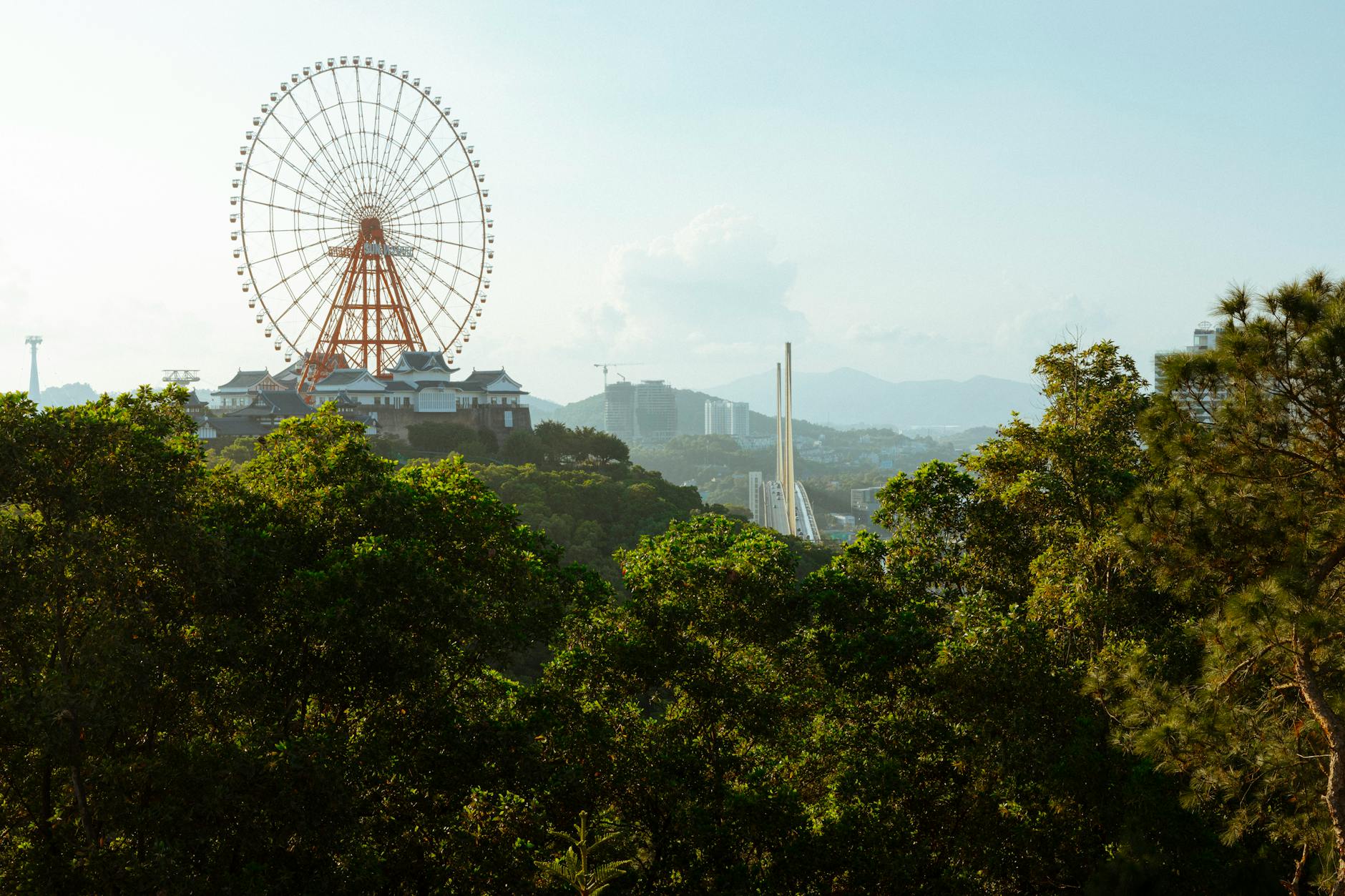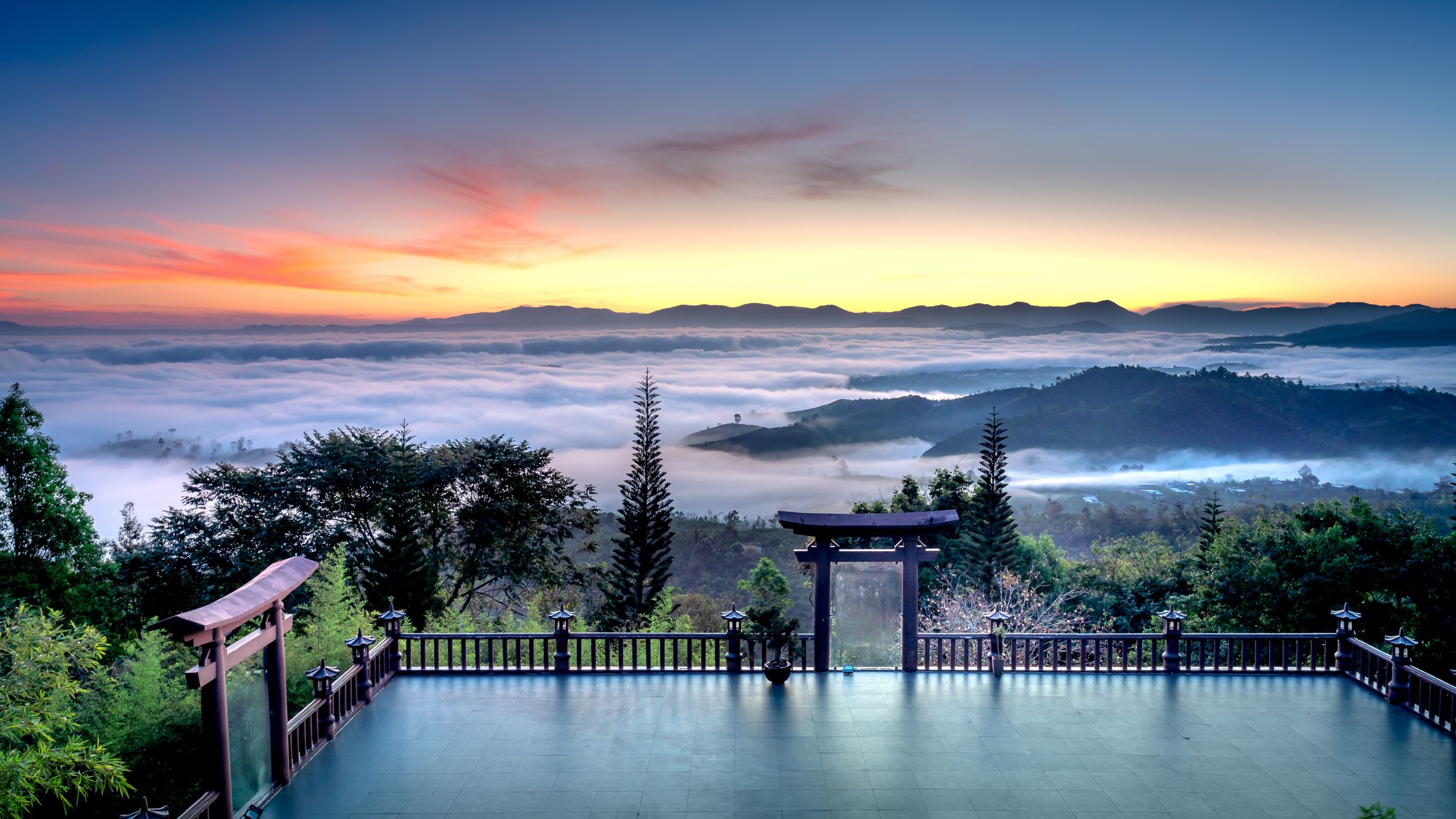
Chua Ba Vang sits on top of Thanh Dang mountain in Uong Bi city, Quang Ninh province — about 120 km east of Hanoi and roughly 40 km west of Ha Long Bay. It's one of the largest active Buddhist temple complexes in northern Vietnam (베트남 / 越南 / ベトナム), and on a clear day from the upper terraces, you can see all the way to the coal hills and the coastline beyond.
What it is and how it got here
The temple's origins trace back to the Tran Dynasty (13th century), when a small pagoda was first established on this hill. For centuries it remained modest and relatively obscure. The current complex is almost entirely modern — a massive reconstruction and expansion project that began in 2014 turned Chua Ba Vang into one of the biggest pagoda compounds in the north. The main hall, bell tower, and multi-tiered terraces climbing up the mountainside are all recent builds, though the site maintains its historical Buddhist lineage.
The name "Ba Vang" roughly translates to "golden light," and it fits. The temple's rooftops and Buddha statues gleam against the green hillside, especially in the late afternoon.
Why travelers go
Chua Ba Vang draws a mix of Vietnamese pilgrims and curious travelers. The appeal isn't just spiritual — the sheer scale of the architecture is impressive, and the hilltop location gives you panoramic views over Uong Bi and the surrounding mountains. It's also a practical stop if you're already heading to or from Ha Long Bay (하롱베이 / 下龙湾 / ハロン湾), breaking up what can be a monotonous highway drive.
For anyone interested in how contemporary Vietnamese Buddhism operates — the chanting sessions, the scale of donations, the communal vegetarian meals — this is a window into that world without the tourist-circuit polish of places like Bai Dinh in Ninh Binh.
Best time to visit
The most comfortable months are October through April, when temperatures in Quang Ninh hover between 15–25°C and humidity drops. January and February around Tet bring the biggest crowds — thousands of pilgrims visit in the first lunar month — so expect packed parking lots and long waits at the cable car if you go then.
For a quieter experience, aim for a weekday in March, April, or October. You'll have the terraces mostly to yourself, and the weather is mild enough for the uphill walk without arriving drenched in sweat.
Avoid July and August if you can. The heat is aggressive, and afternoon thunderstorms roll in fast.
How to get there from Hanoi
By car or motorbike: Take the Hanoi–Ha Long expressway (QL18) toward Uong Bi. The drive is about 120 km and takes roughly 2 hours without heavy traffic. From Uong Bi city center, signs point you to the temple — it's another 5 km up the access road.
By bus: Buses from My Dinh or Gia Lam station in Hanoi run to Uong Bi throughout the day. Tickets cost 80,000–120,000 VND one way, and the ride takes 2.5–3 hours depending on stops. From Uong Bi bus station, grab a local taxi or xe om (motorbike taxi) for about 30,000–50,000 VND to reach the temple gate.
From Ha Long Bay: If you're already in Ha Long city, Chua Ba Vang is only 40 km west — a 45-minute drive. Easy enough as a half-day side trip.
Once at the base, you can either walk up the hillside path (about 25–30 minutes of steady climbing, roughly 400 steps) or take the cable car. The cable car ticket runs around 100,000–150,000 VND round trip.

Photo by Quang Nguyen Vinh on Pexels
What to do
Walk the full terrace complex
Don't just ride the cable car to the top and leave. The complex is built on multiple levels, and each terrace has its own halls, courtyards, and statue gardens. Budget at least 90 minutes to walk through properly. The main worship hall (Dai Hung Bao Dien) is enormous — one of the largest single-structure pagoda halls in Vietnam.
Catch a chanting session
Monks and lay practitioners hold group chanting sessions daily, typically in the early morning and late afternoon. Sitting in on one (quietly, from the back) gives you a sense of how active this temple really is. It's not a museum.
Climb to the upper viewpoint
Above the main hall complex, a path continues uphill to a smaller shrine and lookout point. The view from here stretches across the Uong Bi valley. On clear days, you can spot the industrial skyline where coal mining operations meet the coast. It's a strange, honest panorama — sacred and industrial coexisting.
Join a communal vegetarian meal
The temple offers free vegetarian meals ("com chay") to visitors, typically around 11:00–11:30 AM. You sit at long tables alongside pilgrims and monks. The food is simple — rice, tofu, stir-fried vegetables, soup — but it's part of the experience. No reservation needed; just show up at the dining hall.
Visit the bell tower
The large bronze bell near the main courtyard is one of the heaviest temple bells in the north. You can sometimes hear it ringing from kilometers away. Worth a stop for the craftsmanship alone.
Where to eat nearby
Uong Bi city isn't a food destination, but there are a couple of things worth seeking out. "Banh cuon" — thin steamed rice rolls filled with minced pork and mushroom — is done well at the small shops along the main road into town. Look for places with a queue around 7–8 AM.
If you're heading onward to Ha Long after your visit, save your appetite for seafood there instead. The coastal restaurants in Bai Chay serve better meals than anything around the temple area.
Where to stay
Most travelers visit Chua Ba Vang as a day trip and sleep either in Ha Long city or back in Hanoi. But if you want to stay local:
- Budget: Nha nghi (guesthouses) in Uong Bi city center run 200,000–350,000 VND/night. Basic, clean enough, nothing memorable.
- Mid-range: A few newer hotels along the QL18 highway near Uong Bi offer rooms for 500,000–800,000 VND with air conditioning and breakfast.
- Ha Long option: If you're combining with Ha Long Bay, stay in Bai Chay where hotel options are far better — 400,000 VND for budget up to 1,500,000 VND for waterfront mid-range.

Photo by Tuan Minh on Pexels
Practical tips locals would tell you
- Dress modestly. Shoulders and knees covered. The temple enforces this — they'll lend you a robe at the entrance if needed, but it's easier to just wear long pants and a sleeved shirt.
- Bring cash. There's no ATM at the temple complex. You'll want small bills for the cable car, parking (10,000–20,000 VND for motorbikes, 30,000–50,000 VND for cars), and any offerings.
- Go early. Arriving by 7:30–8:00 AM means cooler temperatures, fewer crowds, and a better chance of catching morning chanting.
- Wear proper shoes. The steps are uneven in places and slippery after rain. Sandals work in dry weather, but sneakers are better for the full climb.
Common mistakes to avoid
- Only seeing the top level. People cable-car up, snap a photo, and leave. You miss 70% of the complex this way.
- Visiting on the 1st or 15th of the lunar month. These are peak pilgrimage days. The crowds are intense and parking becomes a genuine problem.
- Skipping water. There's limited shade on the climb, and vendors at the top charge double. Bring a bottle from the base.
- Combining with too much in one day. Chua Ba Vang plus Ha Long Bay plus Yen Tu mountain in a single day is a recipe for exhaustion. Pick two at most.
Practical notes
Chua Ba Vang works best as a half-day visit folded into a broader Quang Ninh trip — pair it with Ha Long Bay or Yen Tu pagoda nearby. The temple is free to enter; you only pay for the cable car and parking. Give yourself at least two hours to do it properly, longer if you stay for the vegetarian lunch.
Last updated · May 29, 2026 · independently researched, never sponsored.