
What it is
Chua Hang (literally "cave pagoda") sits inside a limestone karst hill about 3 km south of the town of Kien Luong and roughly 30 km from Ha Tien in the far southwest corner of Vietnam (베트남 / 越南 / ベトナム). The pagoda occupies a natural grotto that cuts through the hillside — you enter from one side, walk through a dim cavern lined with Buddhist altars and stalactites, and emerge into daylight on the other end overlooking rice paddies. The official name is Hai Son Tu, though nobody calls it that.
The site dates back to the late 18th century, when monks first established a place of worship inside the cave. Over the decades, locals expanded the altars and added statuary. Today it functions as both a working pagoda and a minor pilgrimage site, but it sees far fewer visitors than the more famous cave temples near Chau Doc or the karst formations in Ha Long Bay — which is exactly the appeal.
Why travelers go
Three reasons, mostly:
-
The cave itself. The main passage runs about 50 meters through the hill. Stalactites hang low, natural light filters through cracks, and the air drops a few degrees cooler than the scorching Mekong Delta (메콩 델타 / 湄公河三角洲 / メコンデルタ) heat outside. It feels genuinely atmospheric rather than manicured.
-
The surrounding karst landscape. Kien Luong district has scattered limestone hills rising out of flat rice fields — a miniature version of Ninh Binh's topography, but without the tour buses. You can rent a motorbike and explore Mo So cave, Hang Tien grotto, and Ba Tai hill all within a 10 km radius.
-
Proximity to Ha Tien. If you're already passing through Ha Tien on the way to Phu Quoc or the Cambodian border, Chua Hang is an easy half-day side trip rather than a dedicated destination.
Best time to visit
The dry season (November to April) is most comfortable. December through February gives you cooler mornings — around 25-28°C — which matters when you're climbing stone steps in humidity. The cave stays relatively cool year-round, but the surrounding roads flood during heavy rains in September and October, making motorbike access slippery.
Weekdays are quiet. Weekends and Buddhist holidays (full moon days, Tet) bring local worshippers and incense smoke gets thick inside the cave.
How to get there
From Ha Tien: Head southeast on Highway 80 toward Rach Gia. After about 25 km, turn left at the signed junction for Chua Hang. Total ride: 30-35 minutes by motorbike. A xe om (motorbike taxi) from Ha Tien costs roughly 80,000-120,000 VND one way.
From Rach Gia: Drive west on Highway 80 toward Ha Tien, about 60 km (1.5 hours by motorbike, 1 hour by car). The turn-off is well marked.
From Saigon: The most direct route is a bus to Ha Tien (7-8 hours via Phuong Trang or Kumho Samco, around 200,000-250,000 VND) then local transport. Alternatively, fly to Phu Quoc and take a speedboat back to Ha Tien — more expensive but faster if you're combining destinations.
No public bus runs directly to the pagoda. You'll need your own wheels or a hired driver for the last stretch.

Photo by Quang Nguyen Vinh on Pexels
What to do
Explore the cave passage
The walk-through takes 15-20 minutes if you linger. Bring a small flashlight — some sections are genuinely dark. The altars inside feature gilded Buddha statues, offerings of fruit, and the occasional bat colony overhead. The exit opens to a view of green paddies and distant karsts that photographs well in morning light.
Climb the hill
A staircase leads up and over the hill (roughly 100 steps). At the top, you get a 360-degree view of the flat delta landscape punctuated by limestone teeth. Worth the sweat.
Combine with Mo So and Hang Tien
Mo So cave is about 5 km away — a larger system with multiple chambers, less developed for tourism. Hang Tien ("coin cave") is another small grotto nearby with a local legend about hidden treasure. You can hit all three in a morning loop by motorbike.
Where to eat
Kien Luong town has a handful of com binh dan (daily rice) spots along the main road where a plate of rice with grilled pork, broken rice style like "com tam", or fish runs 30,000-45,000 VND. For something more memorable, continue to Ha Tien where the seafood is fresher and more varied. Try "hu tieu" Ha Tien style — the local noodle soup uses a pork-and-seafood broth that's distinct from the Saigon version.
If you're eating near the pagoda, there's usually a woman selling banh mi and iced coffee from a cart at the entrance — basic but functional for 20,000-30,000 VND.
Where to stay
Kien Luong has a couple of nha nghi (guesthouses) in the 150,000-250,000 VND range — clean enough, fan rooms, cold water. For better options, base yourself in Ha Tien where you'll find proper hotels with air conditioning and hot water from 350,000-600,000 VND per night. River Hotel and Ha Tien Hotel are both decent mid-range picks.
If you're continuing to Phu Quoc the next day, Ha Tien makes more logistical sense as a base anyway.
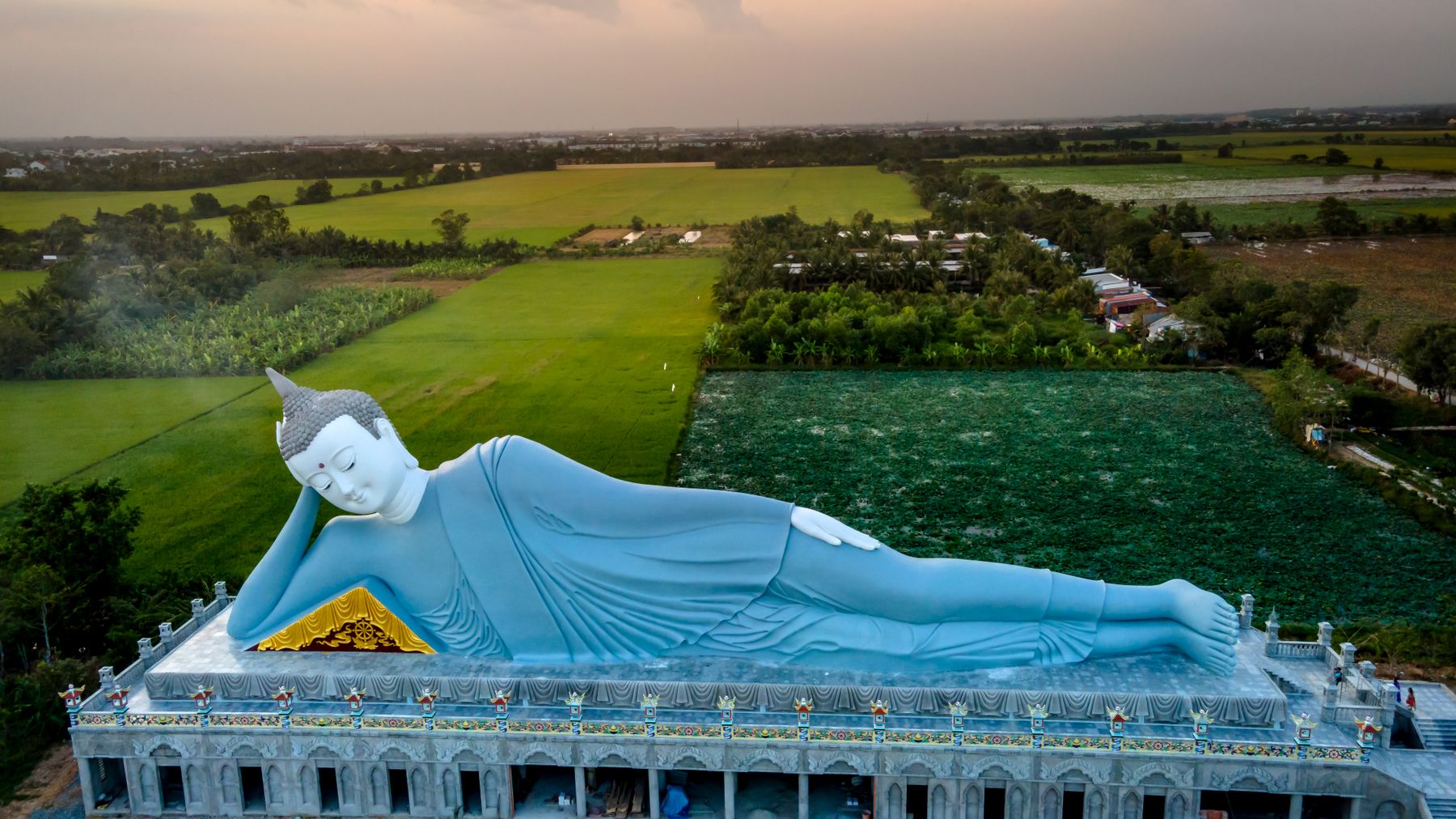
Photo by Quang Nguyen Vinh on Pexels
Practical tips
- Dress code: It's a working pagoda. Cover your shoulders and knees. Shoes come off before entering the cave shrine area.
- Entrance fee: Technically free, though a donation box sits at the entrance. 20,000-50,000 VND is typical.
- Photography: Permitted outside. Inside the cave, flash is discouraged near the main altar — ask the resident monk if unsure.
- Time needed: 1-2 hours for the pagoda and hill. Half a day if you're combining with nearby caves.
- Water: Bring your own. There's no shop inside the grounds, just the cart outside.
Common mistakes
Arriving midday. The cave stays cool, but the climb up the hill in noon heat (35°C+, full sun) is unpleasant. Come before 9 AM or after 3 PM.
Skipping Mo So. Many visitors see Chua Hang alone and leave. The real payoff of this area is the cluster of karsts — budget time for at least one more cave.
No flashlight. Phone lights work in a pinch, but a proper flashlight lets you actually see the stalactite formations in the darker sections without washing out details.
Practical notes
Chua Hang works best as part of a Ha Tien day trip or as a stop on a slow route between Rach Gia and the Cambodian border. It's not a full-day destination on its own, but combined with the surrounding caves and the empty roads through rice fields, it gives you a genuine slice of deep-south Vietnam that most travelers skip entirely on their rush to Phu Quoc.
Last updated · May 29, 2026 · independently researched, never sponsored.









