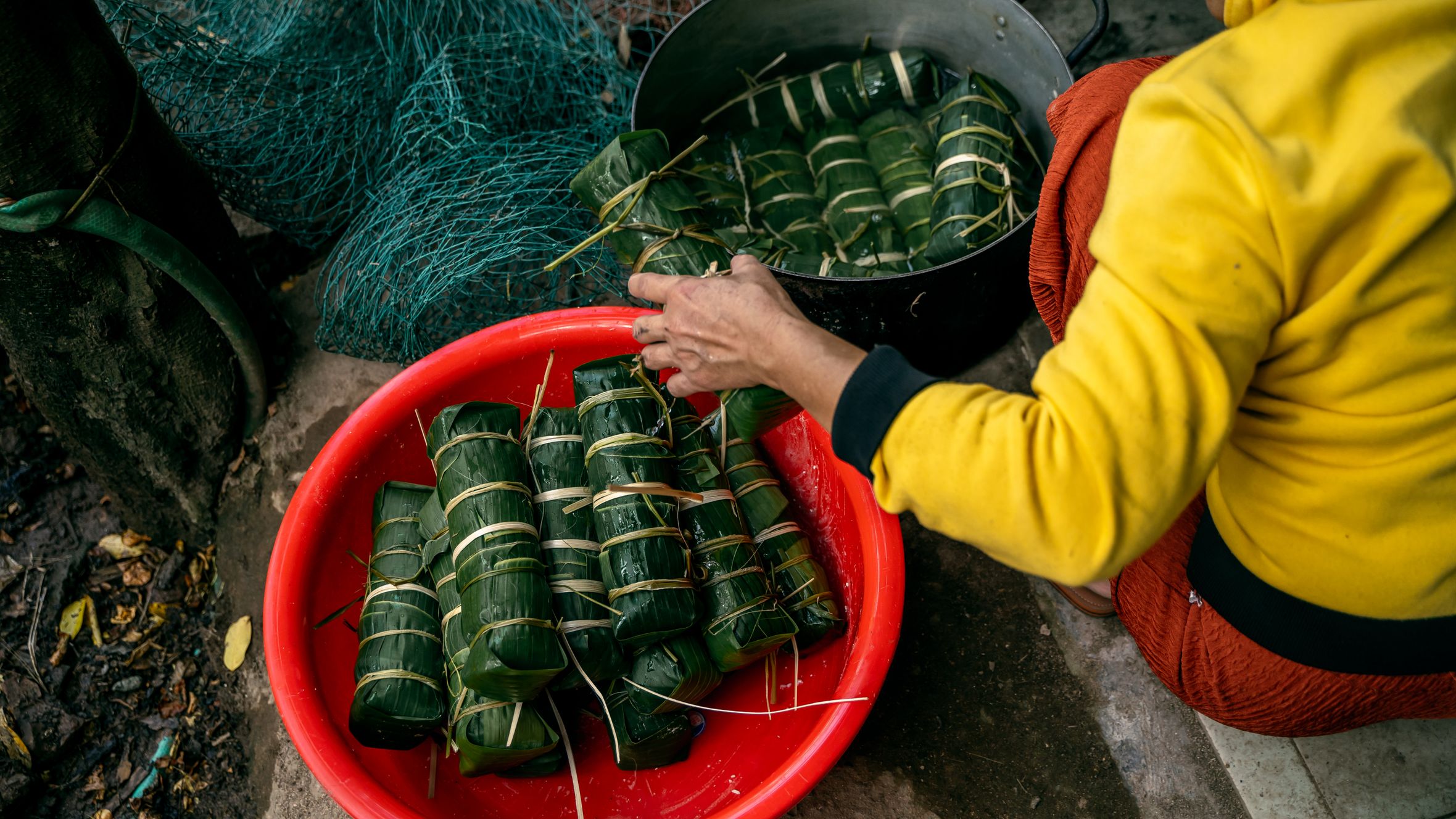
Sapa has a real breakfast culture if you know where to look — and "com lam" is the most honest expression of it. Sticky rice packed into green bamboo tubes, roasted over wood fire until the outer layer chars and the inside turns nutty and fragrant. It's not a tourist gimmick. Hill communities around Sapa have been cooking rice this way for generations, and on a cold morning at 1,500 meters, it makes complete sense.
What Com Lam Actually Is
The bamboo does more than hold the rice. As it heats, the green wood releases moisture and a faint grassy sweetness that soaks into the grains. The charred outer layer peels away to reveal a thin bamboo skin still clinging to the rice — that's the part you eat, not discard. Vendors split the tube with a quick knock and hand it to you whole, still hot.
The rice itself is glutinous — "gao nep" — and the standard accompaniments are "muoi vung" (sesame salt), which you press the rice into, or grilled pork skewers called "thit nuong" cooked on the same fire. Some stalls add a small dish of "ruoc" (pork floss) on the side. The combination is simple and it works: smoky rice, salty-toasted sesame, fatty pork.
Where to Find It in Sapa
The most consistent spot is the row of stalls along Duong Xuan Vien, the road that runs parallel to the valley-facing edge of town near the old church. Between roughly 6:00 and 9:30 in the morning, four or five vendors set up here with portable grills, stacks of bamboo tubes, and small charcoal fires. You'll smell it before you see it.
A single tube of com lam runs 10,000–15,000 VND. A skewer of grilled pork alongside it is another 10,000–20,000 VND depending on size. Breakfast for two with drinks comes to well under 100,000 VND.
If you're staying near the Sapa (사파 / 沙坝 / サパ) Market area on Nguyen Chi Thanh street, there are usually one or two vendors set up on the market's lower steps from around 6:30 AM. Supply here is smaller and they sell out faster — arrive before 8:00.
For something slightly more structured, Nha Hang Hmong Sisters on Ham Rong street serves com lam as part of a broader breakfast spread (around 45,000–60,000 VND per person), with better seating and english-language menus. It's a reasonable fallback in heavy rain.
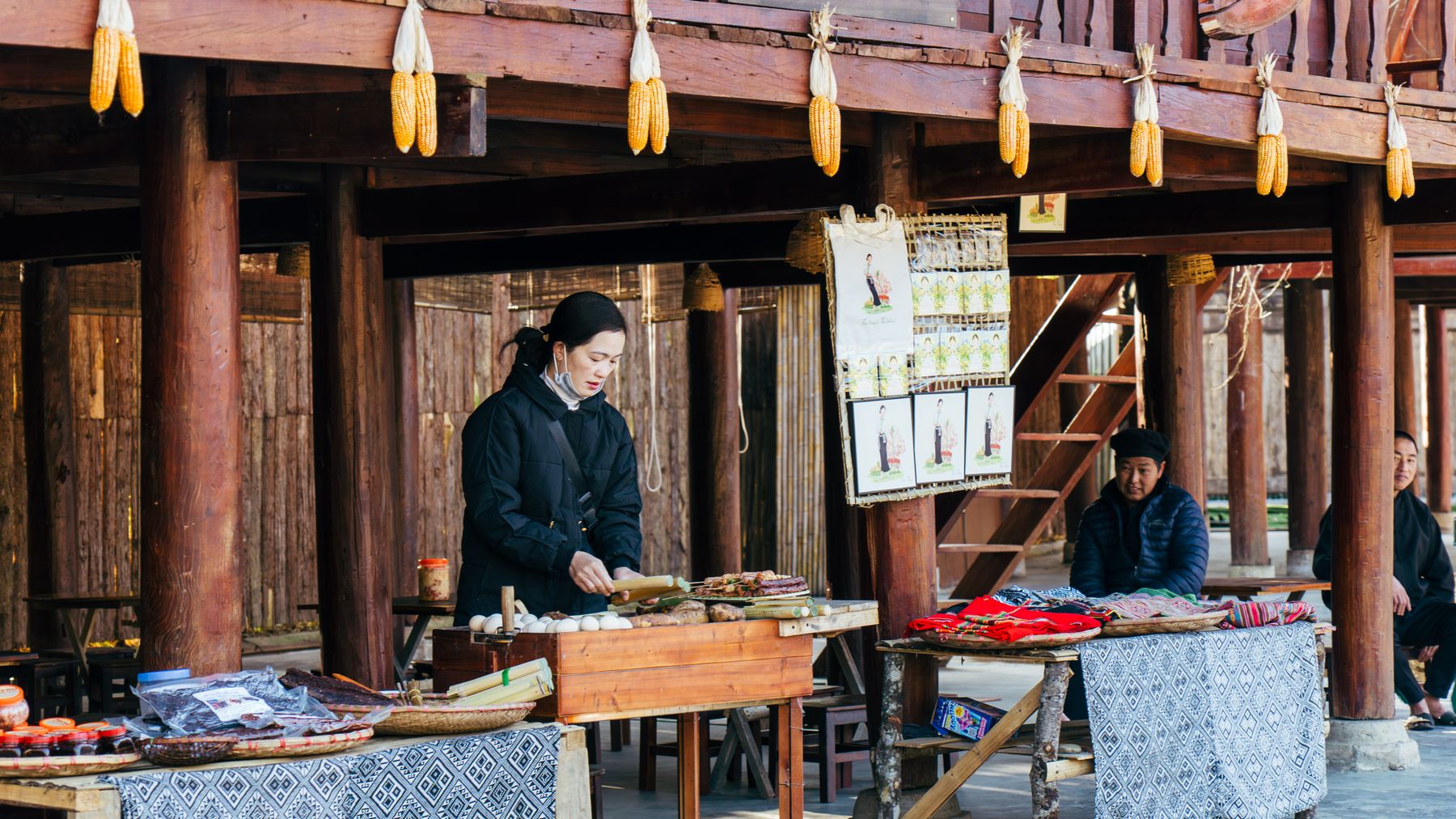
Photo by Gibson Chan on Pexels
How to Order
Point and hold up fingers. "Mot" is one, "hai" is two. The vendor will ask if you want meat — "thit khong?" (meat or not?). Nod yes and they'll add a skewer. Muoi vung usually comes automatically.
Eat it standing or perched on one of the low plastic stools vendors keep stacked nearby. The bamboo tube is your plate. When the rice gets down to the last third, it's common to pour a little hot tea or broth in and eat it like congee — vendors occasionally offer this without prompting.
When to Go
Com lam is strictly a morning food. Vendors who set up at 6:00 AM are mostly gone by 10:00, sometimes earlier on weekdays when the local crowd has passed through. Weekend mornings draw more vendors and a slightly longer window, but the logic is the same: go early.
Sapa is cold year-round by Vietnamese standards, but the October–March period is when com lam feels essential rather than optional. You're standing in mist at altitude with cold fingers, and the warm bamboo tube is genuinely useful. In the warmer months (May–August), it's still good, just less dramatic.

Photo by Chuot Anhls on Pexels
What Else Is On the Grill
The same vendors usually sell "banh ngo" (grilled corn cakes) and sometimes "khoai nuong" (roasted sweet potato) alongside the com lam. These cost 5,000–10,000 VND each and are worth grabbing if the stall has them. The corn cakes in particular are specific to the northern highlands and not something you'll find easily once you're back in Hanoi.
If you want to round out the morning properly, walk five minutes to any of the small coffee stalls near the church for a ca phe sua da (연유커피 / 越南冰咖啡 / ベトナムアイスコーヒー) or hot vietnamese coffee — the contrast between cold air and hot coffee after a bamboo rice breakfast is a reliable way to start a day in the mountains.
Practical Notes
Com lam vendors are cash only, no exceptions. Bring small bills — 10,000 and 20,000 VND notes. Don't expect a menu or a receipt; the transaction takes about thirty seconds and everyone moves on. If you're heading out for a trek later in the morning, it's worth buying an extra tube or two to take with you — com lam holds its heat surprisingly well inside a daypack for an hour or more.
Last updated · Jun 27, 2026 · independently researched, never sponsored.



