Ga Da Lat is one of those places that looks better in person than in photos — which, given how many photos people take here, is saying something. This small Art Deco railway station sits about 1 km east of Da Lat's center, and it operates today not as a functioning transit hub but as a living piece of architecture you can actually ride a train out of, if only for a few kilometers.
What it is and how it got here
Built between 1932 and 1938 during the French colonial period, Ga Da Lat (달랏 / 大叻 / ダラット) was the terminus of the Thap Cham–Da Lat cog railway, an engineering project that hauled passengers and freight 84 km up from the coast at Phan Rang to the highlands at 1,500 meters elevation. The railway shut down in 1968 during the war and never fully reopened. What remains is the station building itself — a blend of Art Deco lines and a roof inspired by the three peaks of Lang Biang mountain — plus about 7 km of restored track running to the village of Trai Mat.
The station was classified as a national historical monument in 2001. Following the 2025 provincial reorganization, Ga Da Lat now sits within the expanded Lam Dong province, though nothing about the station or its surroundings has changed for visitors.
Why travelers go
People come for the architecture, the short train ride, and the fact that it's one of the oldest surviving railway stations in Southeast Asia. But honestly, the real draw is the atmosphere. The building is compact — you can walk the whole thing in ten minutes — yet it has this unhurried quality that most of Da Lat's busier attractions lack. The gardens out front are well maintained, the platforms still have their original signage, and on weekday mornings you might be one of a handful of people there.
It's also one of the few places in Vietnam (베트남 / 越南 / ベトナム) where you can ride a vintage diesel train without it being a luxury experience priced for tour groups.
Best time to visit
Da Lat's dry season runs from November through March, and that's the sweet spot. Mornings are cool (15–18°C), skies are clear, and the light inside the station is good for photography. Avoid the weeks around Tet / 越南春节 / テト) if you don't want crowds — Ga Da Lat is a popular domestic tourism stop during the lunar new year holiday, and the platform gets packed.
April and May are still fine. June through October brings afternoon rain, which isn't a dealbreaker but can cut your Trai Mat trip short if you're on foot afterward.
How to get there
From central Da Lat (around the Xuan Huong Lake area), Ga Da Lat is about 1 km east along Quang Trung street. Walk it in 15 minutes, or grab a Grab bike for 12,000–15,000 VND.
If you're coming from Saigon, the most common route is a bus from Ben Xe Mien Dong (Eastern Bus Station). Phuong Trang and Thanh Buoi both run sleeper buses that take around 7–8 hours and cost 250,000–350,000 VND. Flights from Tan Son Nhat to Lien Khuong Airport take about 50 minutes; from the airport, it's another 30 km (roughly 45 minutes by taxi, around 250,000 VND) into Da Lat city.

Photo by Tuan Vy on Pexels
What to do
Ride the train to Trai Mat
The restored railway runs five daily departures (first at 7:45, last at 4:00 PM) covering 7 km to Trai Mat village. Tickets are 150,000 VND round trip per adult. The ride takes about 30 minutes each way, passing through pine forest and vegetable farms. At Trai Mat, most people visit Linh Phuoc Pagoda — a dragon-mosaic temple built from broken ceramics and glass — then catch the train back.
Tip: the first morning departure is the least crowded. Each train needs at least 20 passengers to run, so on very quiet weekdays, departures can be delayed or combined.
Walk the platforms and grounds
The station itself is free to enter (you only pay if you board the train). Spend time on the platforms looking at the original French-era track switches, the old signal equipment, and a couple of vintage locomotives parked on sidings. The main hall has a small exhibition with photos of the original Thap Cham–Da Lat railway.
Photograph the architecture
The station's triple-peaked roofline is the signature shot, best captured from the garden approach. The colored glass windows inside the main hall cast good light in the morning. The "ao dai" rental stalls near the entrance exist because this is genuinely one of the more photogenic backdrops in Da Lat — take that as you will.
Combine with a walk to Da Lat Market
From the station, it's a 20-minute walk downhill to Da Lat Market (Cho Da Lat), where the ground floor is all produce and the upper level sells everything from artichoke tea to knockoff North Face jackets. Good way to round out a morning.
Where to eat nearby
Two things worth seeking within a few hundred meters of the station:
"Banh canh" at the Trai Mat end — if you ride the train, Trai Mat village has a handful of stalls selling thick tapioca-flour noodle soup, often with pork knuckle. 35,000–45,000 VND a bowl. Not refined, but filling and local.
"Mi quang" on Phan Dinh Phung street — a 10-minute walk from the station toward the city center. Several small restaurants serve the turmeric-tinted noodle dish, which in Da Lat tends to come with more broth than the Da Nang original. 40,000–50,000 VND.
Da Lat is also a strong vietnamese coffee town — the highlands grow the beans, after all. Any cafe near the station will serve a solid "ca phe sua da" for 20,000–30,000 VND.
Where to stay
Ga Da Lat is close enough to central Da Lat that you don't need to stay right next to it. Budget guesthouses around the market area run 200,000–400,000 VND/night. Mid-range hotels on Bui Thi Xuan or Phan Dinh Phung streets go for 500,000–900,000 VND. For something with a view, places up on the hillside around Tran Hung Dao street start at about 1,200,000 VND.
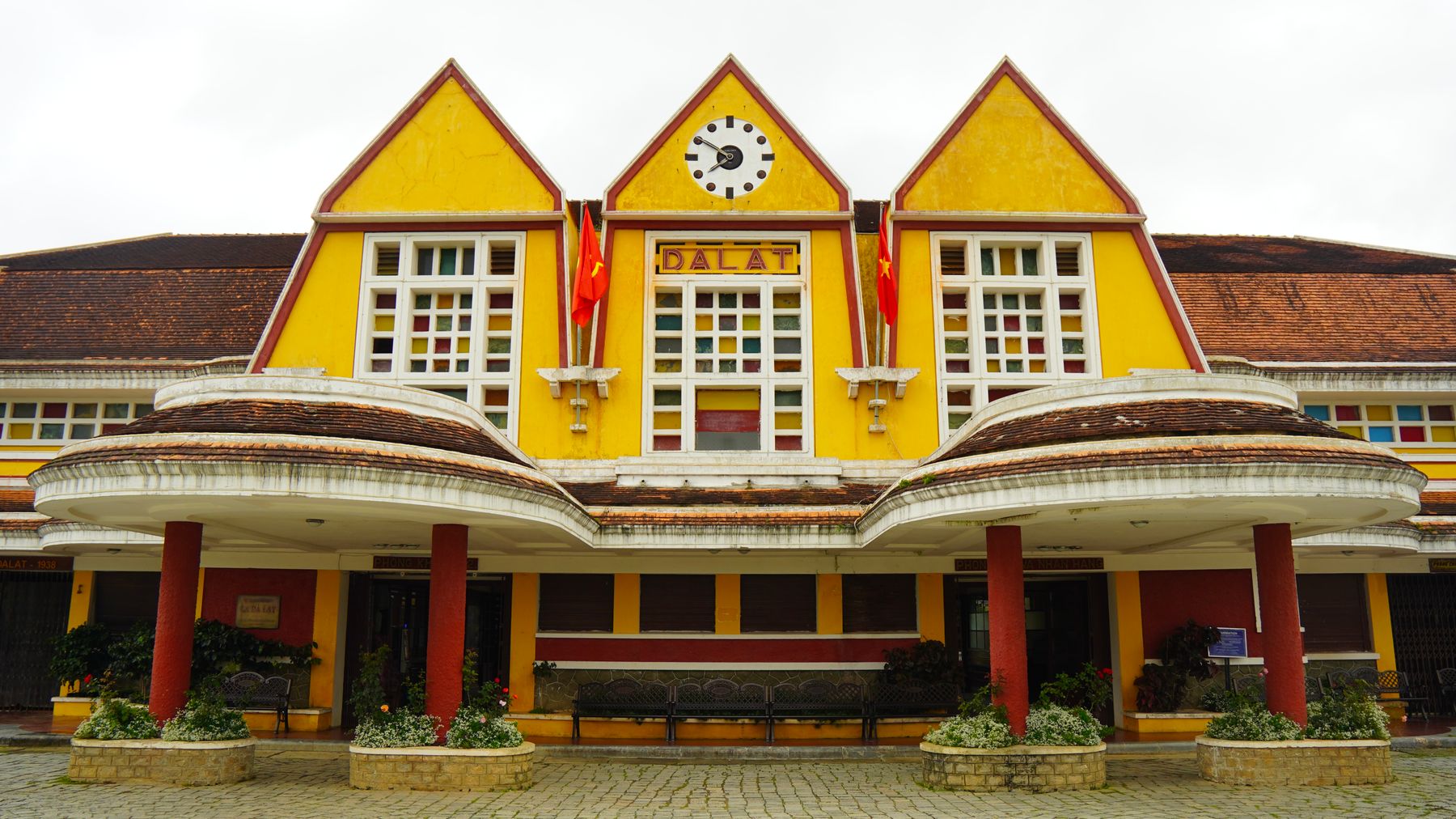
Photo by Tuan Vy on Pexels
Practical tips locals would tell you
- Bring a layer. Even in the dry season, mornings at the station can be cool enough for a light jacket. Da Lat sits at 1,500 meters; it's not the tropics you're used to down in Saigon.
- Cash only for train tickets. No card machines at the ticket window.
- Don't rely on the posted schedule. Trains do run on a timetable, but departures depend on minimum passenger count. If you're set on riding, arrive 15–20 minutes before departure.
- The station closes around 5 PM. No evening visits.
Common mistakes to avoid
Arriving with a tour bus at 10 AM. That's when every group tour hits Ga Da Lat. The station is small and gets crowded fast. Go early or after 2 PM.
Skipping Trai Mat. Some visitors photograph the station and leave. The train ride is the actual experience — seven kilometers of highland scenery for less than the price of a coffee at a Saigon chain cafe.
Expecting a full railway experience. This is a 7 km heritage ride, not a scenic railway journey. Calibrate expectations and you'll enjoy it. Go in thinking it's the Eastern Express and you won't.
Practical notes
Ga Da Lat works best as a morning stop — station visit plus train ride plus Trai Mat plus a bowl of noodles, all done by noon. Pair it with an afternoon at the market or a drive up to Lang Biang peak. It's a small attraction, but it's the kind of place that rewards you for slowing down instead of rushing through a checklist.
Last updated · May 29, 2026 · independently researched, never sponsored.








