What it is
Ho Thac Ba is a 23,000-hectare reservoir tucked into the hills of what was formerly Yen Bai province (now part of the merged Lao Cai province). Built between 1964 and 1971, the lake was created when the Thac Ba hydroelectric dam flooded a valley dotted with limestone karsts, creating over 1,300 islands and islets. Think Ha Long Bay's topography but freshwater, forested, and almost entirely free of tourist boats.
The lake sits at roughly 50 meters elevation, surrounded by hills reaching 500-600 meters. Local Dao and Tay communities still live along its shores, fishing and farming as they have for generations — just now with a lake where rice paddies used to be.
Why travelers go
Honestly? Most don't. That's the appeal. Ho Thac Ba sees a trickle of domestic weekenders from Hanoi (about 170 km away) and almost zero international visitors. You won't find floating karaoke bars or jet skis here.
People come for the quiet. The lake is genuinely scenic — karst towers rising from green water, caves accessible only by boat, and hillside villages where showing up as a foreigner is still a minor event. If you've done Ha Long Bay (하롱베이 / 下龙湾 / ハロン湾) and Ninh Binh and want something rougher and less produced, this is it.
Birders come for the wetland species. Photographers come for dawn mist on the water. Hikers come for trails through Dao villages above the shoreline. Nobody comes for nightlife.
Best time to visit
September through November gives you the clearest skies and comfortable temperatures (22-28°C). The post-monsoon landscape is intensely green without the daily rain.
December through February is cooler (can drop to 12-15°C at night) and often foggy — atmospheric if you like moody landscapes, but boat trips get cold.
Avoid June through August if possible. Heavy rain raises water levels and muddies visibility. Boats still run, but the experience is diminished and some cave access closes.
How to get there
From Hanoi (하노이 / 河内 / ハノイ), take a bus from My Dinh station toward Yen Bai city (now administratively part of Lao Cai province). The ride is about 3 hours on the Noi Bai-Lao Cai expressway, costing 120,000-150,000 VND. From Yen Bai city center, it's another 25 km southwest to Vu Linh commune on the lake's northern shore — grab a local bus (30,000 VND, 45 minutes) or hire a xe om for about 100,000 VND.
If you're coming from Sapa or Lao Cai city, take a bus south toward Yen Bai (2.5-3 hours, 100,000-130,000 VND) and continue to the lake.
Motorbiking from Hanoi is the most flexible option. The route via the expressway and then provincial roads QL37/DT163 takes 4-4.5 hours. Roads to the lake are paved but narrow in the final 10 km.

Photo by Karolina on Pexels
What to do
Boat trips
The main activity. Local fishermen rent aluminum boats for 400,000-600,000 VND per half-day (fits 4-6 people). You'll weave between limestone islands, stop at caves (Thac Ba Cave and Xuan Long Cave are the most accessible), and visit island pagodas. Negotiate at Vu Linh pier or ask your guesthouse to arrange.
Village visits
The Dao communities around Vu Linh and Ngoi Tu still practice traditional dyeing and embroidery. These aren't staged tourism villages — you're genuinely visiting someone's hamlet. Bring small gifts (fruit, instant coffee) rather than cash if you want to be respectful.
Hiking
Trails from Vu Linh lead up into the surrounding hills. A 3-hour loop takes you through bamboo forest and tea plantations with lake views. No marked trails — ask at your homestay for a guide (150,000-200,000 VND).
Swimming and kayaking
The water is clean enough for swimming in the dry season, particularly around the smaller islands away from the main shore. A few homestays now have basic kayaks available for guests — not a guarantee, so ask ahead.
Where to eat
Don't expect restaurant rows. Eating here means homestay meals or small com binh dan shops in Vu Linh town.
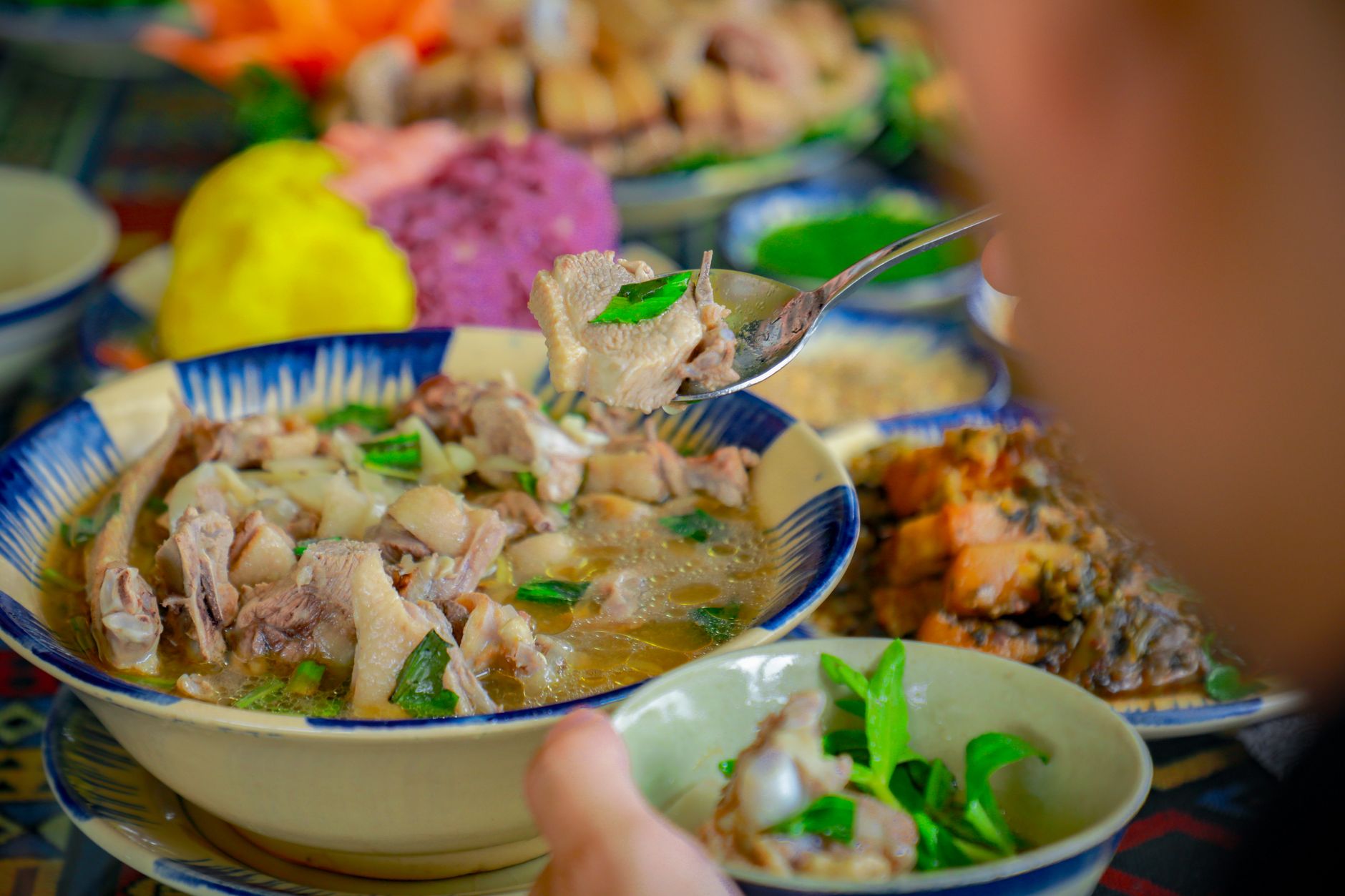
Homestay dinners are the highlight: freshwater fish from the lake (ca chep, ca tram) grilled over charcoal, wild greens foraged from the hillsides, sticky rice steamed in banana leaves. A full dinner runs 80,000-120,000 VND per person. The lake fish here is genuinely excellent — sweet, firm, nothing like the muddy-tasting farmed stuff you get in lowland towns.
In Vu Linh, a couple of small eateries serve "pho" and rice plates for 30,000-40,000 VND. Nothing special, but functional.
If you're passing through Yen Bai city, stop for "bun thang" at the market — the northern version here uses pork bone broth and shredded chicken with a clean, light flavor.
Where to stay
Accommodation is limited to homestays and one or two basic guesthouses. This isn't a complaint — it's part of why the place works.
Vu Linh Homestays — Several Dao families host guests in traditional stilt houses. Expect a mattress on the floor, mosquito net, shared bathroom, and extraordinary hospitality. 200,000-350,000 VND per night including dinner and breakfast.
Thac Ba Guesthouse — A concrete guesthouse near the pier with private rooms, hot water, and wifi. Basic but functional. 300,000-400,000 VND.
Book ahead on weekends (Vietnamese tourists from Hanoi do come). Midweek, you'll likely have your pick.

Photo by Red Nguyen on Pexels
Practical tips
- Cash only. No ATM at the lake. Withdraw in Yen Bai city before heading out.
- Phone signal is spotty on the water but fine in Vu Linh town (Viettel works best here).
- Bring sunscreen and a hat for boat days — there's no shade on the water.
- Insect repellent is essential May through October. Mosquitoes are aggressive at dusk.
- Vietnamese language helps enormously. Almost nobody here speaks English. Download offline translation or learn basic phrases.
Common mistakes
Coming for just a few hours. Some Hanoi day-trippers rush in, do a 2-hour boat ride, and leave. The lake rewards a slower pace — stay at least one night to get the early morning mist and evening atmosphere.
Expecting Ha Long-level infrastructure. There are no ticket offices, audio guides, or paved walking paths. This is rural Vietnam. If you need comfort, this isn't your trip.
Skipping Yen Bai city entirely. The city itself isn't a destination, but the central market is good for stocking up on snacks, fruit, and instant Vietnamese coffee for the lake.
Practical notes
Ho Thac Ba works best as a 2-night side trip — either as a stop between Hanoi and Sapa, or as a standalone escape from the capital. Combine it with a night in the tea hills around Suoi Giang (30 km north) if you want to extend. This is one of the few places in northern Vietnam where you can still feel like you've found something on your own.
Last updated · May 29, 2026 · independently researched, never sponsored.