What Hon Yen Is
Hon Yen is a cluster of rocky islets sitting about 400 meters off the coast of An Hoa village, Xuan Tho commune, in Phu Yen province. It's not an island you stay on — it's a volcanic reef system that emerges dramatically at low tide, creating a natural causeway you can walk across from the mainland. The rocks are covered in bright green seaweed ("rong moi") and pocked with tidal pools full of sea urchins, small fish, and crabs.
Locals have harvested seaweed here for generations. The reef's name translates roughly to "Swallow Islet," a nod to the swiftlet nests once collected from its crevices. Tourism only picked up in the last decade after drone footage of the emerald-green reef went viral on Vietnamese social media. It's still relatively quiet compared to the central coast's bigger draws like Hoi An or Da Nang.
Why Travelers Go
Hon Yen rewards you with something specific: the sight of dozens of women in conical hats ("non la") wading across a jade-green reef at dawn, harvesting seaweed into woven baskets. It's one of those scenes that looks unreal in photos but is just ordinary life here.
Beyond the visual payoff, there's a tactile quality to the place. You walk barefoot across volcanic rock textured like frozen lava. Tidal pools trap small marine life. The water is shallow and warm. It feels exploratory without requiring any real effort or gear.
For photographers, it's genuinely one of the better locations on Vietnam's central coast — the combination of dark volcanic rock, bright green algae, turquoise shallows, and working fisherfolk is hard to replicate elsewhere.
Best Time to Visit
Timing is everything at Hon Yen. You need low tide — specifically, a spring low tide between the 1st and 3rd or 14th and 16th of the lunar month. Without low tide, the reef stays submerged and you're just looking at open water.
The seaweed season runs from roughly January to April (peaking February–March). Outside this window, the rocks are bare and the harvesting scenes disappear.
Weather-wise, Phu Yen's dry season is January to August. The sweet spot is February to early April: low tides coincide with seaweed season, mornings are clear, and the light at 5:30–6:30 AM is golden.
Check a tide chart for Tuy Hoa before committing to a date. If the tide doesn't cooperate, you'll waste the trip.
How to Get There
Hon Yen is about 20 km south of Tuy Hoa, Phu Yen's capital city.
From Tuy Hoa: Rent a motorbike (120,000–150,000 VND/day from guesthouses near the train station) and ride south on the DT645 coastal road. The turnoff to An Hoa village is signposted. Total ride: 35–40 minutes.
From Quy Nhon: About 110 km north along the QL1D. Doable as a day trip if you leave early — 2.5 hours by motorbike, faster by car.
From Da Nang (다낭 / 岘港 / ダナン) or Hoi An: You're looking at 5–6 hours driving. Most travelers combine Hon Yen with a longer Phu Yen itinerary that includes Ganh Da Dia (the basalt columns), Bai Xep beach, and the O Loan lagoon.
Flights: Tuy Hoa's Dong Tac Airport has daily connections from Saigon (1h15) and Hanoi (1h45) on Vietnam Airlines and VietJet.
Getting onto the reef
From An Hoa village, you either wade across at low tide (water knee-deep or lower) or hire a small round basket boat ("thuyen thung") from a local for 50,000–100,000 VND. The basket boat is the safer bet if you're not sure about the tide timing.

Photo by Quang Nguyen Vinh on Pexels
What to Do
- Walk the reef at low tide. Wear water shoes or old sandals — the volcanic rock is sharp. Explore tidal pools, watch seaweed harvesters work, photograph the textures.
- Hire a basket boat. A 20-minute loop around the islets costs 50,000–100,000 VND. Some boatmen will take you to the outer rocks where the reef drops off into deeper water.
- Catch sunrise. Arrive by 5:30 AM. The harvesters start early, and the low-angle light on wet seaweed is the reason photographers come here.
- Snorkel (dry season only). The water around the outer islets is clear enough for basic snorkeling. Bring your own gear — there's no rental available.
Where to Eat
An Hoa village has a handful of family-run seafood spots along the road leading to the shore. Expect grilled fish, steamed clams, seaweed soup ("canh rong bien"), and rice. A full seafood meal runs 80,000–150,000 VND per person.
For something more polished, drive 15 minutes north to the stretch of restaurants along Bai Xep beach, where a few guesthouses serve excellent "banh canh" (tapioca noodle soup) with local fish.
Back in Tuy Hoa, the night market near Tran Hung Dao street has solid "banh xeo" — Phu Yen's version uses rice paper wraps and is crispier than the southern style.
Where to Stay
There's no accommodation at Hon Yen itself. Your options:
- An Hoa homestays: Basic rooms, 200,000–350,000 VND/night. Functional, friendly, zero frills. Book by calling ahead (Vietnamese language helps).
- Bai Xep: 10 minutes north. A few boutique guesthouses with sea views in the 500,000–900,000 VND range.
- Tuy Hoa: Full hotel selection. Mid-range options on Tran Hung Dao street run 400,000–700,000 VND.
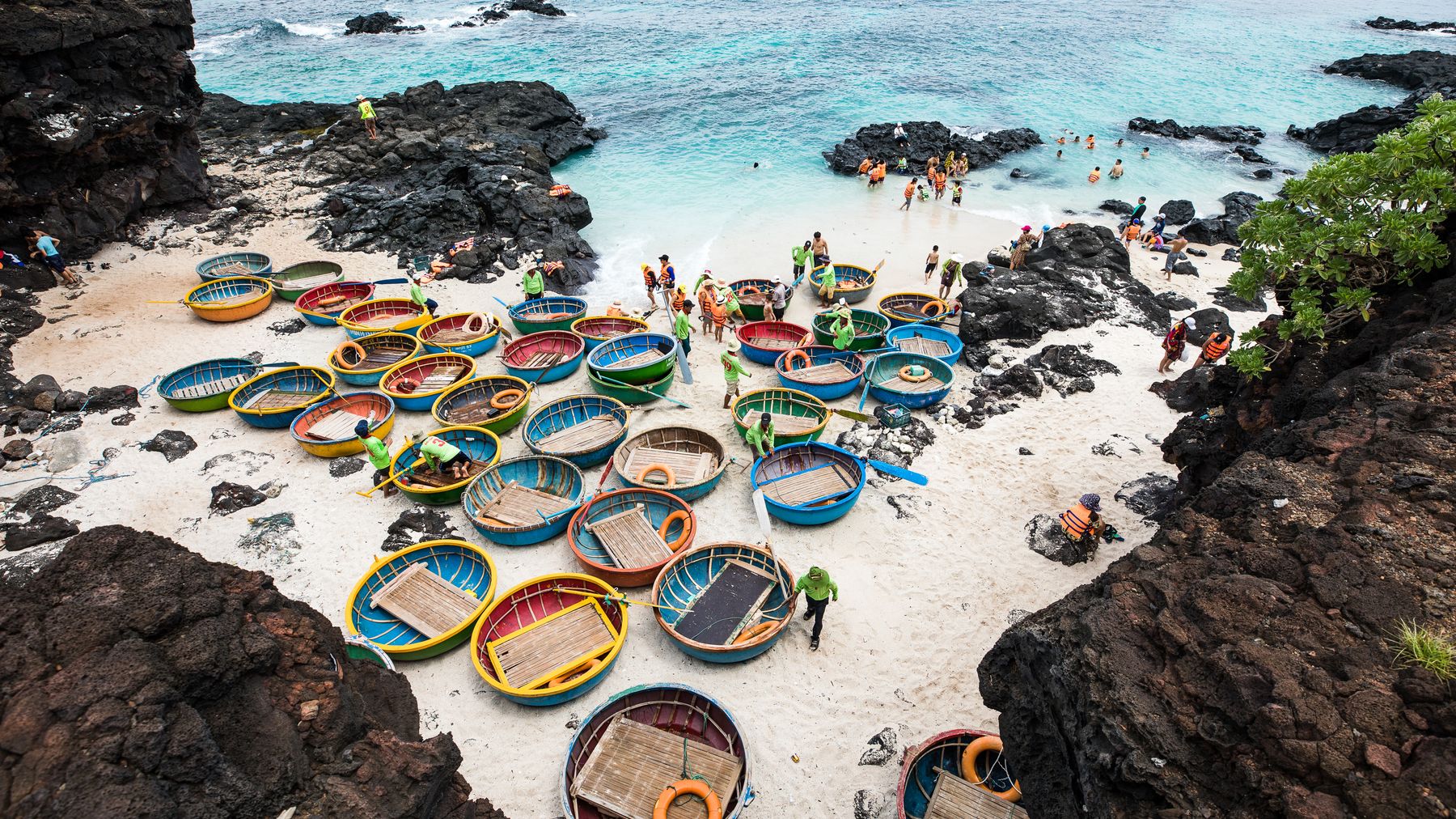
Photo by Son Tung Tran on Pexels
Practical Tips
- Shoes matter. Volcanic rock will shred bare feet. Bring reef shoes or sturdy sandals with grip.
- Check tides the night before. Use the "Tide Times" app or search "Tuy Hoa tide chart." If high tide falls at dawn, sleep in.
- Bring cash. No ATMs in An Hoa. The nearest is in Tuy Hoa.
- Sun protection. The reef offers zero shade. Hat, sunscreen, long sleeves.
- Respect the harvesters. Don't trample the seaweed beds or block working paths for a photo. Ask before shooting close-ups of people.
Common Mistakes
Arriving at high tide. This is the number one wasted trip. The reef is completely underwater and there's nothing to see. Always check tide tables.
Coming outside seaweed season. If the green carpet and the harvesting scene are what you want, don't visit May–December. The rocks will be bare and brown.
Underestimating the drive from Da Nang. It's not a quick side trip. Budget a full day or, better, stay in Tuy Hoa or Bai Xep the night before.
Wearing flip-flops on the reef. You'll slip, cut your feet, or both. Every local wears proper shoes out there — take the hint.
Final Note
Hon Yen isn't a place you linger for days. It's a two-hour experience that demands precise timing — and when you get it right, it delivers something you won't find elsewhere on Vietnam's coast. Pair it with Ganh Da Dia and Bai Xep for a proper Phu Yen loop, and you've got one of the quieter, more rewarding stretches of the central coast.
Last updated · May 26, 2026 · independently researched, never sponsored.