What Is Banh Xeo?
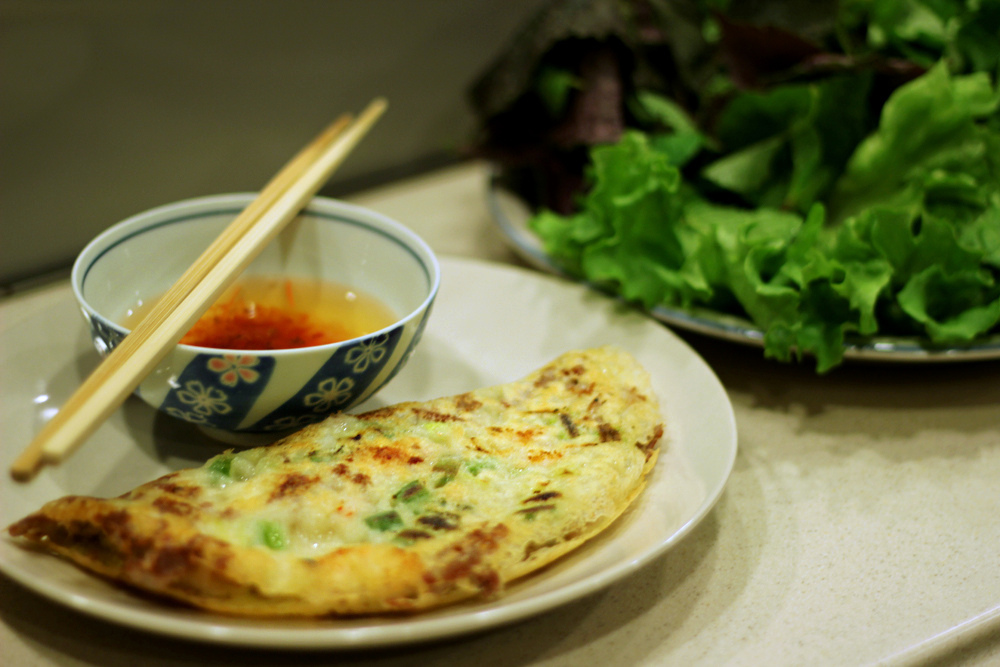
"Banh xeo (반세오 / 越南煎饼 / バインセオ)" gets its name from the sizzle — xeo — when rice batter hits a smoking-hot pan. It's a savory crepe, turmeric-yellow, filled with shrimp, pork, and bean sprouts, then folded into a half-moon and fried until the edges turn crisp. You tear off pieces, wrap them in lettuce and herbs, and dip into fish sauce. The ritual is the same across Vietnam, but the pancake itself — the batter, the filling, the sauce, the herbs — shifts dramatically depending on where you are.
Central Vietnam: Hue's Banh Khoai and Phan Thiet's Teacup Pancakes
In Hue, banh xeo is called "banh khoai" and comes with grilled pork instead of boiled. The defining element is "nuoc leo", a thick, rust-colored dipping sauce made from fermented soybean paste, pork liver, and ground peanuts. It's richer and more savory than the sweet-sour fish sauce you'll find in the south. The herb plate includes tart starfruit and unripe figs alongside the usual lettuce and mint.
The name banh khoai likely comes from banh khoi — smoke cake. When you pour batter into a hot pan filmed with oil, smoke rises. In the Hue accent, khoi sounds like khoai. Making it properly — thin, crispy, with that smoky aroma — takes practice.
Phan Thiet does something completely different. The pancakes are tiny, about the size of a teacup, and you don't wrap them in lettuce. Instead, you drop them straight into a bowl of "nuoc mam chin" — cooked fish sauce blended with garlic and chili. Tuyen Quang Street in Phan Thiet is lined with stalls serving these, earning it the nickname Banh Xeo Street.
Southern Vietnam: Big, Crispy, Herb-Heavy
In the Mekong Delta (메콩 델타 / 湄公河三角洲 / メコンデルタ), banh xeo is bigger, crispier, and comes with an overwhelming herb plate. The batter often includes egg, and the dipping sauce is sweet-sour fish sauce — lighter and brighter than Hue's nuoc leo. The herb selection varies by province. In Can Tho, you'll get "la chiet" (a sharp-flavored leaf). In Dong Thap, "la bang lang". Vinh Long serves young mango leaves. Bac Lieu adds "la cach". Some of these herbs don't have English names — you just eat them and figure it out.
In Saigon, longtime spots like Banh Xeo A Phu and Banh Xeo Dinh Cong Trang have been serving the same recipe for over twenty years. A more recent innovation is "lotus banh xeo," created by artisan Muoi Xiem, which incorporates lotus seeds, stems, and roots into the filling.

Image by CEphoto, Uwe Aranas via Wikimedia Commons (CC BY-SA)
Northern Vietnam: Jicama and Taro
In the north, the filling often includes thinly sliced jicama or taro in addition to the standard shrimp and pork. The pancakes are less crispy than in the south — sometimes closer to a soft crepe.
How It's Made
Traditional banh xeo starts with soaking rice until it's plump, grinding it with fresh turmeric (preferred over powder for brighter color and flavor), then thinning the batter with water. Some cooks add coconut milk, which gives the pancake a pale brownish-yellow color instead of bright turmeric yellow. Dried coconut milk — made by pressing warm water through grated dried coconut — is stirred in, and the batter rests for 30 minutes. Just before cooking, finely chopped green onions go in.
Pre-mixed banh xeo flour is widely available now — just add water.
The filling: boiled pork belly, sliced thin and cooked with a pinch of salt. Shrimp, sauteed lightly with salt and MSG. Hulled mung beans, cooked until soft. Bean sprouts, blanched. In some regions, the filling ingredients are marinated raw and cook directly in the pancake.
To cook: heat a large pan with a small amount of oil. Pour in a ladle of batter, tilt the pan to spread it thin, cover until half-cooked. Add the filling in the center, cover again until crispy. In Hue, cooks use small, flat-bottomed round molds instead of tilting the pan.

Image by CEphoto, Uwe Aranas via Wikimedia Commons (CC BY-SA)
The Herb Plate and Dipping Sauce
Banh xeo is always served with a plate of fresh greens: lettuce, mustard greens, fish mint ("rau ram"), perilla, basil, and sometimes young "com nguyen" leaves. The dipping sauce varies. In the south: fish sauce, water, lime juice (not vinegar — lime tastes better), sugar, a touch of MSG, shredded carrots, minced chili. In Hue: nuoc leo, thick and savory with fermented bean paste and liver.
Korea and Japan Have Their Own Versions
Korea's pancakes are called "jeon". Examples: "baechujeon" (napa cabbage), "dongnaepajeon" (whole green onion), "buchujeon" (chive). Buchujeon is often paired with "makgeolli", a sweet, milky rice wine served in a small teapot or a wooden bowl with a ladle. Korean pancake batter is looser than Vietnamese. Seafood is blanched in water with white wine, mixed with 5cm pieces of green onion and chive, then combined with a batter made from flour, sugar, garlic, vinegar, and salt. Beaten egg is poured over the filling before frying.
Japan's version is "okonomiyaki" — the name means "grilled as you like it." It's a specialty of Kansai and Hiroshima, but you'll find it across Japan. The batter is flour, water, and egg, mixed with shrimp, pork, thinly sliced cabbage, red ginger, and green onions. Pre-mixed okonomiyaki flour often includes seasonings. After frying on both sides (about 5 minutes per side), it's drizzled with okonomiyaki sauce and mayonnaise, then topped with bonito flakes that curl and wave in the heat.
All three — Vietnamese banh xeo, Korean jeon, Japanese okonomiyaki — share the same basic idea: savory pancake, hot pan, crispy edges, lots of toppings. But the details — the batter, the herbs, the sauce, the ritual — are completely different.
Last updated · May 26, 2026 · independently researched, never sponsored.