
What it is
Thien Vien Truc Lam Phuong Nam is the largest Zen Buddhist monastery in the Mekong Delta (메콩 델타 / 湄公河三角洲 / メコンデルタ) — a 38-hectare complex of halls, bridges, lotus ponds, and manicured gardens about 30 km south of central Can Tho. It belongs to the Truc Lam Zen school, a modern Vietnamese Buddhist order founded in the 1960s that also operates well-known monasteries near Da Lat and Hue. The Phuong Nam branch opened in 2014 after roughly a decade of construction, built on reclaimed marshland in what was formerly Hau Giang province (now part of merged Can Tho).
Unlike many Vietnamese pagodas that pack into narrow city plots, this place sprawls. The main hall sits on an island reached by an arched bridge over a lake dense with lotus. A 300-meter covered walkway connects the gate to the inner grounds, passing through courtyards with bonsai trees and stone carvings. The architecture blends traditional Vietnamese temple design — curved tiled roofs, dragon motifs — with the Truc Lam school's preference for clean geometry and open space.
Why travelers go
Most visitors to Can Tho (껀터 / 芹苴 / カントー) come for the floating markets and leave within a day. Thien Vien Truc Lam Phuong Nam gives you a reason to stay longer, or at least drive out of the city center. The grounds are genuinely peaceful — not in a brochure sense, but in the sense that you can walk for 20 minutes without hearing a motorbike horn. The lake, the lotus blooms (peak around June–August), and the sheer scale of the place make it one of the more photogenic spots in the delta.
It's also free to enter. No ticket, no guided tour fee, no pressure to donate (though donation boxes exist). For travelers interested in Vietnamese Buddhist architecture without the crowds of places like Bai Dinh in Ninh Binh, this is a quieter alternative.
Best time to visit
The Mekong Delta has two seasons: wet (May–November) and dry (December–April). For photography, come during lotus season — June through August — when the lakes turn pink. Mornings before 9 AM are best: cooler temperatures, fewer tour buses, and softer light on the water.
During Tet and other Buddhist holidays (Vesak in particular, usually May), the monastery hosts ceremonies and draws large local crowds. Interesting to observe, but not ideal if you want quiet.
Avoid midday year-round. There's limited shade between structures, and delta heat at noon — 34-36°C with high humidity — makes the long walkways uncomfortable.
How to get there
From central Can Tho (Ninh Kieu district), the monastery is about 30 km south along National Route 1A toward Soc Trang, then a right turn onto a smaller road. The ride takes 40–50 minutes by motorbike or car.
Options:
- Grab car: 150,000–200,000 VND one way. Ask the driver to wait (negotiate an hourly rate of about 80,000–100,000 VND) since Grabs are scarce out here.
- Motorbike rental: 120,000–150,000 VND/day from most guesthouses in Can Tho. The road is flat and straightforward — typical delta driving, just watch for trucks on Route 1A.
- Organized tour: Some Can Tho day tours bundle the monastery with My Khanh floating market or fruit orchards. Expect 400,000–600,000 VND per person including transport and lunch.
There's a large free parking lot at the entrance.
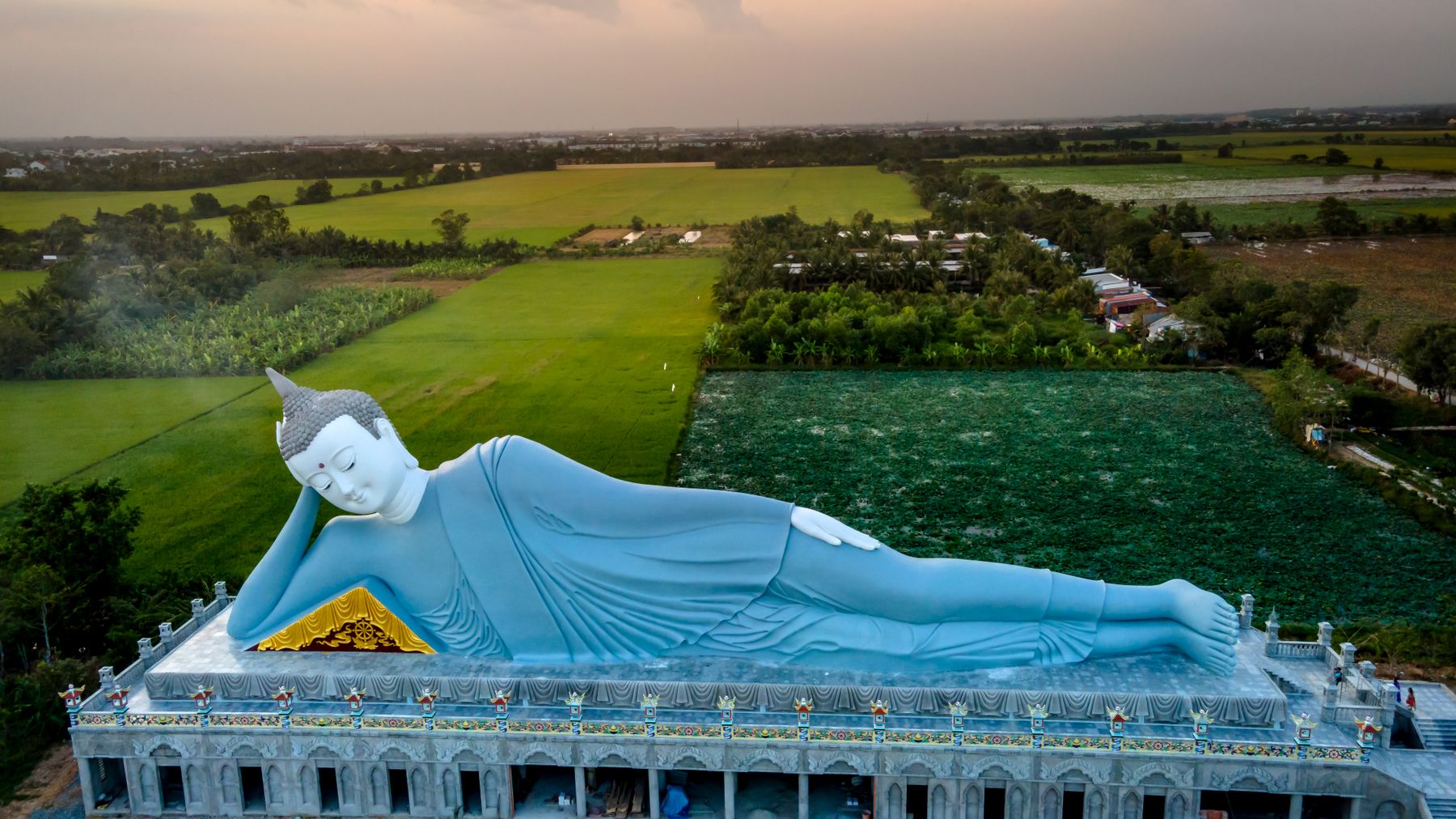
Photo by Quang Nguyen Vinh on Pexels
What to do
Budget 1.5 to 2 hours for a relaxed visit.
Walk the grounds
The main axis runs from the entrance gate across the arched bridge to the Chanh Dien (main hall). Take the covered corridor or walk along the lake edge. Side paths lead to smaller meditation halls, a bell tower, and gardens with hundreds of bonsai specimens — some over a century old.
Visit the main hall
The Chanh Dien houses a large Shakyamuni Buddha statue and is open to visitors outside of prayer times (typically 4–5 AM and 5–6 PM). Remove shoes, dress modestly (knees and shoulders covered), and keep voices low. Photography is allowed in the courtyard but generally discouraged inside the hall.
Lotus lake
If you visit during bloom season, the lake is the highlight. Walk the full perimeter — about 1.2 km — for different angles. Early morning light reflecting off the water with lotus in the foreground is the shot everyone comes for.
Sit
Seriously. Find a bench in the garden or a spot along the covered walkway. The monastery was designed for contemplation, and the ambient quiet — birdsong, distant chanting, water — is the real draw.
Where to eat
The monastery has a small vegetarian cafeteria ("com chay") serving simple rice plates for 20,000–30,000 VND. It's basic but fresh — expect rice, braised tofu, stir-fried morning glory, pickled vegetables.
For something more substantial, eat before or after in Can Tho proper:
- Nem Nuong Thanh Van (Hai Ba Trung Street): grilled pork rolls with rice paper, about 60,000 VND per set.
- Floating market stalls at Cai Rang: bowls of "hu tieu" (Mekong-style pork noodle soup) for 25,000–35,000 VND, best before 8 AM.
- For the delta's regional noodle dishes, look for "bun nuoc leo" — a Soc Trang-origin fish broth noodle soup common in Can Tho, typically 30,000–40,000 VND.
Where to stay
No accommodation at the monastery itself (it's an active monastic community, not a retreat center for tourists). Stay in Can Tho:
- Budget: Mekong My Tho Hostel or Kim Lan Hotel in Ninh Kieu, 200,000–350,000 VND/night.
- Mid-range: Iris Hotel or Nesta Hotel, 500,000–800,000 VND/night, both near the riverfront.
- Splurge: Azerai Can Tho, a former colonial-era building turned boutique hotel on the Hau River, from 2,500,000 VND/night.

Photo by Serg Alesenko on Pexels
Practical tips
- Dress code: Enforced loosely but respected. Long pants or skirts below the knee, covered shoulders. Scarves available to borrow at the entrance if needed.
- Silence: The monastery asks visitors to keep phone calls and loud conversation to a minimum. Tour groups sometimes ignore this — mornings before group arrivals (usually 9–10 AM) are best.
- Bring water: There's a small shop near the parking lot, but nothing once you're inside the grounds.
- Combine with Cai Rang: The floating market in Can Tho runs from about 5–8 AM. Visit the market at dawn, have breakfast on the water, then drive to the monastery by mid-morning.
Common mistakes
- Arriving at noon: The heat and harsh light make the grounds unpleasant and un-photogenic. Come early or after 3 PM.
- Not allowing enough time: Some people treat it as a 15-minute photo stop. The scale of the grounds rewards a longer, slower visit.
- Expecting English signage: Almost everything is in Vietnamese. Download a translation app or read up beforehand. Monks occasionally speak some English but aren't tour guides.
- Confusing it with other Truc Lam monasteries: There are Truc Lam branches near Da Lat (the original), in Hue, and elsewhere. If booking a tour, confirm it's Truc Lam Phuong Nam specifically.
Final note
Thien Vien Truc Lam Phuong Nam won't make most Mekong Delta itineraries, which tend to focus on floating markets and fruit orchards. That's partly why it works — it's a counterpoint to the sensory overload of delta river life, a place where the loudest sound is a bell.
Last updated · May 29, 2026 · independently researched, never sponsored.










