
What Van Mieu Mao Dien actually is
Most travelers who've been to Hanoi have walked through the Temple of Literature — the 11th-century Confucian university that ends up on everyone's itinerary. Van Mieu Mao Dien is its lesser-known counterpart, built in 1028 during the Ly dynasty as the Confucian temple for the broader Hai Duong region. It sits in Mao Dien village, Cam Giang district, in what is now part of the expanded Hai Phong administrative area (following the 2025 merger of the former Hai Duong province).
The temple was originally established to honor Confucius and his disciples, and over the centuries it became a center for scholarly examinations in the north. During the Le dynasty, Hai Duong province produced more doctoral laureates than almost any other region — 637 "tien si" (doctoral graduates) across multiple imperial exam cycles. The temple houses stone stelae recording their names, similar to the stelae at the Temple of Literature in Hanoi (하노이 / 河内 / ハノイ) but with a regional focus that makes them arguably more interesting for history-minded visitors.
The complex was heavily damaged during wartime and left to decay for decades. A major restoration completed in 2004 rebuilt the main halls, ceremonial gates, and gardens across roughly 10 hectares. What you see today is largely reconstructed, but the layout follows traditional Confucian temple architecture faithfully — and the stelae are originals.
Why travelers go
Honestly, most don't — and that's exactly the appeal. On weekdays you'll share the grounds with a handful of students and the occasional family burning incense. No tour buses, no selfie sticks, no hawkers.
Vietnamese families visit before exam season (May–June) to pray for academic success, a tradition that's been continuous for centuries. If you're interested in Confucian heritage, Vietnamese scholastic culture, or just want a quiet temple complex without the crowds of Hanoi's tourist circuit, this is worth the detour.
Best time to visit
The temple is open year-round, but timing matters.
February to April is ideal — cool weather, clear skies, and the gardens are green without being overgrown. The [Lunar New Year](/posts/tet (뗏 (베트남 설날) / 越南春节 / テト)-lunar-new-year-guide) period (Tet) brings ceremonies and offerings, though the temple can get busy with local families during the first few days of the holiday.
May to June is exam season. Students and parents flood the complex to pray and leave offerings. It's atmospheric and culturally fascinating, but expect weekend crowds.
July to September is hot, humid, and prone to heavy rain. You can still visit, but the heat in an open temple complex with limited shade is draining.
The temple opens daily from around 7:00 to 17:30. Mornings before 9:00 are quietest.
How to get there
Van Mieu Mao Dien sits about 45 km west of central Hai Phong along National Highway 5 and roughly 55 km east of Hanoi.
From Hai Phong: Grab car or taxi runs about 250,000–350,000 VND one way, taking 50–60 minutes depending on traffic. Local buses from Hai Phong's Tam Bac station serve Cam Giang district, but schedules are irregular and you'll need a motorbike taxi for the final 3 km from the main road. Budget around 30,000 VND for the bus.
From Hanoi: The simplest route is a Grab car (around 300,000–400,000 VND, roughly one hour via Highway 5). You could also catch any Hai Phong-bound bus from Gia Lam or My Dinh station (80,000–100,000 VND) and ask to be dropped at the Cam Giang turnoff, then take a local "xe om" (motorbike taxi) for the remaining distance — about 20,000–30,000 VND.
If you're combining this with a broader trip, Van Mieu Mao Dien pairs well with a day visiting Con Son–Kiep Bac temple complex, about 30 km south.
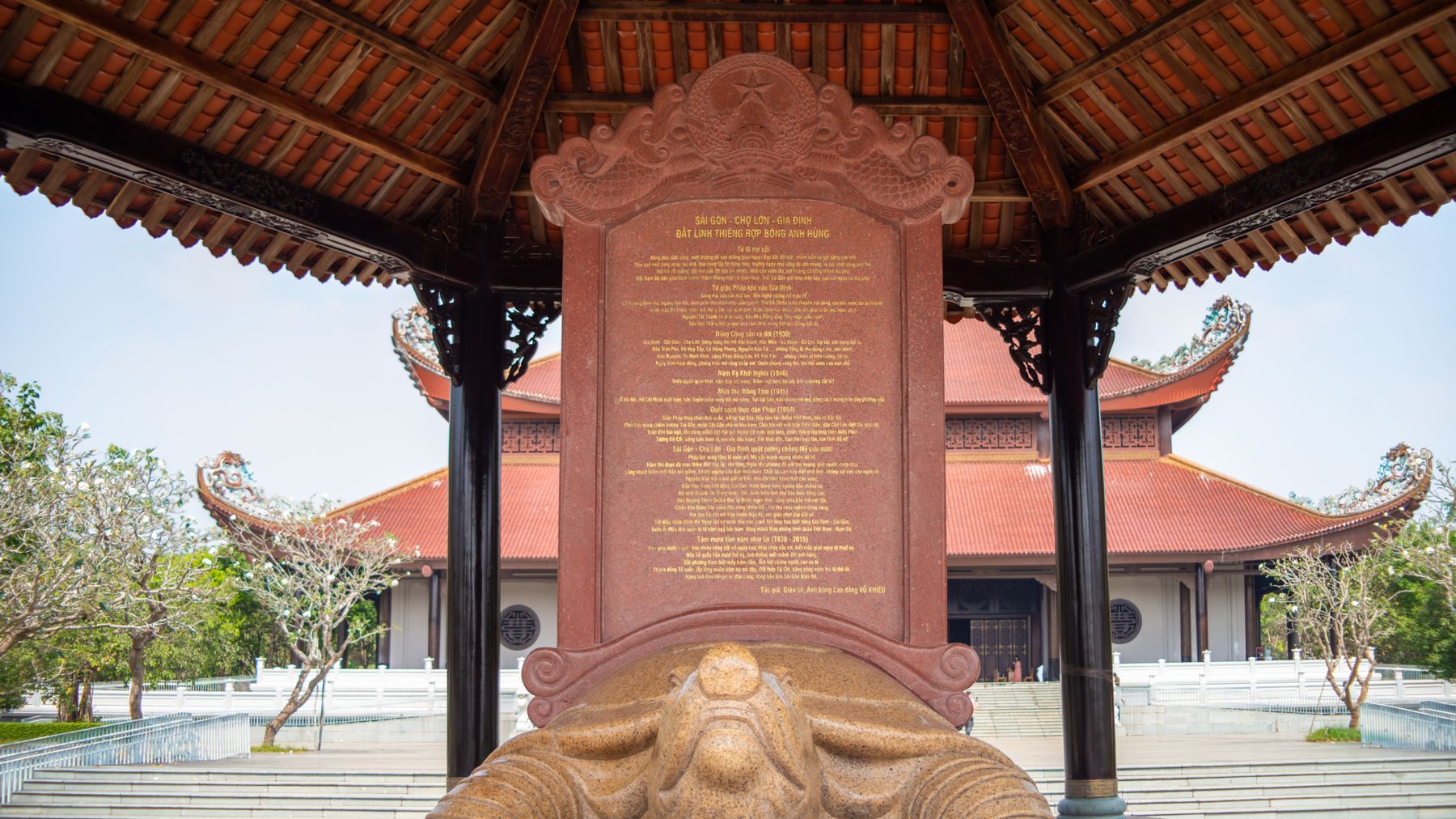
Photo by Ty Nguyễn on Pexels
What to do
Walk the five courtyards
The complex follows the classic five-courtyard Confucian temple layout. Start at the main gate ("Nghi Mon") and walk the central axis through each courtyard. The third courtyard holds the stone stelae — take time to read the translated inscriptions listing laureates by exam year and hometown. The rear hall ("Hau Cung") houses altars to Confucius, Chu Van An, and other notable scholars.
Study the stelae up close
There are 12 stone stelae recording the names of 637 doctoral graduates from the region. Unlike Hanoi's Temple of Literature stelae (which sit on stone tortoises behind glass), these are more accessible and less crowded. Some date to the 15th century.
Visit during a ceremony
If you time it right — particularly during Tet, exam season, or the temple's anniversary festival (usually the 18th day of the second lunar month) — you'll see incense offerings, traditional music, and sometimes "ca tru" performances. The annual spring festival is the most elaborate, with processions and scholar re-enactments.
Explore the gardens
The 10-hectare grounds include lotus ponds, frangipani trees, and well-maintained paths. The rear garden area is almost always empty and good for 30 minutes of quiet walking.
Talk to the caretakers
The temple staff are often local retirees who know the history in detail. A few speak basic English. They'll happily show you features that aren't signposted — damaged original carvings built into the reconstruction, for instance.
Where to eat nearby
Cam Giang district isn't a culinary destination, but there are a couple of things worth seeking out.
"Banh cuon" (steamed rice rolls) from small shops along the road into Mao Dien village is the local breakfast staple — thin, delicate sheets filled with minced pork and mushroom, served with "cha" (pork sausage) and dipping sauce. Expect to pay 25,000–35,000 VND per portion.
For lunch, head toward the main highway where local "com binh dan" (everyday rice) restaurants serve plates of rice with three or four dishes for 35,000–50,000 VND. Nothing fancy — pork, greens, tofu, soup — but solid and filling.
If you're headed back to Hai Phong afterward, save your appetite for "banh mi" from the stalls near Tam Bac Market or a bowl of "bun ca" (fish noodle soup), a Hai Phong specialty that's harder to find elsewhere.
Where to stay
Most visitors treat Van Mieu Mao Dien as a half-day trip rather than an overnight destination. The village itself has no tourist accommodation.
Budget: Guesthouses in Cam Giang town run 200,000–350,000 VND per night. Basic but functional.
Mid-range: Hai Phong city center has plenty of hotels in the 500,000–900,000 VND range — Avani, Manoir des Arts, or smaller boutique spots near the opera house district.
From Hanoi: If you're based in the capital, this works as a comfortable day trip with time to spare.

Photo by Tuan Minh on Pexels
Practical tips locals would tell you
- Dress modestly. Shoulders covered, no shorts above the knee. This is an active place of worship, not just a monument.
- Bring cash. There's no ATM within walking distance of the temple, and the entrance fee (if collected — it varies) is small, around 20,000 VND.
- Mosquito repellent is useful, especially near the lotus ponds in the afternoon.
- Photography is fine in the courtyards and gardens. Be respectful in the altar halls — ask before shooting.
Common mistakes to avoid
- Confusing it with Hanoi's Temple of Literature. They're different sites with different histories. Don't skip one assuming you've "already seen a Van Mieu."
- Arriving without a plan to get back. Grab coverage in rural Cam Giang is patchy. Arrange a round-trip with your driver or confirm Grab availability before your driver leaves.
- Rushing through. The complex looks small from the gate, but 90 minutes to two hours gives you time to read the stelae, explore the gardens, and actually absorb the place. Thirty-minute drive-by visits miss the point.
Practical notes
Van Mieu Mao Dien is a quiet, genuine piece of Vietnamese scholastic heritage that rewards visitors who take the time to get there. Pair it with a seafood lunch in Hai Phong or a return trip through the Red River Delta countryside, and you've got one of the better day trips in the north that most guidebooks ignore entirely.
Last updated · May 29, 2026 · independently researched, never sponsored.






