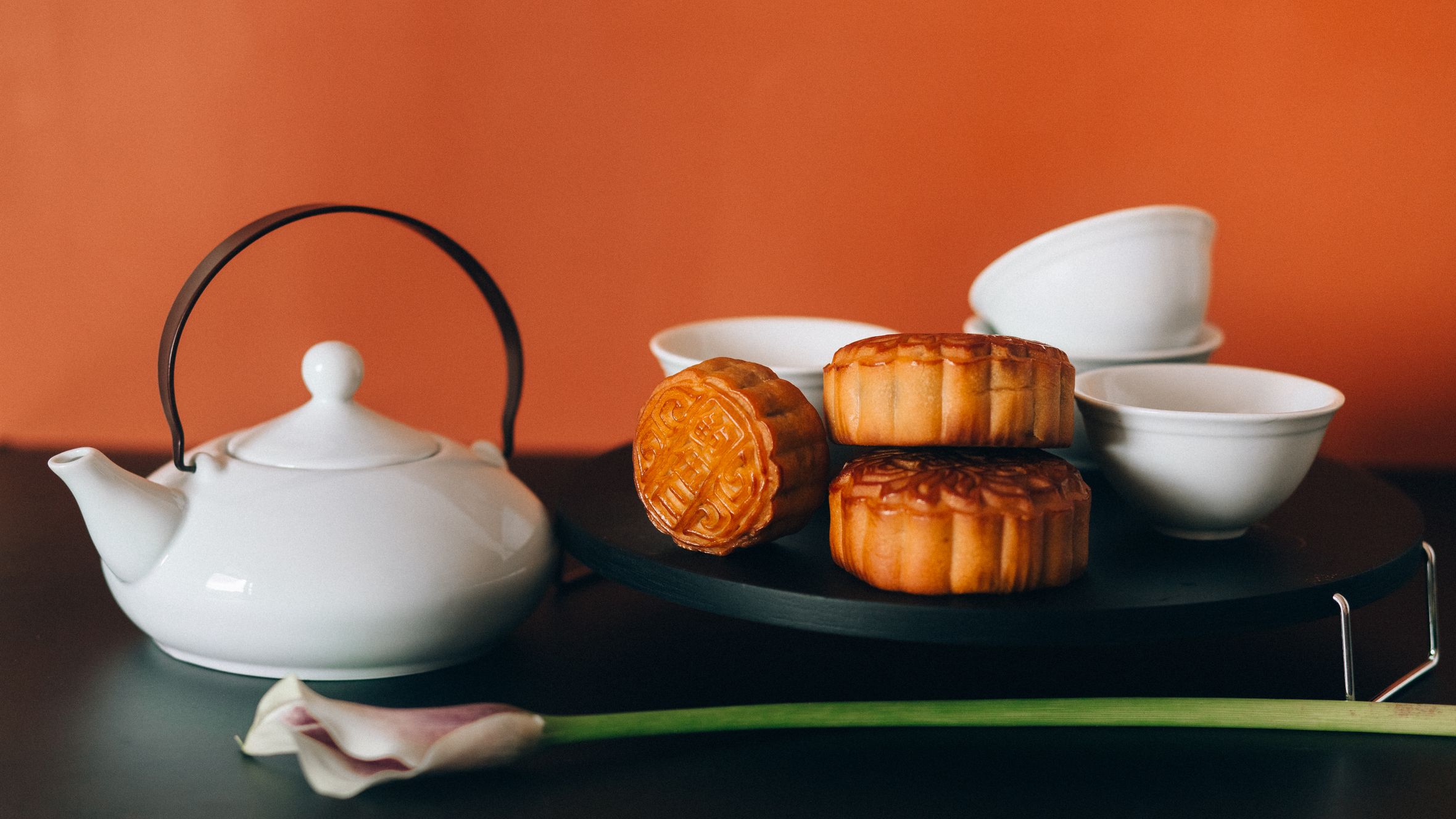
Every year in the weeks leading up to Tet Trung Thu — the Mid-Autumn Festival — Vietnam's bakeries, street stalls, and hotel lobbies fill up with elaborately boxed mooncakes. If you've never navigated this market before, it can be disorienting: stacked tins, vacuum-sealed plastic, fillings you can't identify, and price tags that range from 20,000 VND per piece to 500,000 VND per box. Here's how to make sense of it.
The Two Types: Banh Nuong vs Banh Deo
"Banh nuong" is the baked mooncake — the one most people picture. It has a thin, golden-brown crust, slightly shiny from an egg wash, and a dense filling. The pastry itself is mildly sweet and a little chewy. These are the most common mooncakes you'll find nationwide and they keep for two to three weeks at room temperature, which is part of why they dominate the gift-box market.
"Banh deo" is the other camp entirely. These are snow-skin mooncakes — uncooked, made from roasted glutinous rice flour mixed with sugar syrup and a little lard or shortening. The skin is white and pillowy, slightly translucent, with a texture closer to mochi than pastry. They need refrigeration and only last about a week. Banh deo are considered the more traditional of the two, particularly in northern Vietnam (베트남 / 越南 / ベトナム), and they have a cleaner, less sweet flavor that pairs well with lotus tea.
If you're buying to eat rather than to gift, banh deo is worth trying first — most tourists default to the baked version and miss it entirely.
What's Inside
The classic filling for both types is "hat sen" (lotus seed paste), often paired with one or two salted egg yolks embedded in the center. That yolk is the key detail: it represents the full moon, and a single-yolk cake costs noticeably less than a double-yolk. The saltiness cuts through the sweetness of the paste, and a good one should have a bright orange, slightly oily yolk — not a dry, pale, crumbly one.
Beyond lotus, fillings include:
- Dau xanh (mung bean paste): milder, lighter yellow, very common in the south
- Dau do (red bean paste): sweeter, darker, popular in central and northern Vietnam
- Thap cam (mixed filling): a combination of roasted seeds, candied fruit peel, dried sausage (lap xuong), and sometimes ham. This is the old-school northern variety — savory-sweet, dense, and polarizing. Worth trying once.
- Tran Chau (black sesame): smooth, slightly nutty, increasingly common
- Modern and hotel-brand fillings: durian, pandan, chocolate, matcha, even cheese. Results vary wildly.
For a first buy, go with lotus seed and single salted egg yolk. It's the benchmark everything else is measured against.
Photo by Tuan Vy on Pexels
The Gift-Giving Culture
Mooncakes are not primarily a food you buy for yourself. They are gifts — exchanged between colleagues, given to teachers and bosses, sent between family members who live in different cities. In corporate Vietnam, mooncake boxes are as much a part of the Mid-Autumn season as the lanterns and the lion dancers.
This explains the packaging. A 200,000 VND box of mooncakes might contain four pieces that cost 25,000 VND each to make — the rest is the tin, the ribbon, and the brand name on the lid. Premium hotel brands (Sofitel, Meliá, Sheraton) charge 400,000–800,000 VND per box and lean heavily into presentation. These are bought to impress a client or a landlord, not because the mooncake inside is four times better than a street bakery version.
If you want to give mooncakes as a gift — and it's a genuinely appreciated gesture if you're staying with a Vietnamese family or have made local friends during Tet (뗏 (베트남 설날) / 越南春节 / テト) Trung Thu — a mid-range boxed set from a reputable bakery (Kinh Do, Bibica, or a well-known local brand) in the 150,000–250,000 VND range is perfectly appropriate. Don't overthink the tier.

Photo by HONG SON on Pexels
Where to Buy
Street Stalls and Local Bakeries
In the two to three weeks before Mid-Autumn Festival, temporary stalls appear on major streets in every city. In Hanoi, Hang Ma street in the Old Quarter is the epicenter — less for the mooncakes themselves and more for the lantern shopping, but you'll find plenty of vendors. In Saigon, Luong Nhu Hoc street in District 5 is the traditional hub, packed with both mooncakes and festival goods. Prices here start around 20,000–40,000 VND per individual piece, unboxed.
Local bakeries — the kind that operate year-round, not pop-up stands — generally offer better quality than street stalls. Look for places that are making banh deo fresh daily; the difference is noticeable.
Supermarkets
Co.opmart, WinMart, and Big C all carry mooncakes in reasonable selection from late August onward. Packaged, labeled with ingredients, refrigerated section for banh deo. Good for comparison shopping and for reading what's actually in the filling before you commit.
Hotel and Boutique Brands
If you're near a five-star hotel, their mooncake counters usually set up in the lobby from early September. Packaging is often beautiful — good for gifts. Taste is usually solid but rarely justifies the price premium over a good local bakery.
Practical Notes
Banh nuong keeps two to three weeks unrefrigerated; banh deo needs the fridge and should be eaten within a week. If you're traveling through multiple cities around Mid-Autumn Festival, picking up a regional variety wherever you are is worth the small effort — the banh deo in Hue, for example, tends to be slightly less sweet and more fragrant than the Saigon equivalents. A single mooncake from a street stall is plenty for a first taste — no need to commit to a full box until you know which filling you actually like.
Last updated · May 29, 2026 · independently researched, never sponsored.




