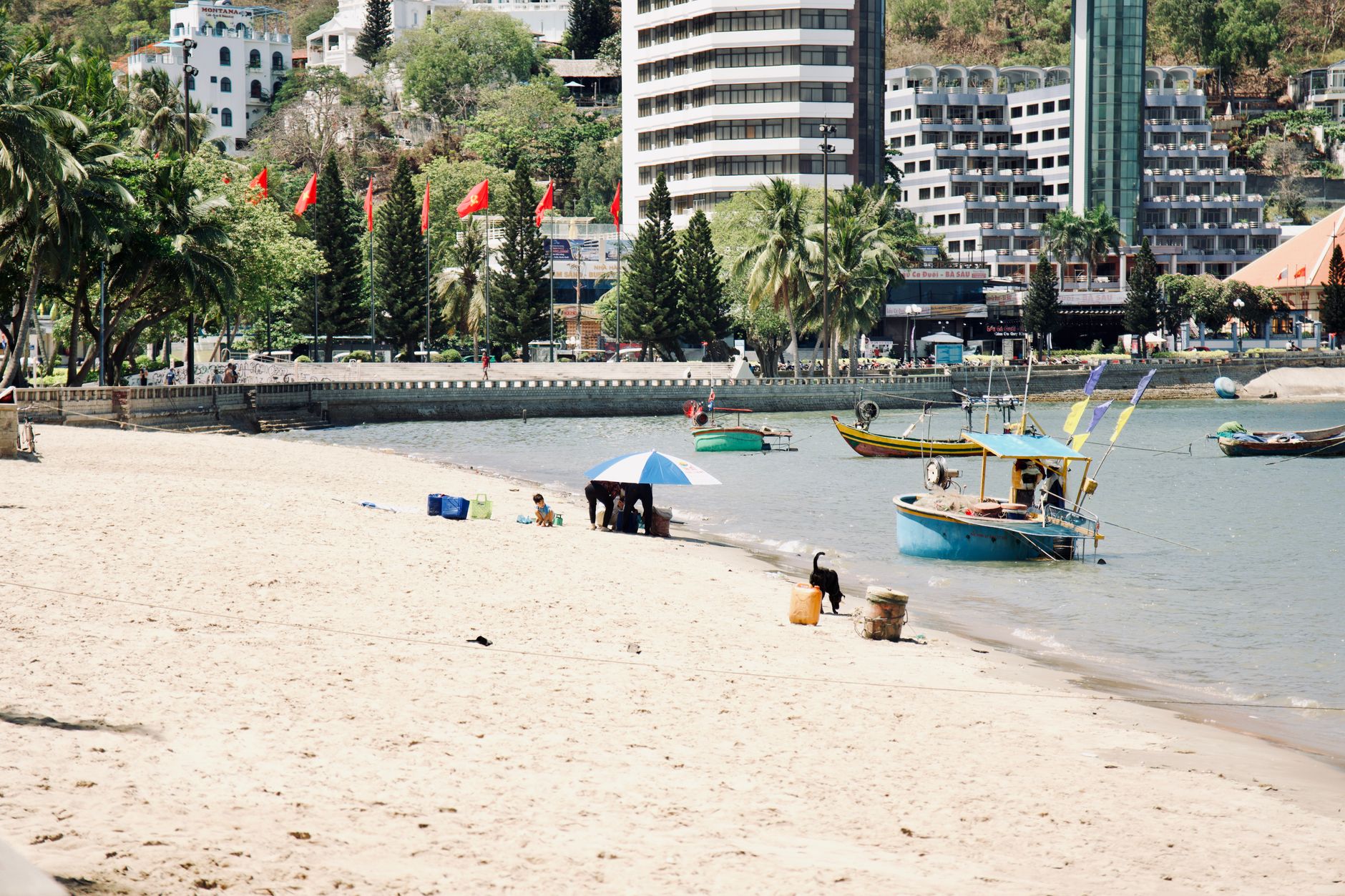
Vung Tau is easy to underestimate. Weekenders from Saigon arrive for the beach and leave without touching the street food — which is a shame, because this city has one of the most coherent local eating cultures on the southern coast. The seafood is obvious, but the noodle stalls, banh mi carts, and morning markets reward anyone willing to wander before 8 a.m.
Front Beach Area — Early Morning Until Noon
The strip along Tran Phu, running parallel to Front Beach (Bai Truoc), is at its best before the sun gets serious. Local vendors set up from around 5:30 a.m. and most pack up by 11.
What to Eat Here
Banh canh cha ca is the dish that defines Vung Tau (붕따우 / 头顿 / ブンタウ) mornings. The thick, slightly chewy noodles sit in a light fish-based broth with slices of fried fish cake on top. Look for the cluster of plastic-stool joints on Tran Phu near the roundabout at the base of Small Mountain (Nui Nho). A bowl runs 35,000–45,000 VND depending on portion size.
A few meters down you'll find vendors selling "banh mi (반미 / 越式法包 / バインミー)" with a distinctly southern filling — pate, head cheese, pickled daikon, and a swipe of chili sauce. These are not the fluffy tourist versions. The bread is thin-crusted and the filling-to-bread ratio is aggressive. Around 15,000–20,000 VND per roll.
Walking radius: The entire Front Beach eating stretch covers roughly 800 meters. You can walk it end to end in under 15 minutes, grazing as you go.
Phan Thi Ky Market Area — All Day, Peak at Lunch
Head inland from Front Beach toward the Phan Thi Ky wet market and the eating density increases. This is where residents shop and eat, not tourists. The streets immediately surrounding the market — particularly Ly Tu Trong and Ho Van Hue — have permanent stalls running from early morning through mid-afternoon.
"Bun rieu" shows up here in a good version. The crab-paste tomato broth is sharper and more sour than what you'd get in Hanoi — expect a squeeze of tamarind and a pile of water spinach on the side. 40,000–50,000 VND.
For something lighter, a few vendors sell "goi cuon" — fresh rice paper rolls — from folding tables along Ly Tu Trong. The shrimp is local and the peanut dipping sauce is made in-house rather than from a packet. Three rolls for around 25,000 VND.
The market itself is worth walking through even if you're not buying. The fish section has species you won't see in Saigon markets — small reef fish and crab varieties that end up in the cooking pots of the surrounding restaurants by midday.
Best time: Arrive between 10:30 a.m. and 1 p.m. for the widest selection.

Photo by Tuan Vy on Pexels
Back Beach (Bai Sau) — Late Afternoon Into Evening
Back Beach is louder and more commercial than Front Beach, but the stretch of Nguyen Dinh Chieu running along the waterfront comes alive in the late afternoon when the heat drops and families start arriving. The evening eating here leans toward grilled seafood and snacks rather than full noodle meals.
The carts selling "banh trang nuong" — rice paper grilled over charcoal and topped with egg, dried shrimp, and scallion oil — are everywhere from around 4 p.m. A single sheet costs 15,000–25,000 VND and makes a solid pre-dinner snack.
For something more substantial, look for the com tam vendors who set up carts near the southern end of Nguyen Dinh Chieu from around 5 p.m. The broken rice is served with a grilled pork chop, a fried egg, and the standard accompaniment of pickled vegetables and fish sauce. This is classic Saigon-style eating transplanted to a beach town: 60,000–80,000 VND per plate.
Several small grilled-seafood spots operate with menus written on chalkboards and tanks out front — the mantis shrimp (tom tit) is what locals order, not the lobster. Prices are negotiated by weight; expect 150,000–200,000 VND per 500g.
Walking radius: The active eating strip runs about 1.2 km along Nguyen Dinh Chieu. The northern end, closer to the roundabout at Ha Long, has the denser concentration of street carts.

Photo by Nguyễn Hưng on Pexels
Nguyen Thai Hoc Street — The Old Quarter Spine, Morning Only
This street, which cuts through the older residential grid northwest of the city center, has the kind of low-key morning eating scene that rewards early risers. It's a 10–15 minute walk or short xe om ride from Front Beach.
"Hu tieu" is the thing to order here. The southern-style noodle soup — clear pork broth, thin rice noodles, sliced pork, and dried shrimp — is lighter than "pho" and eaten at room temperature as often as hot. A few stalls on Nguyen Thai Hoc have been running the same recipe for decades. 35,000–45,000 VND.
There's also a reliable "banh cuon" stall operating out of a private house around the middle of the street — look for the steam rising through a ground-floor window. The fermented rice rolls are filled with minced pork and wood ear mushroom, served with cha lua (pork sausage) and nuoc cham. 40,000 VND for a standard serve.
Best time: Before 9 a.m. Several stalls sell out by mid-morning.
Practical Notes
Vung Tau is compact — a motorbike or bicycle covers the eating circuit in a single morning. Most street food stalls are cash only; keep small bills (10,000 and 20,000 VND denominations) on hand since change is often approximate. If you're coming from Saigon, the high-speed ferry from Bach Dang wharf docks near Front Beach, putting you five minutes from the first banh canh stall.
Last updated · May 29, 2026 · independently researched, never sponsored.