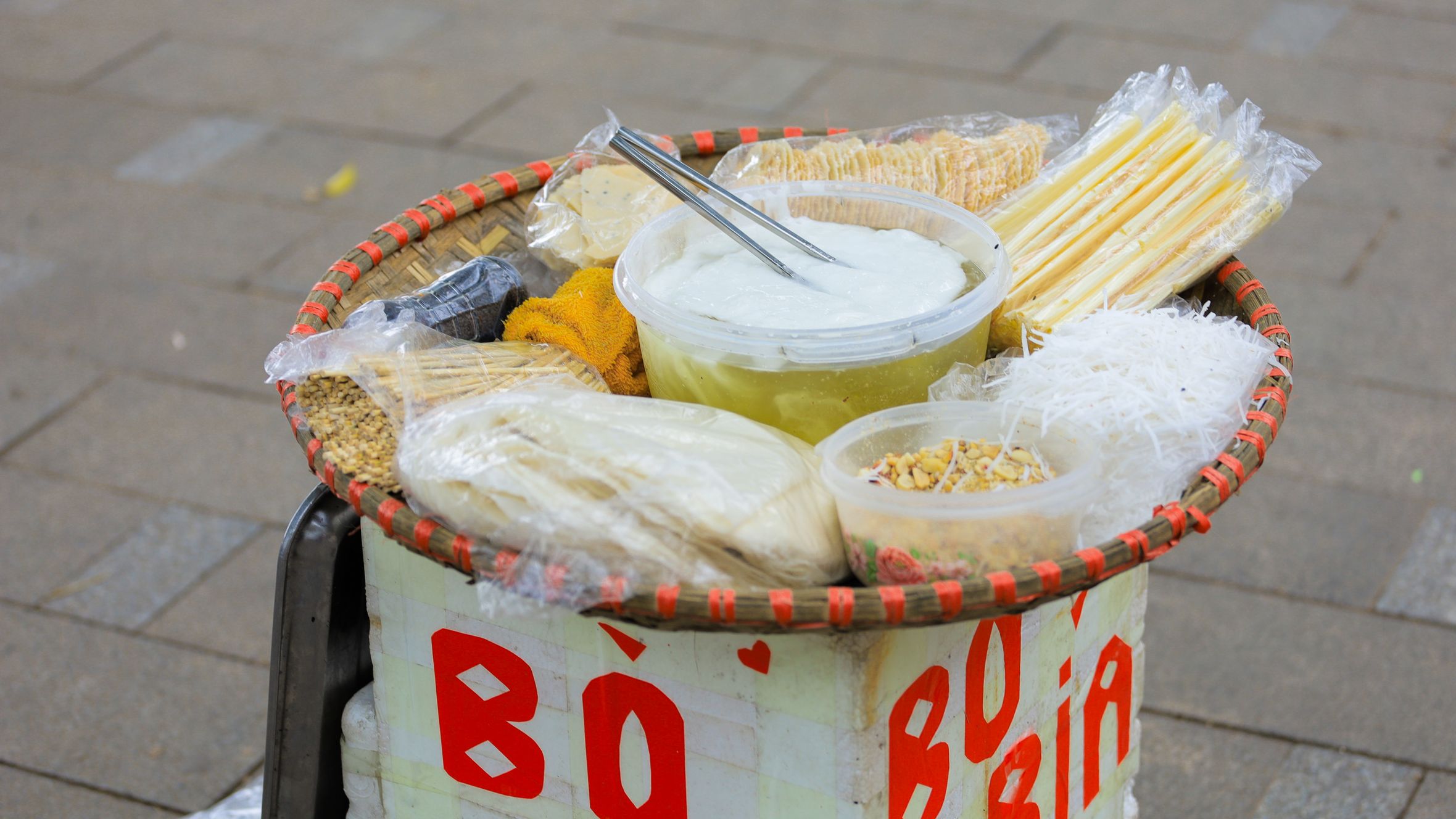
Ha Tinh doesn't get much traveler traffic — most people pass through on Highway 1 heading north toward Vinh or south toward Hue. That's a mistake worth correcting, at least for one meal. The province has a genuinely distinct food identity, built around a few dishes that locals are quietly proud of and that rarely show up on any tourist radar.
Banh Muot — The Dish That Defines the Province
"Banh muot" is the thing to order here. The name loosely translates to "slippery cake", which doesn't do it justice but is at least accurate. The dish is a close relative of "banh cuon" — thin sheets of steamed rice batter, soft and translucent — but Ha Tinh's version has its own character. The sheets are rolled looser, often left partially open rather than tightly sealed, and served in a shallow bowl with warm broth ladled over the top rather than served dry with dipping sauce on the side.
The broth is the differentiator. It's a light pork bone stock, clear and slightly sweet, sometimes finished with a spoonful of rendered shallot fat that pools on the surface. The filling inside the rice rolls is typically minced pork and wood ear mushroom, though some vendors add small dried shrimp for depth. On top: a pinch of fried shallots, a few sprigs of Vietnamese coriander (rau ram), and a wedge of lime if you ask for it.
The texture combination — soft rice sheet, warm broth, slight crunch from the shallots — is the whole appeal. It's a breakfast dish in Ha Tinh, eaten between 6am and 9am, and by 10am most good vendors have sold out. Look for it near Nguyen Du Market in Ha Tinh City, where a bowl runs about 20,000–25,000 VND. Street stalls near the market's north entrance tend to be the most consistent.
Ke Che — A Sweet Dish With an Odd Name
"Ke che" is harder to pin down. "Che" in Vietnamese refers to a broad category of sweet soups and puddings, but ke che is a local Ha Tinh variation that uses small sticky rice dumplings (nhan) filled with mung bean paste, served in a coconut milk broth sweetened with palm sugar. What makes it distinct from the che you'd find in Hue (후에 / 顺化 / フエ) or Saigon is the addition of a small amount of grated cassava mixed into the dumpling dough, which gives the outer layer a slightly chewier, more substantial texture than pure glutinous rice.
It's sold at the same morning markets as banh muot, often by the same vendors, and it functions as dessert or a second breakfast — nobody here seems troubled by the ambiguity. A portion costs around 15,000 VND. Don't expect a written menu; point at the pot.

Photo by Hồng Quang Official on Pexels
Chao Luon — Eel Porridge From the Inland Districts
Ha Tinh's inland areas around Huong Son district have a different food identity from the coastal towns. Rice paddies and rivers mean freshwater fish and eel feature heavily. "Chao luon" — eel porridge — is the standout. Eel is cleaned, marinated with turmeric and lemongrass, then stir-fried before being stirred into a loose rice porridge (chao) that has been cooked down until almost creamy. The result is golden-tinged and fragrant, topped with crushed roasted peanuts, fresh herbs, and a pinch of black pepper.
This is not an easy dish to track down without local guidance — it's more of a home-cooked and small-restaurant dish than a street food. If you're traveling through Huong Son on the way to or from the Pu Mat National Park area, ask at guesthouses for "quan chao luon" and you'll usually get pointed somewhere useful.

Photo by FOX ^.ᆽ.^= ∫ on Pexels
Banh Trang Phoi Sung — Puffed Rice Paper Snacks
Not unique to Ha Tinh — you'll find versions of these across central Vietnam (베트남 / 越南 / ベトナム) — but the local rendition is particularly good. "Banh trang phoi sung" are rice paper crackers that have been sun-dried and then briefly fried or toasted until they puff into light, shatteringly crisp rounds. In Ha Tinh, vendors sell them topped with dried shrimp paste, scallion oil, and crushed chili. They're packaged in small bags at market stalls and in roadside shops for about 10,000–15,000 VND, and they survive travel well if you want to bring a few packs on the bus.
A Few Practical Notes on Eating in Ha Tinh City
Ha Tinh City is small and navigable on foot from most guesthouses. Nguyen Du Market is the main hub for morning food — get there before 8am for the widest selection. The covered section of the market has a row of permanent stalls, but the better vendors are often the ones with plastic stools set up on the pavement outside the east entrance.
For iced coffee between meals, Ha Tinh has a strong local cafe culture. "Ca phe sua da" here is brewed strong and slightly bitter — closer to Hue's style than to the sweeter southern versions. Expect to pay 20,000–30,000 VND at a local shop.
If you're already planning a coastal central Vietnam itinerary that includes Hue, Ha Tinh is about 90 km north — easily reachable by bus or a rented motorbike. The province isn't set up for tourism, which means prices are honest and the food is cooked for locals, not visitors. That's the whole point.
Practical notes: Most street food stalls in Ha Tinh City accept cash only; carry small denominations. Morning eating culture here starts early — if you arrive after 9am expecting banh muot, you may be out of luck. Accommodation is limited but adequate in Ha Tinh City; the province works better as a half-day food stop than an overnight destination for most itineraries.
Last updated · May 26, 2026 · independently researched, never sponsored.



